











Are you also failing to use the full cutting height of the pre-milling cutters on your edgebander?
Most of the products you mill are much thinner than the cutting height of your pre-milling cutters.
Panel materials are usually 18 or 22 mm thick, while the cutters have a cutting height of 45 or 65 mm. This means that only a small part of the diamond inserts becomes blunt, but the entire cutter head still has to be reground. The sharp section is also reground, otherwise the cutter head would not have the same diameter all the way round, meaning its run-out would be inaccurate.
Does one small chip lead to sharp diamond being reground unnecessarily?
How often does it happen with fixed DIA cutters that a cutter is sent for regrinding in its entirety because of a small chip, even though the rest is still sharp? In this case, it is not possible to regrind only the damaged diamond insert, as this would leave a mark on the product. The sharp diamond on all the inserts is ground away by the same amount as the depth of the damage on that one insert. This is a very costly necessity and shortens the service life of the pre-milling cutter set.

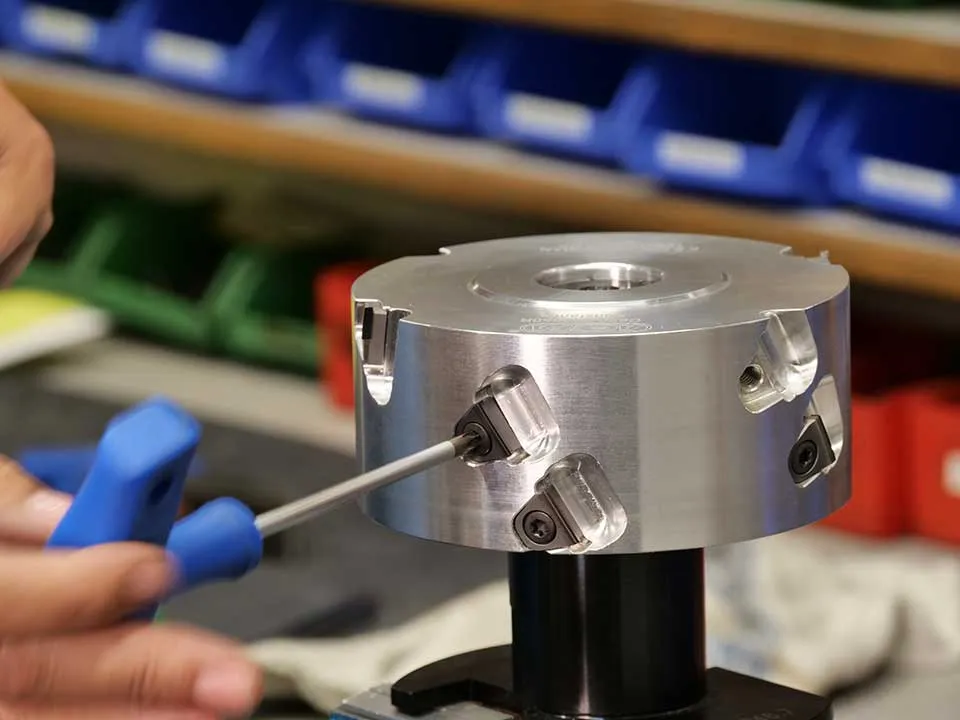
A range of tools has been developed to address the situations outlined above and meet the need for more efficient tool use. The solution is a cutter with an interchangeable insert system based on a completely new technology. The blunt diamond inserts at the bottom of the cutter head are swapped with the sharp inserts at the top. This doubles the service life of a cutter head around 45 or 65 mm high if you mainly mill products up to 22 mm thick.
With this type of cutter for your edgebander, you simply replace the damaged insert and can resume production straight away. You can do this yourself thanks to the precision-engineered, patented seats. The inserts are loosened and tightened using a torque wrench, ensuring run-out accuracy of 0.02 mm. And when the entire set of diamond inserts is blunt, you can send them in for regrinding. Fit a spare set of sharp inserts to the cutter bodies, then have the blunt set reground.
Use a cost-saving system
Make sure you use a system that requires only one pre-milling cutter set, with the inserts reground independently of the cutter head. Only when all the inserts are blunt do you replace them all at once, fitting the cutter with a complete new set. The blunt set of inserts can then be reground to a fixed diameter. This keeps machine set-up time to a minimum, so you can get straight back to work.
Swap the inserts between the pre-milling cutter that does 90% of the milling and the one that does 10%. This doubles the service life of the pre-milling cutters. You can also move the inserts at the top of the cutter head to the bottom, where they are blunter, to extend their service life further. This saves costs, and with a few spare inserts your production can keep running.
Bear in mind that other cutters with diamond inserts are also available on the market. However, those inserts must always be reground while still in the body. This means the pre-milling cutter set, including the bodies, still has to be sent to a grinding shop. In other words, you still need two sets of cutters. So check for these features to keep costs down!
Question about this story? Ask your question
Keep following this
Get an email when a new story is published. No account needed.
- SubjectGeneral







