Working smarter in interior fit-out: More bespoke work, less pressure thanks to the Meubelplanner
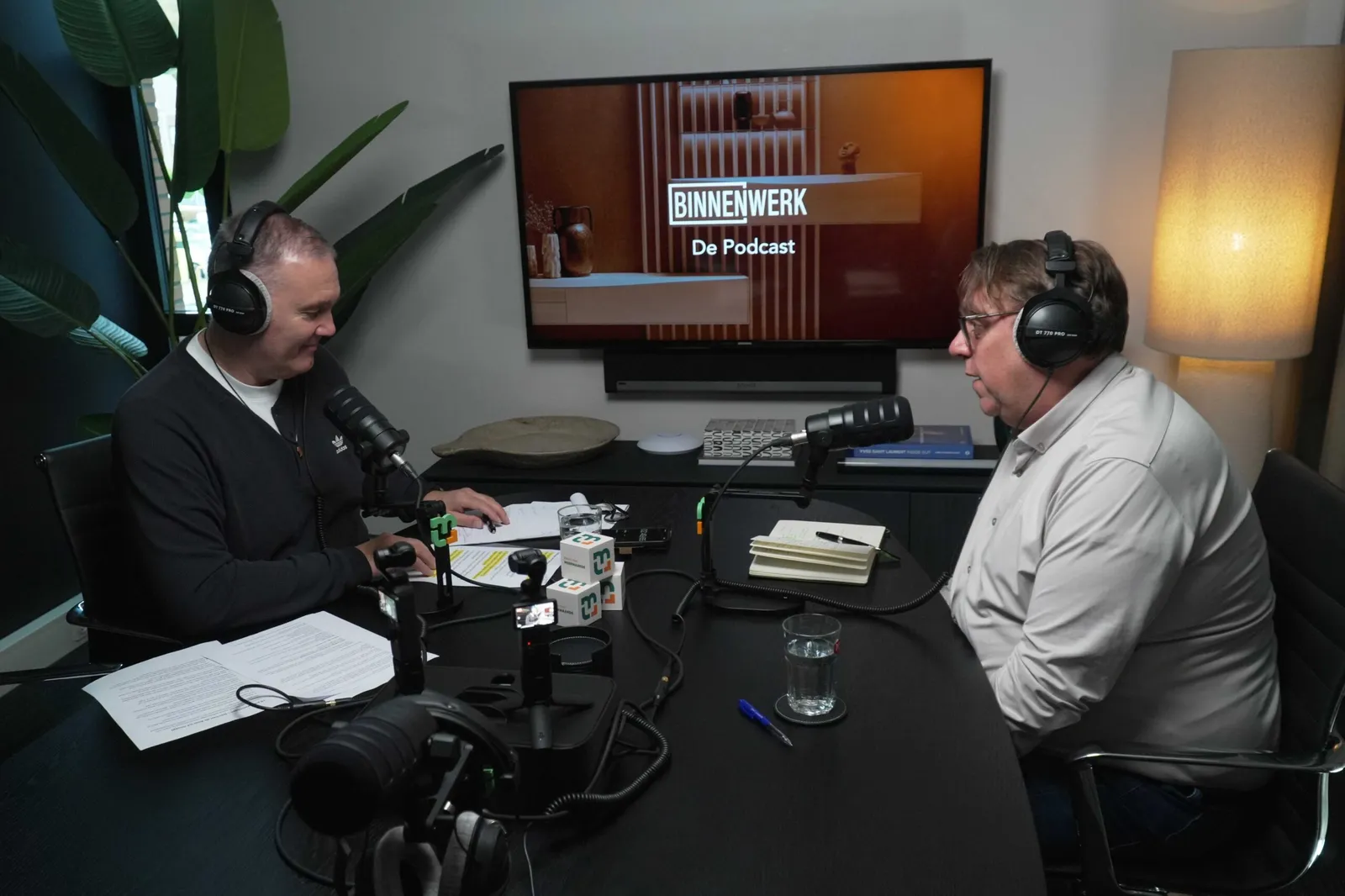
Speaker: Germen de Boer, commercial manager, bespoke solutions | Moderator: Jerry Helmers
Demand for bespoke work is growing, but interior fit-out companies and furniture makers are increasingly facing staff shortages, logistical challenges and high levels of physical strain. How can smaller businesses work efficiently without compromising on quality or craftsmanship?
In this episode of Binnenwerk de Podcast, presenter Jerry Helmers talks to Germen de Boer, commercial manager for bespoke solutions at LF Group. They discuss the future of the craft, AI’s influence on furniture design and the opportunities offered by outsourcing standard work.
At the heart of the discussion is the Meubelplanner, an online configurator that allows interior fit-out companies to specify and order made-to-measure panels and complete cabinets. Germen explains how this solution saves time, reduces heavy work and gives skilled craftspeople more scope to focus on what they do best: creating unique interiors.
A conversation about running a smarter business, technological developments and why, according to Germen, the future of interior fit-out is not about working harder, but about making more considered choices about what you do yourself.
Full transcript
All chapters (29)
- Introducing Binnenwerk and guest Germen de Boer
- Three propositions on business, AI and the future of interior fit-out
- Meet Germen de Boer
- Consumers design with AI, skilled craftspeople make it possible
- The biggest challenges facing furniture makers and interior fit-out companies in 2026
- Physical strain and the health of skilled craftspeople
- Skills shortages and preserving craftsmanship
- Bespoke work versus mass production
- Vocational training and renewed interest in working with your hands
- Practical solutions for logistics and physical strain
- What is the Meubelplanner and how does the configurator work?
- Developing the Meubelplanner for the Dutch market
- Feedback and experiences from Meubelplanner users
- The balance between craftsmanship and outsourcing standard work
- The future for interior fit-out specialists who insist on doing everything themselves
- Growing a business without major investment in machinery
- Entrepreneurship and focusing on making beautiful things
- The Meubelplanner in practice and the ordering process
- Personal support for the Meubelplanner
- Technological developments, AI and the future of craftsmanship
- Developing knowledge and expertise within LF Group
- New employees and intrinsic motivation
- Trends in interior fit-out and working more efficiently
- Outsourcing as an opportunity for business growth
- Meubelplanner as an ally to the interior fit-out company
- Practical tips for cabinetmakers and interior fit-out companies
- Germen de Boer’s 60 Seconds of Fame
- Where can interior fit-out professionals find the Meubelplanner?
- Looking back on the podcast debut and signing off
Introducing Binnenwerk and guest Germen de Boer
Jerry Helmers Welcome back to a new episode of Binnenwerk, the podcast, produced by Louwers Mediagroep. My name is Jerry Helmers and I’m your presenter for this episode. And who’s here in the studio with me today? It’s Germen de Boer, commercial manager for bespoke solutions at LF Group. Hello, Germen, lovely to have you here. And well done for making the journey from Culemborg to the studio here in Weert. Are you ready?
Germen de Boer I’m all set, and thank you for the invitation.
Jerry Helmers Yes, we’ll introduce you in a little more detail shortly. And I’ll put a few propositions to you. But first, I’d like to ask you: who should be listening to this podcast? Why should they listen? And can you perhaps make them a promise? What’s in it for them when we wrap up the podcast in 40 minutes?
Germen de Boer Well, the people who should listen are anyone making things for interiors who simply don’t have enough time.
Jerry Helmers Mhm.
Germen de Boer Anyone who struggles to manage their workload, has a long order book and is seriously in need of an extra pair of hands.
Jerry Helmers Seriously in need.
Germen de Boer Seriously in need of an extra pair of hands.
Jerry Helmers So you’re talking about interior fit-out companies, furniture makers and woodworkers. Are you hoping that large or small businesses will keep listening?
Germen de Boer Well, particularly small and medium-sized businesses. In fact, any interior fit-out company with up to, say, five, six, seven or eight people.
Jerry Helmers Yes.
Germen de Boer Yes, they’ll definitely get something out of this.
Jerry Helmers Okay, but of course larger furniture makers and interior fit-out companies are welcome to keep listening too. You’re very welcome.
Read the full transcriptCollapse transcriptnog 28 hoofdstukken
Three propositions on business, AI and the future of interior fit-out
Jerry Helmers Germen, I’d like to put a few propositions to you.
Germen de Boer Yes.
Jerry Helmers And this is a bit unfair. You can only answer agree or disagree. Okay? Then perhaps we’ll come back to them later in the podcast. Here’s one I came up with for you: the average interior fit-out company spends too much time designing and not enough time running the business.
Germen de Boer Disagree.
Jerry Helmers Disagree, clear enough. Here’s the next one. Tomorrow’s consumer will design their own furniture using AI and leave the furniture maker to do nothing but manufacture it.
Germen de Boer Agree.
Jerry Helmers Yes, for those watching at home, a slight smile crossed Germen’s face, perhaps because he had some reservations. Well, I’ll come back to that proposition later, of course. One more: any interior fit-out company that insists on doing everything itself will have a serious problem in five years’ time.
Germen de Boer Agree.
Meet Germen de Boer
Jerry Helmers Germen, thank you. Who are you? Let’s hear a little more about you. Who do I have the pleasure of talking to?
Germen de Boer Well, I’m Germen. I’m 57 years young and the father of two daughters. I’ve spent most of my working life in manufacturing. I worked in construction for a long time, or rather in supplying the construction industry, and I’ve been in interior fit-out for about seven years now. And I have a real soft spot for people who can make beautiful things. I think it’s wonderful. I have two left hands myself, so I’m always impressed and amazed by what they can do. And I’m pleased to be doing something now that can help the interior fit-out sector move forward.
Jerry Helmers Yes, exactly. What do you mean by beautiful things? This is getting a bit philosophical. What is beautiful?
Germen de Boer Well, look, I have IKEA furniture in my home too, of course.
Jerry Helmers Who doesn’t, eh?
Germen de Boer Who doesn’t? I have to admit, I also have an Eames chair. So I do appreciate beautiful designs and beautiful cabinets. When you walk into a place, you can just tell whether something has been well made. That’s something I really appreciate.
Jerry Helmers IKEA makes some lovely things too, absolutely. Let’s give the Swedish furniture giant a compliment straight away.
Germen de Boer Definitely, definitely.
Jerry Helmers No, quite. Well, it’s lovely to have you here. Have you recorded podcasts before, or is this your debut?
Germen de Boer This is my debut.
Jerry Helmers Okay. Have you been sleeping well this past week?
Germen de Boer Well, not really.
Consumers design with AI, skilled craftspeople make it possible
Jerry Helmers You smiled a little at that proposition. Or perhaps you raised an eyebrow. At any rate, you looked as though you were thinking: how am I going to answer this? The proposition was: tomorrow’s consumer will design their own furniture using AI and leave the furniture maker to do nothing but manufacture it. You said you agreed, after a moment’s hesitation. What were you thinking when you considered that proposition?
Germen de Boer Well, I like to put myself in the picture too. For example, when I happened to be looking for a new bathroom, I noticed that I was using AI to make a little drawing of it.
Jerry Helmers Yes.
Germen de Boer But of course, you don’t take into account what the person who’s going to build it can and can’t do. The result was that I’d come up with a bathroom measuring two by two square metres. Then I went to someone, and it was going to cost me €35,000 to have it built.
Jerry Helmers You have expensive ideas.
Germen de Boer I had some very expensive ideas. And then it’s up to the builder to say, in effect, “Look, this is possible and this isn’t.” So I’ve noticed that I’m starting to make more use of AI myself too.
Jerry Helmers But are you disappointed if a builder says to you, “That really isn’t possible. It’s a lovely AI image you’ve brought me, Mr De Boer, but it’s technically impossible”? Are you disappointed?
Germen de Boer No, not really.
Jerry Helmers Why not? Do you readily accept what isn’t possible?
Germen de Boer Well, because you come up with the idea as a layperson, then you’re sitting opposite a skilled craftsperson who can shape it and will often come up with alternatives that are just as lovely and beautiful.
Jerry Helmers What should a furniture maker or interior fit-out company be able to do to prompt you to come up with even better ideas based on your original one?
Germen de Boer Yes, I think that’s important.
Jerry Helmers Are there furniture makers like that?
Germen de Boer Absolutely.
Jerry Helmers Very good.
The biggest challenges facing furniture makers and interior fit-out companies in 2026
Jerry Helmers Here’s my first question, which also gives us a way into the conversation and the podcast: what are the biggest challenges facing furniture makers and interior fit-out companies right now, in 2026?
Germen de Boer Well, there are a few indirect challenges, actually. Logistics is a common one at the moment. You often find that furniture makers based in cities are difficult to reach with large lorries. Well, to put it very simply, furniture is made from sheet material. Interiors are made from sheet material. That’s where it starts. A standard sheet measures 2.80 metres by 2.07 metres and weighs 50 kilos. That’s no problem when it comes to getting it to a site on an industrial estate. But I also have customers in central Utrecht, for example. That’s a bit more difficult. It’s a challenge.
Jerry Helmers Yes, so you’re saying it’s almost impossible for the furniture maker to get what they’ve assembled, or even the individual sheets, into the city.
Germen de Boer Yes, getting materials delivered is becoming more and more of a challenge. You know that yourself, of course. If you have a diesel car, do you have a diesel car?
Jerry Helmers No, I don’t have a diesel car.
Germen de Boer But in the past, the field sales representative who covered a lot of miles would have had a diesel car.
Jerry Helmers Really?
Germen de Boer Yes, that same diesel car is no longer allowed in Utrecht or Amsterdam. So a lot is changing, and it affects you indirectly too, beyond the challenges you face as a business owner.
Jerry Helmers Yes, these are decisions made by, for example, the municipality of Utrecht. I mean, just ask Amsterdam how much of a nightmare it is there. You have to deal with it, and there’s very little you can do to influence it.
Germen de Boer Exactly.
Jerry Helmers A logistical challenge.
Physical strain and the health of skilled craftspeople
Germen de Boer I think another indirect challenge is physical health. Things are heavy and have to be carried around. Everyone working in manufacturing bends down a lot, spends a lot of time on their knees and carries heavy loads. That’s definitely something furniture makers have to deal with.
Jerry Helmers I think we still underestimate that a little as a society. That’s my impression, anyway. I was at a company move recently. I was filming and podcasting a bit too. And I thought: my job is actually very easy. I watched those guys carrying things. In this case they were removal men. It’s comparable to furniture makers who have to carry all sorts of things inside. I thought: my God, those are the people doing the hard work.
Germen de Boer Yes, definitely. And I feel it already. I’m 57, though you wouldn’t think it, but I really am. When I get out of bed in the morning, I do it differently from when I was 37. But I don’t have to carry heavy things. I just go to my comfy office chair, and I don’t have to do all that much.
Jerry Helmers You open your laptop, and someone brings you a coffee.
Germen de Boer Exactly.
Jerry Helmers And then there’s nothing else to do. No, that’s true. So this is a lovely tribute to all the people who do the really hard work. But you’re right. Physical health is something everyone needs to be aware of.
Germen de Boer Yes.
Skills shortages and preserving craftsmanship
Jerry Helmers A second challenge. Are there any more?
Germen de Boer Well, I think the biggest challenge, especially for smaller interior fit-out companies, is simply having enough people. Finding skilled tradespeople is very difficult. You can see that fewer traditional carpenters, men and women, are being trained than in the past. That is something you have to contend with as an interior fit-out company. So you have to rely much more on your own expertise and the way you put something together, rather than being able to outsource it to someone who can do it exactly as you have in mind.
Jerry Helmers Yes.
Germen de Boer Because the average interior fit-out specialist is a bit of a craft fanatic. They like making beautiful things.
Jerry Helmers It’s craftsmanship, isn’t it?
Germen de Boer Craftsmanship, exactly.
Jerry Helmers Do you think craftsmanship will survive? I expect we’ll talk about technological developments later in this podcast too. Can craftsmanship survive in the current climate?
Germen de Boer Yes, absolutely. I’m 100 per cent convinced.
Jerry Helmers No doubts?
Germen de Boer No doubts.
Jerry Helmers We’ll hear more about that shortly. You’ve mentioned three challenges: logistics, physical wellbeing, and finding people, skilled tradespeople, in a tight labour market. Are those the three challenges?
Germen de Boer Yes, I think those are the biggest challenges. Of course, you’re always competing with the big companies that produce things in volume. You also see famous chair designs being copied and mass-produced. I mentioned an Eames chair earlier, for example. But I think there will always be a market for interior fit-out companies and for people who really…
Bespoke work versus mass production
Jerry Helmers Yes, you say small interior fit-out companies have to compete with the big players. But you could look at it the other way round, couldn’t you? The big players need to recognise that the small ones can offer fantastic niche products.
Germen de Boer Yes, they learn from them too, don’t they? They look at what they’re doing. So that’s why it’s not among my three biggest challenges. That’s right. But it is something you have to contend with. A cabinet made by an interior fit-out company generally costs a little more than one you buy from a large cabinet manufacturer. That’s just how it is.
Jerry Helmers But then you get it made to measure.
Germen de Boer You get it made to measure. It’s exactly what you want. And it’s a cabinet that only you have.
Jerry Helmers Do you think that, well, we’ll talk about trends later, but will made-to-measure become the standard again?
Germen de Boer Yes, 100 per cent.
Jerry Helmers 100 per cent sure?
Germen de Boer Yes, definitely. It’s a trend you see everywhere… I don’t know, but here’s an interesting aside. Take a building contractor, a company that builds houses. 40 years ago, a contractor with 50 people would have ten people in the office and 40 out on site. That same contractor now has 40 people in the office and ten out on site.
Jerry Helmers Yes, something’s not right there, is it?
Germen de Boer No, so there’s increasing use of semi-finished products and all that sort of thing.
Vocational training and renewed interest in working with your hands
Jerry Helmers A quick aside. Is there something wrong with the vocational training system in the Netherlands, then? I’m about to ask you a political question, in a way. We have the Hout- en Meubileringscollege, for example. I spoke recently to a kitchen manufacturer who said: ‘Well, I learnt the basics there, but once you actually start working in the trade, things look quite different.’ So there was a veiled criticism of how the Hout- en Meubileringscollege structures its courses. What’s your view? Because if you want to preserve craftsmanship, you have to start at the beginning, at the grassroots, so to speak.
Germen de Boer Well, I have to say, since we’re talking about trends, something happened quite by chance last week. I was at one of our trading companies, A. Silva in Steenwijk, where I gave a talk about the Meubelplanner one evening. A woman was standing next to me. She came from the dental sector and had switched to furniture making. She’d had a passion for making furniture her whole life. And then she thought, on day one, day two: ‘Right, I’m just going to do it.’ I’m hearing that more and more. People train for something, an office job or whatever, and then they start to feel the urge to do what they really enjoy. So I’m seeing a bit of a trend towards working with your hands becoming more appealing again.
Jerry Helmers Have government campaigns helped, then? In the sense that you don’t have to work in an office or get a very high-level qualification, such as a degree or university education. We also need people who can keep craftsmanship alive, because they’re essential too. We definitely need those finished products.
Germen de Boer Yes, absolutely.
Practical solutions for logistics and physical strain
Jerry Helmers You mentioned three challenges: logistics, physical wellbeing, and finding people and skilled tradespeople. The first two are things you either can’t influence or, in the case of your physical wellbeing, are very much your own responsibility. But what’s the solution to the third challenge, finding people and skilled tradespeople?
Germen de Boer Actually, sorry to interrupt, but as an organisation we can certainly help think through the first two as well. Take sheet material, for example. I mentioned that, and it works perfectly well. We supply a lot of sheet material. But if you can’t handle it, if your workshop is behind your house, for instance, you could ask us to cut the sheet to the dimensions you need and deliver it that way. Then it can be delivered in a smaller vehicle because the sheet material takes up less space. And the person handling it has less to carry.
Jerry Helmers I almost want to say: if only there were a Meubelplanner!
Germen de Boer Well, that would be fantastic.
Jerry Helmers Well, listeners, I think my guest in the studio is about to tell us what the Meubelplanner is. We’ve talked about all those problems and challenges. Is the Meubelplanner the ultimate solution?
What is the Meubelplanner and how does the configurator work?
Germen de Boer It will certainly help with the problems I’ve just mentioned. The Meubelplanner is essentially an online configurator, to use a fancy term, where you as an interior fit-out specialist can have your panels cut to size and edged. Edging means applying edge banding to sheet material. If you don’t know what that is, do let me know.
Jerry Helmers Yes, I know what that is.
Germen de Boer It can also prepare complete cabinets. That could be a cabinet carcass, or a complete cabinet with carcass and front. Then you have a complete cabinet.
Jerry Helmers But am I right in understanding that you at LF Group developed the Meubelplanner?
Germen de Boer Yes.
Jerry Helmers What prompted it, or when did the first idea come up, perhaps at a management or sales meeting: ‘Shall we build something to solve these challenges in the market?’ How did it happen?
Germen de Boer I should also point out that the Meubelplanner is based entirely on EGGER sheet material. EGGER is a brand represented by LF Group through its seven branches. The Meubelplanner was ultimately developed by EGGER. Within LF Group, we had Oldevuuren, where we supplied sheet material cut to size. That means cut and fitted with edge banding. Then we started getting more and more requests from the market: ‘Could you also drill the holes for my hinges? Or the line-boring for my cabinet interiors? Or could you mill a groove in the sheet material for the back panel?’ Well, this is a trend across Europe, not just in the Netherlands. It’s happening everywhere. EGGER responded by developing a furniture configurator. We started working with it about a year and a half ago, or two years ago.
Developing the Meubelplanner for the Dutch market
Jerry Helmers Because you joined forces with EGGER?
Germen de Boer Yes, we’re EGGER’s Dutch distributor, so to speak. And we worked with a team to adapt the furniture configurator for the Dutch market. That means taking account of the trends that matter in the Netherlands, and how we join cabinets together here. For example, when you assemble a cabinet, you can use a dowel. But you can also use a Lamello or a Clamex.
Jerry Helmers Are we in the Netherlands really that different from, say, Germany, Denmark or France?
Germen de Boer Yes, a little, yes.
Jerry Helmers Oh, right. Are we unique, then, or just different?
Germen de Boer Well, if you look at the motorway in summer, you see caravans everywhere. Somehow you see more with Dutch number plates in the Netherlands than with Brazilian ones.
Jerry Helmers Yes, that’s true.
Germen de Boer For example, sheet material in the Netherlands is 18 mm thick. In Germany it’s 19 mm thick, to give a slightly odd example. Anyway, we tested it and asked our customers about it. There turned out to be a very strong demand for it: taking work off interior fit-out companies’ hands by supplying cabinets already prepared. The interior fit-out specialist can simply use the configurator to design a cabinet to their exact specifications, save it and place an order.
Jerry Helmers Is it all-inclusive?
Germen de Boer It’s all-inclusive.
Feedback and experiences from Meubelplanner users
Jerry Helmers Right. It’s already online. Just to let listeners know, we’re recording this podcast in autumn 2026. The Meubelplanner configurator is online. What kind of feedback are you getting from the market?
Germen de Boer The feedback has actually been quite positive. We did have a few teething problems at first. For example, a hole was drilled where a milled hole should have been, and so on. But of course, we learn from it every day. We’re getting very positive feedback because the cabinet is still the interior fit-out specialist’s own creation. They still choose their own colour and dimensions, all tailored to what their customer wants. The difference is that they don’t have to put it through the saw themselves. They don’t have to buy a CNC saw. They don’t have to buy an edgebander, if they don’t already have one. They simply receive a complete kit and just have to assemble it at the customer’s premises.
Jerry Helmers Is this the new craftsmanship, then?
The balance between craftsmanship and outsourcing standard work
Germen de Boer Yes, it’s somewhat related, because it doesn’t rule out craftsmanship. So, for example, as an interior fit-out specialist, you still design, create and make things. This is really more about the standard work that interior fit-out specialists do too, such as making carcases for certain types of cabinets. If an interior fit-out specialist has an order for five or six cabinets, and I can see a TV cabinet here, and sells them to customers in all sorts of different colours, they really enjoy that. But every cabinet has that carcase inside. It looks identical. They have to cut it to size and edge-band it every time. If they can outsource that, they can focus on what they enjoy, which is giving their cabinet its appearance. The fronts, and so on.
The future for interior fit-out specialists who insist on doing everything themselves
Jerry Helmers That also explains your answer to statement three, which I put forward at the start of this podcast. An interior fit-out specialist who wants to keep doing everything themselves will have a serious problem in five years. You said you agreed. But I’d like to know: what serious problem do you think they’ll have in five years?
Germen de Boer Well, I think they’ll be overtaken by anyone who focuses on what customers go to an interior fit-out specialist for, namely buying something beautiful. They’ll also find themselves facing incredibly long lead times for making what they want to make.
Jerry Helmers But you say they’ll be overtaken. Can you be more specific? Will that interior fit-out specialist still exist? To put it bluntly.
Germen de Boer Yes, they’ll definitely still exist.
Jerry Helmers Right, so you don’t mean they’ll go bankrupt.
Germen de Boer No, no. But of course there are other interior fit-out specialists who will work more efficiently. A very simple example: if you have a cabinet with drawers, putting a drawer together, if you want to make a good drawer, you need a runner underneath, it needs to be straight and close smoothly with a soft-close mechanism. That takes an interior fit-out specialist an hour or so. So if a cabinet has three or four drawers, they can easily spend four hours on them. Or they can simply buy them ready-made. That doesn’t affect the quality of the drawer, because we make it in exactly the same way. So they get the quality they want. They can simply focus on making a beautiful cabinet. Every interior fit-out specialist you speak to enjoys creating something, making something beautiful. And what they have to do to get there is, of course, also part of the job. Every job has its necessary evils. The carcase still has to be assembled. That rectangular cabinet still has to be assembled. Well, that’s what we help with, through the Meubelplanner.
Growing a business without major investment in machinery
Jerry Helmers So can an interior fit-out specialist still grow their business? Because you say that at some point they literally won’t need the machines any more.
Germen de Boer Well, quite a lot of interior fit-out specialists don’t have those machines.
Jerry Helmers No, and perhaps they don’t want to invest in them either.
Germen de Boer No, or they can’t. Or whatever. If you want to buy a professional edge-bander, you can easily spend €100,000 or €150,000. And all it does is apply a strip of edge banding to sheet material. So you can also choose to buy a panel that already has the edge banding on it. It doesn’t affect the quality, it’s simply already there. That means even a small interior fit-out specialist can make things they might not normally be able to make because they don’t have the machinery.
Entrepreneurship and focusing on making beautiful things
Jerry Helmers So, looking at those statements again, the first one was that the average interior fit-out specialist spends too much time designing and not enough time running their business. I can see now why you said you disagreed. But what does entrepreneurship mean?
Germen de Boer Well, yes.
Jerry Helmers The statement also uses the word ‘entrepreneurship’. Running the business is going to change, isn’t it, for that interior fit-out specialist?
Germen de Boer Well, maybe it takes them back to what they started out doing, which was creating and making beautiful things. I think the average interior fit-out specialist, and this isn’t set in stone, spends quite a large part of their time making standard items that ultimately serve as the basis for something beautiful and unique. And outsourcing work is nothing unusual for the average interior fit-out specialist either. There have always been companies saying, ‘Let me assemble your panels, so you can focus on this.’ So it’s not a strange or completely different way of working at all. It’s something we take off the interior fit-out specialist’s hands, so they can focus again on what they enjoy, which is creating a beautiful interior.
Jerry Helmers So you’re saying that the Meubelplanner you’re bringing to market in collaboration with EGGER is simply a way to improve efficiency.
Germen de Boer Yes, to a large extent. At the same time, we’re aiming for the high-end quality that interior fit-out specialists deliver. That’s why it’s made with EGGER board materials. You can find out all about them. We still assemble a cabinet in the same way an interior fit-out specialist would. We use branded fittings, joints, hinges and drawers. It’s not as if the trade is suddenly changing.
The Meubelplanner in practice and the ordering process
Jerry Helmers Right, right. How does it work in practice? Do you log in somewhere, or do you need to create an account? Can you explain it in practical terms?
Germen de Boer Certainly. Within LF Group, we have six branches where interior fit-out specialists buy EGGER board materials. They can log in to the Meubelplanner and simply say, ‘I’d like a certain number of panels made from this board material, with all the edges banded.’ Or, ‘I’d like the carcase for a kitchen cabinet, so I can finish it myself with some nice fronts.’ Or, ‘I’d like to configure a complete cabinet that I’ve sold to a customer.’
Jerry Helmers So there’s a logical sequence of steps in the configurator’s workflow, taking you through it one step at a time.
Germen de Boer Yes, absolutely.
Personal support for the Meubelplanner
Jerry Helmers OK. Is support available for the Meubelplanner?
Germen de Boer Yes, absolutely. We have a team of six people based in, well, I drive from Culemborg myself, who are fully dedicated to the Meubelplanner. We provide this service for the six branches within LF Group. Any customer with questions eventually comes to us. We also visit customers, show them the Meubelplanner and explain how it works.
Jerry Helmers And the support is still provided by real people. No arguments there. And that’s not to say anything about videos, or all the AI bots that never give you the answer. Though perhaps in a year or two they’ll have improved or become more professional.
Germen de Boer Well, I’m not so sure about that. In this particular case, I think we’ll definitely continue to need people with expertise and trade knowledge. We have a number of skilled professionals who can explain things to interior fit-out specialists. So I don’t believe AI will replace that. No.
Technological developments, AI and the future of craftsmanship
Jerry Helmers To move straight on to future developments, technological advances are happening incredibly quickly. It’s almost impossible to keep up with how fast things are moving. How do you see that affecting the trade, and perhaps the Meubelplanner too? I think if you came back on this podcast in two or three years, the Meubelplanner might look completely different.
Germen de Boer It will certainly develop. I hope so, yes. And, well, I think this is a trend that can’t be reversed. Everyone uses it in one way or another... But you also see a countertrend. You see that with every trend: there’s a countertrend. And that’s skilled work. That’s craftsmanship, as you just said. Of course, private customers, our customers’ customers, will use AI to design a beautiful cabinet. They’ll think, ‘That’s what I want,’ and then ask an interior fit-out specialist to make it. The specialist will then apply their craft to achieve the finished result. So I think AI will be used more and more as a design tool. I’m convinced of that. I think everyone will be designing with AI in two years. But craftsmanship, the making, won’t change. Tools will change and everything will become easier, as with outsourcing standard work to the Meubelplanner, for example. But real craftsmanship won’t change.
Developing knowledge and expertise within LF Group
Jerry Helmers How do you develop your own expertise within LF Group? Technological and technical developments are moving very quickly. How on earth do you keep up? You have a large team, of course, but how do you know you have the right knowledge? You also have responsibilities within the company as commercial manager. Your work is changing too, isn’t it? How do you keep your expertise at the highest level? And the same goes for your team and colleagues.
Germen de Boer This may sound a bit glib, like a bit of a sales pitch, but that’s just the way I am.
Jerry Helmers Ah, yes, you?
Germen de Boer Me. But, of course, by staying in touch with my customers too, and listening to the challenges they face. Everyone in our organisation has their own area of expertise. We have an in-house trend forecaster. Our logistics department is constantly looking at the challenges in the market and how we can improve things. We have a professional marketing department. Yes, we have expertise across the board.
Jerry Helmers Do you ever go to conferences or seminars, or watch webinars?
Germen de Boer Absolutely.
Jerry Helmers Are there countries in Europe or elsewhere that inspire your company? Places where you see particular developments...
Germen de Boer Absolutely. We attend international trade fairs, of course. Italy is naturally a country where people live in Italy. Yes, that certainly happens. Absolutely.
Jerry Helmers What, for example, are you learning from Italy at the moment?
Germen de Boer You’re asking the wrong person. But I have learnt that if you eat a lot of pasta, you put on weight.
Jerry Helmers Oh, in Italy. Definitely.
Germen de Boer No, but you do see trends in colours and how they’re used. We incorporate those into our collections. We have various collections, quite apart from the Meubelplanner. We have EGGER, as well as various other brands that we carry, which also respond to trends.
New employees and intrinsic motivation
Jerry Helmers Is that right? I know you’re not responsible for hiring new employees within your organisation. No, but for your own department, that does apply, OK. You have interviews with them, of course. So what sort of questions do you ask, for example, when someone comes in for an introductory meeting or a job interview? Because at that point, you want to know: I want to bring in a nice, friendly person, a man or woman who’ll be a good colleague. But I also want someone who understands what’s happening in the market. Because you want people to, well, it’s a cliché, add value. Absolutely. So what questions do you ask?
Germen de Boer Ideally, you’d also find someone who knows the market, the interior fit-out market. What’s really important to me is whether someone is intrinsically motivated to learn about the work they’re doing. I know my customers well, so to speak, and I enjoy visiting them. Not just to sell them that Meubelplanner cabinet, although that is part of it, ultimately. I’m genuinely interested in how things work at a customer’s business. And you do see that, if you look at everything under one umbrella, the problems customers face can always be traced back to those three challenges, let’s put it that way.
Jerry Helmers Yes, exactly. If I were to put forward another proposition, would you say that developing knowledge is the key, or the success factor, for survival?
Germen de Boer Yes, absolutely.
Jerry Helmers And that’s something you do plenty of.
Germen de Boer Yes, absolutely.
Trends in interior fit-out and working more efficiently
Jerry Helmers We’ve already touched on trends a little. I know I shouldn’t ask you what the colours, textures and patterns will be in 2027. No, perhaps we should invite one of your colleagues on to talk about that sometime. You have said a few things about it, though. But I’d like to focus the discussion on this point now, or sum it all up.
Germen de Boer Yes.
Jerry Helmers For the listeners, then: what are the trends in work and working practices in this field, for cabinetmakers and interior fit-out companies?
Germen de Boer I think I could sum it up in one word: efficiency. Working efficiently. There’s still a huge market for interior fit-out companies. There aren’t that many in the Netherlands, so it’s not a market where... They’re not on every street corner. But there’s plenty of work for them. So an interior fit-out company has to manage its time well to make sure its customers keep buying their cabinets from them. To put it very simply. The trend we’re seeing is bespoke work. Bespoke work. Customers are outsourcing standard tasks. They used to buy a pack of boards measuring 2.80 metres by 2.07 metres. Now they buy panels. A panel is basically a piece of board with edging applied, cut to the right size. That saves the interior fit-out company an enormous amount of time and money, because they don’t have to do it themselves. If they even have the right machinery in the first place. A large interior fit-out company with its own CNC saw and large edgebander will do that itself. It just goes through the machine. That’s standard work for that company, and that’s absolutely fine. But smaller companies in particular, which spend a lot of time on those kinds of basic tasks, want to outsource them.
Outsourcing as an opportunity for business growth
Jerry Helmers So bespoke work is the trend in that sense. But you’re saying the trend, or really its logical consequence, is that smart interior fit-out companies and cabinetmakers will outsource.
Germen de Boer Yes, absolutely.
Jerry Helmers And perhaps that’s where the potential for increased revenue, or business growth, lies.
Germen de Boer Absolutely.
Jerry Helmers It’s really different from twenty or twenty-five years ago, or maybe even ten years ago.
Germen de Boer Completely different, yes.
Jerry Helmers Completely different.
Germen de Boer Yes.
Jerry Helmers That’s interesting. Though, as a business owner, you do need to enjoy a challenge. Do you still know cabinetmakers or interior fit-out companies, perhaps sole traders, who don’t see it that way? Who are still working a bit as they did in the eighties or nineties, as we always say?
Germen de Boer Oh, absolutely.
Jerry Helmers And who are still making beautiful things, too.
Germen de Boer Absolutely. I do talk to people who say: “Yes, but I make my own drawers. No one can make drawers as well as I can.” Well, who am I to say: “You should use my drawer”?
Jerry Helmers No, everyone is free to choose. But perhaps you do have a view on this. Can a business like that survive today?
Germen de Boer Ultimately, if a business owner has been doing it for 25 or 30 years, they’ll probably keep going for another 25 or 30. So they’ll always be around. And when we were first getting started, I did speak to interior fit-out companies who saw us a bit as competition. “Are you going to do my work now? Are you going to take my market?”
Jerry Helmers And what was your answer?
Germen de Boer No.
Jerry Helmers “I’m not going to do that.”
Germen de Boer No, and we really won’t, because we’re not going after the interior fit-out company’s customers. We stick with the interior fit-out company. We really want to take work off their hands and give them an extra pair of hands, so they can focus on what they’re really good at.
Meubelplanner as an ally to the interior fit-out company
Jerry Helmers So what’s the right word to describe you, or Meubelplanner? A sounding board? An ally? A marriage partner? Go on, choose one.
Germen de Boer Yes, that’s a good one.
Jerry Helmers “Ally”? That sounds quite good.
Germen de Boer Yes, an ally. Perhaps, yes.
Jerry Helmers As allies, perhaps you have to join forces to take on the big, bad outside world.
Germen de Boer Perhaps. We also have, I have to say, quite a lot of in-depth contact with customers who use Meubelplanner repeatedly. Because you work together, and that’s actually another important point when we’re talking about trends. Apart from the fact that people are increasingly buying bespoke work, interior fit-out companies are the first to know what their customers will be asking for in terms of trends. So they tell us, too. To give a very simple example: in the past, every cabinet was assembled with a dowel. That’s absolutely fine. These days, you see all sorts of connectors that can be taken apart again. So an interior fit-out company will say to me: “Why isn’t that joint in Meubelplanner?” Or: “If I have a cabinet with a wood grain, I want the grain to run continuously in one line. Why isn’t that in Meubelplanner yet?” We certainly take that on board. And you can see how Meubelplanner adapts to the customer’s needs.
Jerry Helmers Then you’re allies.
Germen de Boer Yes, then we’re allies.
Jerry Helmers Perhaps you could suggest it to Meubelplanner’s marketing department: “Meubelplanner, your ally.” Yes, yes, that’s a good one.
Germen de Boer If I speak to someone from marketing, I’ll definitely pass that on.
Practical tips for cabinetmakers and interior fit-out companies
Jerry Helmers Yes, definitely. We’re getting quite close to the end of this podcast. You’ll have your sixty seconds of free speech shortly, which you can fill with as much commercial content as you like. I hope you make it interesting, so the listeners keep listening. But before we get to that, do you have a few practical tips, two or three perhaps? I may be putting you on the spot. Tips for cabinetmakers and interior fit-out companies that they could put into practice straight away after listening to this podcast. A few genuinely practical, useful tips.
Germen de Boer Well, if an interior fit-out company wants to make something for a customer in a colour that isn’t very common, they might be used to having to buy a whole pack of board. Don’t do that. Just buy edged panels cut to size. Then you only have to buy the one panel you actually need. As for practical tips, the most important one is: have a play with Meubelplanner. I’m convinced it can really extend what you do, without taking anything away from the work you’re focused on.
Jerry Helmers That’s two practical tips. I’m wondering if there’s a third one coming.
Germen de Boer You want a third one, do you?
Jerry Helmers Yes, I’m going to challenge you a little.
Germen de Boer You’ve caught me out there. No, I can’t think of one right now. Is that all right?
Jerry Helmers Yes, that’s fine.
Germen de Boer Give me a prompt.
Jerry Helmers Well, I’m thinking: we’ve also talked in this podcast about entrepreneurship and what it takes to be a good entrepreneur. A tip about running a business, about how to deal with all the developments taking place. At the start, we talked about the logistical challenges, and about looking after your physical health. Then there was the whole issue of the extra hands and skilled workers we need. But when it comes to running a business...
Germen de Boer Then I’d say: focus on the added value you bring as an interior fit-out company. What sets you apart is your signature, what you bring to a piece of furniture or an interior. And outsource the basic work. Just focus on what you’re really good at, which is creating something beautiful.
Jerry Helmers So are you also saying: try to put your own stamp or signature on what you bring to market?
Germen de Boer Absolutely. And they do. Interior fit-out companies do that. But you do see that they spend a lot of time on peripheral tasks. I used to be a business owner myself. And I found that I was getting further and further away from what I enjoyed most, which was talking to customers.
Jerry Helmers I think that’s a good lesson. Yes, I’m convinced the listeners can take something from that.
Germen de Boer OK, great.
Germen de Boer’s 60 Seconds of Fame
Jerry Helmers I think it’s time for those 60 Seconds of Fame now. In this podcast, we also call it the Loeki de Leeuw moment. I don’t know if you’ve prepared anything. But you did know you’d have sixty seconds of free speech. And the great thing is, I’ll keep quiet and won’t say a thing. So, are you ready? I’m about to start the clock, and then we’ll hear what you have to say in sixty seconds. Are you ready?
Germen de Boer Yes, absolutely.
Jerry Helmers Little bumper.
Germen de Boer I remember André van Duin once did a sketch on television. He had to write an essay about a cat. Then he shouted, “My cat’s gone!” and spent the next three minutes calling for it. I could of course keep saying the word Meubelplanner over and over again, but I won’t. The Meubelplanner takes care of a number of things that really help the interior fit-out professional. These are logistical matters. They receive their materials in manageable packages. They don’t have to lug them around. An average sheet measuring 280 by 207 weighs 50 kilos. They receive it neatly cut to size. We deliver bespoke work within four weeks, exactly as they have configured it in the Meubelplanner. The cabinet they outsource to the Meubelplanner remains their cabinet, with its own look and its own connectors. So we don’t change a thing. We simply make whatever the Meubelplanner commissions us to make. 56 seconds, I’m happy with that.
Jerry Helmers Quick sting. Yes, you had four seconds left, didn’t you? But I’m going to give you a tip anyway. There’s one loose end for me after your sixty seconds, or actually 56 seconds, and this podcast: where can people find the Meubelplanner?
Where can interior fit-out professionals find the Meubelplanner?
Germen de Boer You can go to the LF Group website, lfgroup.nl. There’s a section on the Meubelplanner. Or you can visit the website where you currently buy your EGGER sheet materials. So, at one of the six LF Group branches, Iboma, A. Silva, Decanova, Decovisie. I always forget two of them when I have to name them from memory. But whichever supplier you buy your sheet materials from, you’ll also find it on their website. But simply go to lfgroup.nl, send an email to maatwerk.lfgroup.nl and everything will be sorted.
Jerry Helmers Yes, and just to be absolutely clear, LF Group is spelled “group” the English way.
Germen de Boer The English way, yes.
Jerry Helmers And LF, so, right, yes. I thought I’d just give you that opening. You’ve spoken about the Meubelplanner with such passion, enthusiasm and expertise. So I think that’s why I wanted to know if I could…
Germen de Boer Yes, well, that’s very kind.
Jerry Helmers So I thought I’d help you out with that.
Germen de Boer Thank you, thank you.
Looking back on the podcast debut and signing off
Jerry Helmers We’ve come to the end of this podcast. It was your worldwide podcast debut. How was it? Was the journey from Culemborg to the studio here in Weert worth it?
Germen de Boer Yes, I think so. I hope the listener stuck with us for the journey too.
Jerry Helmers If they’re still listening to you now, then they did.
Germen de Boer But I really enjoyed it, and I’m also very enthusiastic about the Meubelplanner. We’re always happy to talk about it.
Jerry Helmers I can tell, yes. Will you come back again?
Germen de Boer Definitely.
Jerry Helmers Any tips for me?
Germen de Boer No, I thought you did a pretty good job.
Jerry Helmers Well, that’s made my day. Germen, thank you for coming to the studio here in Weert. I hope I’ll have the chance to talk to you here again about all the developments in the market. So perhaps we should arrange to do this again next year and see what’s happened over the course of the year. So Germen, thanks for coming. And of course, thanks to all our listeners, in this case all the interior fit-out professionals and furniture makers who have been inspired by what Germen has shared here. Thanks for listening. Binnenwerk the Podcast is a production of Louwers Mediagroep. The magazine and platform managers are Jerry Wolter and Frank Wekking. My name is Jerry Helmers. I was, and am, the presenter of this podcast. So I’ll say to all our listeners: see you in the next episode.
Germen de Boer Thank you.
Keep following this
Get an email when a new story is published. No account needed.
- ThemeFrom site measurement to production
- SubjectGeneral