From supplier to knowledge partner: the power of collaboration in interior fit-out
Successful collaboration is about more than good products and competitive prices. In a market where projects are being postponed, lead times are under pressure and skilled workers are in short supply, knowledge, trust and open communication make all the difference.
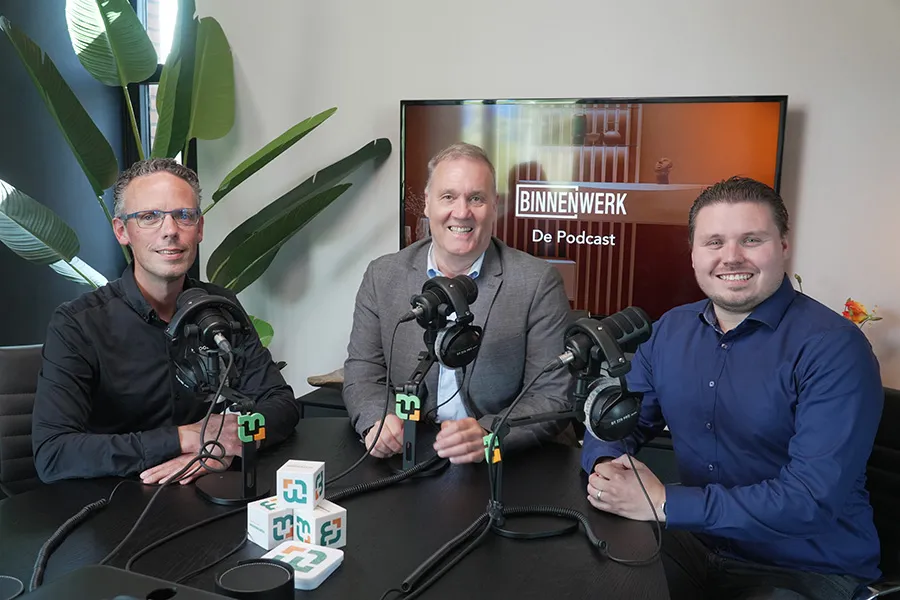
In this episode of Binnenwerk de Podcast, host Jerry Helmers speaks to Mitch Henskens, key account manager at Häfele Nederland, and Pieter van de Minkelis, commercial manager at Hoogendoorn 1961. The two companies have been working together for more than 30 years, showing what a long-standing partnership looks like in practice.
How can you stay competitive as an interior fit-out contractor? Why is it important to involve specialists early in a project? And what role will AI, knowledge development and personal contact play in the future of the industry?
A discussion about the challenges and opportunities in interior fit-out, with practical tips on taking collaboration between suppliers and interior fit-out contractors to the next level.
In conversation:
- Mitch Henskens, Häfele
- Pieter van de Minkelis, Hoogendoorn
Host: Jerry Helmers
Have a business enquiry for Häfele? Get in touch
Full transcript
All chapters (28)
- Introduction to the podcast and guests
- Statements on suppliers, knowledge and lead times
- Mitch Henskens on his role at Häfele
- Pieter van de Minkelis and Hoogendoorn 1961
- Developing a long-term partnership
- Market challenges: project delays, prices and lead times
- How do you stay competitive?
- AI’s impact on costing and pricing
- Tough questions and open communication
- Four major challenges and their solutions
- Partnership from design to delivery
- Bringing the right specialists together
- A joint hospitality project
- How does Häfele keep its knowledge up to date?
- AI at Häfele and the importance of personal contact
- Developing knowledge and Hoogendoorn’s own training school
- Labour shortages
- Investing in staff and opportunities for career progression
- The new generation and the four-day working week
- Working with training providers and recruiting staff
- Sharing knowledge through the trade association
- The future of the interior fit-out market
- Practical tips for better collaboration
- Bring in expertise early and build relationships
- Häfele’s 60-second pitch
- Response to the pitch and a review of the statements
- Looking back on the podcast recording
- Closing remarks and thanks
Introduction to the podcast and guests
Jerry Helmers Hello, listeners. You’re tuned in to the Binnenwerk podcast. Today I have two guests here at the table, who will introduce themselves in a moment. Let me give you their names first: Mitch Henskens and Pieter van de Minkelis. Welcome, gentlemen. Mitch is from Häfele. Pieter van de Minkelis is here, and as your shirt tells us, you’re from Hoogendoorn. Hoogendoorn 1961 is the company’s official name. Before we introduce you both in more detail, let’s make sure our listeners stay with us. Why should they keep listening, and who in particular should tune in, gentlemen? I’m looking at you both now. Mitch, over to you.
Mitch Henskens If you want to hear how a collaboration works between two companies that have been working together for years and go beyond the usual supplier and interior fit-out contractor relationship, listen in to find out how it can work even better and what makes it successful.
Jerry Helmers So interior fit-out contractors should listen?
Mitch Henskens Interior fit-out contractors should listen.
Jerry Helmers Okay, listen up, interior fit-out contractors of the Netherlands. The people at Hoogendoorn should keep listening too, according to you. Just to be clear, you work with Häfele.
Pieter van de Minkelis Yes, we’ve worked together for years.
Jerry Helmers And it’s been a good relationship. You were allowed to come along to this podcast.
Pieter van de Minkelis I was allowed to come along to this podcast.
Jerry Helmers Who do you think should keep listening to this podcast, and why?
Pieter van de Minkelis Anyone interested in bespoke solutions for fittings, furniture and interior fit-out. Anyone looking for a partner who is willing to think through solutions to the challenges that come our way. Keep listening. This collaboration goes back many years.
Jerry Helmers Yes.
Pieter van de Minkelis And that has its advantages too.
Jerry Helmers You’d wish every interior fit-out contractor in the Netherlands a collaboration like this.
Pieter van de Minkelis Yes, exactly.
Jerry Helmers Don’t be so modest. You can be proud of it.
Pieter van de Minkelis Yes, well.
Mitch Henskens Yes, more than 30 years.
Jerry Helmers Well, I’m sure we’ll hear more about that shortly. So, interior fit-out contractors of the Netherlands, do keep listening, especially if you’re looking for a long-term partnership. Could I say one that helps you grow too? One where you can really rely on each other? Where you can be allies?
Mitch Henskens Yes, that’s exactly what we’re looking for. A genuine partnership. Not just supplying products to customers like Hoogendoorn. We really want to explore things in greater depth. How can we make bespoke work even better? How can we improve the collaboration and work together on both straightforward and challenging projects?
Jerry Helmers Well, I’m sure we’ll hear all about the finer points, and perhaps even the secrets. Can I also ask you both, perhaps get a promise out of you, to give listeners two or three, maybe even four useful tips at the end of this podcast that they can apply in their day-to-day work? Can I set you that challenge? Could you give some thought during our conversation to what those tips might be? Can I count on an unequivocal yes?
Mitch Henskens Absolutely, we can do that.
Jerry Helmers Okay, listeners, they’ve made that promise, so keep listening. This podcast will last about 35 to 40 minutes. We’ll end with some really practical tips for interior fit-out contractors.
Read the full transcriptCollapse transcript27 more chapters
Statements on suppliers, knowledge and lead times
Jerry Helmers Before we introduce you in a little more detail, can I put a few statements to you? You can only answer agree or disagree. Pieter, may I put them to you first?
Pieter van de Minkelis Certainly.
Jerry Helmers Here we go. The days when a supplier only had to deliver a good product are well and truly over.
Pieter van de Minkelis Agree.
Jerry Helmers You agree. And what does Mitch say?
Mitch Henskens Absolutely agree.
Jerry Helmers Absolutely agree. Well, at least we’re starting in agreement. Mitch, I’ll ask you first about the next one too. On a distinctive interior project, a supplier’s expertise can sometimes be more important than the product they supply.
Mitch Henskens I completely agree with that too.
Jerry Helmers You agree too. I think I’ll ask you to explain that a bit more later. What’s your view, Pieter?
Pieter van de Minkelis It has to be. Yes, yes.
Jerry Helmers But would you say agree or disagree? I’m going to encourage you to choose one.
Pieter van de Minkelis I’m inclined to agree.
Jerry Helmers You’re inclined to agree. You should be a politician with answers like that. ‘Inclined to agree.’ Very good. I have one more. Pieter, are lead times more important than brands these days?
Pieter van de Minkelis I disagree.
Jerry Helmers What do you say, Mitch?
Mitch Henskens No, I disagree too.
Jerry Helmers Disagree. I was really curious about this one too. Because perhaps the feeling is that you want both to be right.
Mitch Henskens on his role at Häfele
Jerry Helmers Okay, good. Just briefly. Mitch, you work at Häfele. What do you do there, and why is it such a great place to work?
Mitch Henskens For me, Häfele has been the best family business in the Netherlands and Germany for years.
Jerry Helmers You can’t exactly say anything else.
Mitch Henskens Of course, but that’s genuinely how I feel. I’m a key account manager at Häfele. I’ve been doing that for two and a half years, and before that I worked in sales for five years.
Jerry Helmers Just to clarify, okay, what does a key account manager do?
Mitch Henskens I’m responsible for Häfele’s interior fit-out division and its largest accounts. So I manage Häfele’s 100 biggest accounts.
Jerry Helmers So it’s a busy job.
Mitch Henskens We do our best.
Jerry Helmers Are you on the road a lot?
Mitch Henskens Yes, a lot.
Jerry Helmers Yes, hardly ever at the office itself.
Mitch Henskens As little as possible.
Jerry Helmers Yes, they often say that if a key account manager is at the office, something’s wrong.
Mitch Henskens No, exactly. We need to be with the customer. That’s where we have some great places to work.
Jerry Helmers Yes, exactly. And you said it’s a great family business. That clearly makes it a very good place for you to work. What’s the secret to a successful family business?
Mitch Henskens Well, what’s nice is that Hoogendoorn is a family business too. At Häfele, we still do things sometimes because they’re enjoyable or worthwhile, rather than just because they make money or boost the bottom line. We still launch projects because we think, okay, this is good for the market.
Jerry Helmers So you’re not a philanthropic organisation, then?
Mitch Henskens No, of course not. We still have to make money, and we’ll continue to do that successfully. Fortunately, business is going very well. But you can still see the Häfele family’s values at work.
Jerry Helmers Yes, lovely. A common thread is that you have to keep your passion for everything you do.
Mitch Henskens Absolutely.
Jerry Helmers We agree on that. It’s clear that there needs to be some money left at the end of the day. Is it the same at Hoogendoorn? Do you need to have some money left over on the bottom line from time to time?
Pieter van de Minkelis Not from time to time. That’s the objective. Otherwise, we wouldn’t have a reason to exist.
Jerry Helmers No, exactly.
Pieter van de Minkelis and Hoogendoorn 1961
Jerry Helmers Tell us, who are you and what do you do at your company? And what made you say yes when Mitch asked you to join this podcast?
Pieter van de Minkelis We’ve been together for a number of years now. Yes, let’s start at the beginning.
Jerry Helmers Yes, exactly.
Pieter van de Minkelis I’m Pieter van de Minkelis, commercial manager at Hoogendoorn 1961. Hoogendoorn specialises in marine outfitting and interior fit-out. I think that’s a fairly unique combination.
Jerry Helmers Yes, by marine you mean that you work on ships and boats?
Pieter van de Minkelis Yes. Ships and boats include inland vessels and passenger ships. We also work in seagoing and offshore. And yachts. Interior fit-out covers pretty much everything on land: offices, hospitals and hotels. But the expertise is fairly similar in marine and interior fit-out. That’s how we describe it, though we separate the two divisions into marine and interiors.
Jerry Helmers Yes.
Pieter van de Minkelis So when it comes to fittings and things like that, there’s little difference between supplying them for a marine project and for a hotel room. And what made me say yes? I like a challenge, and it’s nice to try something new for a change. This is my first podcast. Yes, it’s a worldwide debut.
Jerry Helmers I think it’s Mitch’s first too. A worldwide debut indeed. What’s so good about working with Häfele?
Pieter van de Minkelis I’m convinced that partnership, working together and drawing on each other’s expertise are among the basic principles of our business. I think that’s how we achieve the best results.
Jerry Helmers Has that changed over the past 10 or 15 years? Your view of it, or perhaps your experience of the market?
Pieter van de Minkelis I think the picture has shifted somewhat, yes. In the past, purchasing may have been more hard-nosed.
Jerry Helmers Yes.
Pieter van de Minkelis You’d say, no, these are the components we need. Put suppliers A and B side by side and give the job to the cheapest one.
Jerry Helmers Yes, exactly.
Pieter van de Minkelis I think that has changed. We’ve realised, I think, that quality isn’t just the product. It’s also the service around it, the input and the expertise the company can bring to the table.
Jerry Helmers Yes, exactly. I used the word alliance in the introduction just now. That was a spontaneous choice on my part. Is that a concept, a word you’re looking for in the market? For your business too, when looking for a good supplier?
Pieter van de Minkelis Yes, ally sounds a bit idealistic, as does alliance, but essentially, yes. You really do it together. We need each other, too. It’s also a bit arrogant to think, ‘I can do everything myself.’ We can achieve a lot with the right people around us.
Jerry Helmers Yes, exactly. And so you eventually brought Häfele on board, too.
Pieter van de Minkelis Yes, yes.
Developing a long-term partnership
Jerry Helmers You’re a key account manager now, but you had a different role before that. Was Hoogendoorn already a customer at the time?
Mitch Henskens Hoogendoorn has been a customer for over 30 years.
Jerry Helmers Yes, you said that. Yes, 30 years.
Mitch Henskens Yes, possibly even longer. Our longest-serving employee said, ‘They were already a customer when I joined.’ They’ve been in the Netherlands for 40 years now, and yes, they were definitely a customer. I’ve completely lost track of your question for a moment.
Jerry Helmers No, I was just curious about how you see it, because that was my lead-in to the idea of an alliance. I mentioned it earlier. There’s a reason you invited Pieter along, too. Pieter noticed, or recognised, that there’s been a kind of change over the last 10 or 15 years. For him, it’s no longer all about hard-nosed purchasing. He’s been looking more for partnership and expertise. So my lead-in was to ask you the same thing: have you seen that change too?
Mitch Henskens We’ve seen that change very clearly, and I think Hoogendoorn is the best example of it for Häfele Nederland. That’s why I invited Pieter along, apart from the fact that he’s a great guy to have with you. The difference with many other customers is that they often still just ask, ‘What’s the best price?’ and buy on that basis, without looking any further. Hoogendoorn really does look a step further. They look at where the expertise lies, together with us. Several of my colleagues, who are specialists in different areas, are in contact with different departments. That means we can really help each other move forward, work closely together and be a genuine partner to the interior fit-out company.
Market challenges: project delays, prices and lead times
Jerry Helmers What challenges are we facing? That’s the first topic I’d like to discuss with you in detail. What challenges do we see in the market right now? Mitch, I’ll hand over to you first.
Mitch Henskens One thing we’re seeing a lot in the market right now is project delays. Then there are rising prices and how to pass those on to customers. Lead times have also been very important in recent years, especially in the Netherlands.
Jerry Helmers Yes.
Mitch Henskens And it’s a challenge for us at Häfele to manage that as well as we can.
Jerry Helmers What do you mean by lead times, especially in the Netherlands?
Mitch Henskens I think the Netherlands is one of the world’s pioneers in just-in-time management. So the requests we get here for very fast delivery, ideally within a day, are much less common abroad.
Jerry Helmers Oh, I see. And what do you mean by project delays?
Mitch Henskens With the energy problems we’re facing at the moment, we’re seeing projects being postponed more often. Products aren’t ordered, or are ordered later, and sometimes projects are simply cancelled altogether. So we’re seeing problems with our planning. What are we going to do over the next year, and in our five-year plan? That’s always a challenge. How will projects get going again?
Jerry Helmers Are we having to react more and more in the short term, or am I jumping to conclusions? But that’s what it comes down to: the short term.
Mitch Henskens Yes, exactly. Order today, deliver yesterday.
Jerry Helmers Right, okay. Pieter, what challenges do you see in the market? Do you agree with Mitch about project delays, rising prices and pressure on lead times? What are you seeing? Do you agree, or are there other challenges facing the market too?
Pieter van de Minkelis Our challenges are obviously somewhat different from Häfele’s, although there’s a fair amount of overlap. I do think project delays are an issue. There’s always something going on in construction.
Jerry Helmers There’s always something going on in construction, yes.
Pieter van de Minkelis Sometimes there’s no utility connection, so the project can’t be connected to electricity or water or whatever. That delays the construction process again. At the same time, there’s a certain unpredictability: when they do get started, they need to get going straight away.
Jerry Helmers Yes, that’s what Mitch was saying: order today, deliver yesterday.
Pieter van de Minkelis Yes, and then a year can go by, let’s say, without us knowing when we’ll be starting again. Then we’re told, ‘We’re starting now,’ and we have to go full throttle straight away. That’s a challenge you can manage very well, I think, with the right partner around you. At the same time, another challenge is staying competitive. Remaining competitive.
How do you stay competitive?
Jerry Helmers What do you mean by staying competitive?
Pieter van de Minkelis Keeping prices at a level that clients are willing to pay for their projects. So we simply have to be competitive on price.
Jerry Helmers I want to ask you about that straight away. How do you find out? It’s something every business owner struggles with. You’ll struggle with it, Häfele will struggle with it. I struggle with it sometimes too. How do you know what’s competitive? Sometimes putting together a quote is a bit of a gamble, too.
Pieter van de Minkelis Yes, that’s right.
Jerry Helmers Give us some insight. How do you know? You say it’s a challenge to stay competitive. So you must have a benchmark or some idea of what counts as competitive for you.
Pieter van de Minkelis Yes. When you work out the costs, there are a number of fixed elements. Those are your materials, whether that’s Häfele hardware or other components. Those are straightforward sums.
Jerry Helmers Yes, that’s right.
Pieter van de Minkelis There’s also always a large element of uncertainty for us: the hours we’ll need. We’re an hours factory, so to speak. We put in a lot of hours. If, for example, you estimate 100 hours for a particular piece of furniture and it takes 120, you’ve got a problem. If it takes 80, you’re 20 hours ahead. So that’s always a factor. But I think the real test of whether you’re competitive comes in conversations with the client. They say, ‘I’ve got another quote, but it’s 5% below yours. How come?’
Jerry Helmers Is that a game you play along with?
Pieter van de Minkelis Well, I’m always curious. Recently, we missed out on a job because someone else was genuinely 5% cheaper. Afterwards, once everything had been settled, I asked if I could sit down with them and learn from it, purely for my own benefit. I wanted to know: where were the differences, and how had they done it?
Jerry Helmers Oh, that’s very decent of you. Tell us, how did that go?
Pieter van de Minkelis Well, you find out that we’d priced certain components very high. Then you go back and review it at the office. You think, ‘Maybe I estimated the hours too high. Maybe I used the wrong sheet material. I should have used melamine instead of HPL. Or perhaps a different type of hardware.’ And the reason is different every time.
Jerry Helmers Yes.
Pieter van de Minkelis To put it bluntly, you find out what’s competitive by taking a knock.
Jerry Helmers And thinking, ‘I didn’t get the job.’ That’s a good one. Finding out what’s competitive by taking a knock. And sometimes you just have to accept it. I’ll ask Mitch the same question in a moment, but I also want to know whether you think developments in AI could help you work more competitively, or get closer to that, with all the proposals and quotes you put together.
Pieter van de Minkelis Yes, I can’t fully see how AI is going to help us. That it will help us is beyond doubt. It’s coming, because there’s a lot coming our way, in a positive sense too. It will definitely help. I think it could help with business operations, purchasing and costing. It could make our costings more accurate.
AI’s impact on costing and pricing
Jerry Helmers This year is a learning process. We’re recording this podcast just after the summer of 2026. We have a rough idea of where things stand with AI right now. But we don’t really know what it will look like in five months, for example. It’s all moving so fast. Right, understood. Mitch, I’d like to ask you the same question. How do you go about staying competitive? How do you know you’re competitive, or is there still a small element of guesswork?
Mitch Henskens There’s always an element of guesswork. We have a lot of customers, of course, so we get plenty of feedback from them, which means we know fairly quickly whether we’re competitive. With our large team out in the field, we hear a lot of feedback too. But it’s always difficult. How do you know if you’re competitive? And another thing that’s difficult is whether you’re comparing like with like. What does being competitive actually mean? I find that very difficult in interior fit-out. Even with our hardware, and I think it’s even more so in the field Pieter works in. We often see different brands being used interchangeably, even though there can be major differences between them.
Jerry Helmers Yes, the question is whether you can compare all brands. You can compare anything, but how equivalent are the products when you compare brands?
Mitch Henskens Very often, they aren’t.
Jerry Helmers Very often, they aren’t. And the art is in finding that out. This is turning into an almost philosophical podcast, isn’t it? Have you noticed? I find it really thought-provoking. I think listeners will too, because every business owner, including every independent interior fit-out specialist, faces this challenge time and again.
Tough questions and open communication
Jerry Helmers Have you ever had this? Maybe it’s a tricky question. You do business together, and I think you get on, personally as well. But Pieter, has Häfele ever asked you, for example, ‘Hang on, you’re putting together a proposal now. Is it competitive?’
Pieter van de Minkelis Not quite that directly. At the same time, we do know what things should cost. Unless Häfele is the only one able to supply that component or type of hardware at that particular moment, and there’s nowhere else to get it.
Mitch Henskens And we’re more than happy when that happens, because then we’re always competitive.
Jerry Helmers Exactly, then you always are. So an alliance also means asking each other tough questions. Mitch, how do you handle tough questions?
Mitch Henskens With Hoogendoorn, everything is very open, because nothing ever drags on for long. Hoogendoorn communicates very directly with me or with several colleagues. So we know exactly where we stand with each other. That’s really helpful, because then you can sort things out straight away, one way or another. Are we too expensive? Then we’ll analyse it. Or is this simply the price? We can tell Hoogendoorn that too. This is what it is, and this is what it costs.
Jerry Helmers You’ve already offered a subtle first tip, in a way. I’m not even sure it’s really all that subtle. But the secret to a good working relationship, call it an alliance, lies in good communication. It may be stating the obvious, but putting it into practice is another matter: good communication. Okay, clear. Yes, because ultimately, as you said earlier, you do want to see a few euros in your favour at the end of the day. That’s how it works, of course.
Four major challenges and their solutions
Jerry Helmers Right. We’ve identified four challenges facing the market. Project delays are one. Rising prices are affecting all of us, of course. Geopolitical troubles, the energy crisis, you name it. Pressure on delivery times, and the challenge we’ve just discussed at length, of staying competitive. Those are four major challenges facing the Netherlands’ interior fit-out sector. So what are the solutions? I’d say good collaboration. We’ve already talked about communication as part of that. Perhaps that’s the first thing a good working relationship is built on. What else is a good working relationship built on, Mitch?
Mitch Henskens For me, communication remains the central point of it all. But so do having the right people.
Jerry Helmers Aha.
Mitch Henskens Well, we have several specialists working at Häfele. Take all the lighting plans we produce: we have a lighting specialist with years of experience in that field. We also have a specialist for our hotel projects and the hospitality sector, who really understands how that world works. And they talk to the right people. That’s why Pieter is in regular contact with my colleague, our hotel specialist, to get a feel for the market: how it’s doing, where it’s heading, how we can support each other, what we’re hearing. That’s how we try to bring it all together. So make sure the right people talk to each other.
Jerry Helmers Make sure the right people, yes, exactly. It’s not just about open communication, but also making sure the right people talk to each other about the right subjects.
Mitch Henskens Yes, an account manager can come over for a coffee, and that’s great, but they’re not an expert in everything. Certainly not at a company like ours, with the full range we offer. Make sure the people your customer needs are there for them.
Partnership from design to delivery
Jerry Helmers So is this, I’m thinking aloud here, a kind of partnership from design to delivery?
Mitch Henskens Yes, you could see it that way.
Jerry Helmers Because that’s the whole process you offer, isn’t it?
Mitch Henskens Yes, we do try to get involved right from the start, bringing the right products and the right expertise to the table. In other words, to be a knowledge partner to our customer. All the way through to completion and delivery. And afterwards too, if a problem comes up, we work together to resolve it. Don’t start pointing fingers and asking who’s to blame. Just solve it together.
Jerry Helmers You don’t want egos getting in the way, do you?
Mitch Henskens No, ego is very much a thing of the past.
Jerry Helmers Yes, that’s good. Ego is very much a thing of the past, because it doesn’t work any more.
Pieter van de Minkelis Egos don’t make the world a better place.
Jerry Helmers They certainly don’t. We’ve got a few good quotes out of this podcast, I notice.
Bringing the right specialists together
Jerry Helmers Pieter, we agree that communication is the foundation of good collaboration. And we’ve talked about having an alliance. You need to speak to the right people. What other characteristics do you think a good working relationship needs to be built on?
Pieter van de Minkelis I agree with what Mitch just said. Communication is really key to everything, including bringing in expertise. Whether it’s your colleague who handles lighting, or the one who handles hotels, or someone else. It’s the same internally for us. We have estimators who are involved at the start of a project, or account managers. Procurement looks at things from a different angle. Production and work preparation have their own perspectives too. Bring in the right people in the right roles. But communicate.
Jerry Helmers Don’t let things slide. Don’t leave things to chance.
Pieter van de Minkelis No, don’t leave things to chance. If something comes up, pick up the phone or send an email. Talk to each other. We have a problem, and it needs to be solved. Don’t wait until, say, Häfele visits in three weeks. Let’s gather everything up and discuss it then. No, it needs to be sorted out before Häfele gets here in three weeks.
Jerry Helmers But that means, Pieter, Mitch is your, let’s call him, main contact or the person you’re in touch with most often. Do you also deal with other people at Häfele?
Pieter van de Minkelis Yes, yes, yes. Just as you describe. I’m in regular contact with the colleague who handles hotels. Estimators are in touch with other people.
Mitch Henskens Yes, they’re in regular contact with the lighting specialists or the specialists for our kitchen appliances. So they already try to do a lot of that. It’s about having the right people in the right roles. As key account manager, I’m responsible for the whole process, so I try to bring everyone together. We try to make sure the right people are involved.
Jerry Helmers So you lead a team, so to speak, can I put it that way, or do you coordinate it?
Mitch Henskens I coordinate it. I don’t lead them. People are perfectly capable of managing all that themselves, both at Hoogendoorn and on my side. But I do try to keep an overview.
A joint hospitality project
Jerry Helmers Can you remember the first time you walked into Hoogendoorn?
Mitch Henskens The first time was great. It was a very large project straight away. I’d been working at Häfele for about a week, and we were given the chance to deliver our biggest lighting project to date. So that was quite a challenge to start with.
Jerry Helmers That must have been a great way to make an entrance at that family business.
Mitch Henskens Yes, I said, ‘Bring on the turnover.’ No, it was a really lovely hospitality project, the N-O-Hotel. It became a fantastic reference project for both us and Hoogendoorn. And I think that led to even more collaboration. So it was great.
Jerry Helmers Was Pieter there when you first walked in?
Mitch Henskens No, I was sitting down with the procurement department, including the legendary Jan van Varik, who had 100 years’ experience at Hoogendoorn. I think I met Pieter shortly afterwards.
Pieter van de Minkelis Exactly as it should be. I sold it as an account manager. I was involved, the project came in, and then work preparation got started on it, along with procurement and so on. Then other people stepped in. Jan van Varik ultimately bought it from Häfele. He was our head of procurement at the time. So it’s not about me, Mitch or any one individual at the company. It’s about the companies using each other’s expertise across the board and communicating at those levels. There’s no hierarchy involved.
Jerry Helmers It’s almost like a marriage, isn’t it?
Mitch Henskens No, but there are weeks when I speak to Hoogendoorn about some projects almost as much as I speak to my wife.
Jerry Helmers What does your wife think about that?
Pieter van de Minkelis Well, at least there’s less arguing.
Jerry Helmers That’s it.
Pieter van de Minkelis Communication is key in marriage too.
Jerry Helmers Yes, that’s a whole subject in itself. We should do a separate podcast about that one day. I think we’d get a lot of listeners too. It should work, because I think you’ve got some useful tips on that as well.
Mitch Henskens My colleague can join us for that one.
How does Häfele keep its knowledge up to date?
Jerry Helmers Okay, yes. One thing I’ve been wondering about: you work well together, and there’s good chemistry between you. We’ve heard how you approach collaboration. What I found really interesting was your point that the right people should have the right conversations. So, drawing on expertise from different areas. But somehow, that knowledge has to be within the company. And I’m looking particularly at Häfele here. Social, technological and technical developments are moving incredibly fast. How do you keep your own knowledge up to date? If, as I’ll put it, you want to deliver complete bespoke solutions, you need to understand what a complete bespoke solution involves. So the question is: how do you develop your own knowledge?
Mitch Henskens We try to do that across a broad range of areas. We work with our suppliers when we buy products in, but we also make a lot of products ourselves. So we have plenty of specialists in-house too, and we bring them in to train us. The specialists train the specialists. Our product manager is trained by Häfele Germany, by the people who actually developed the product. They do their best to pass on their knowledge to us. But it’s a challenge to know everything ourselves. That’s why we also make sure the right people are in the right roles. And if we don’t have the expertise in-house, we try to find someone in the industry who knows a lot about it and can help us move forward.
Jerry Helmers So does that mean, for example, that you go to trade fairs, conferences and seminars, or take part in an international webinar? Just to give a few examples.
Mitch Henskens Webinars are held regularly, both internally and with external partners. We also travel to our partners, mainly around Europe, to learn from them. Usually a few colleagues go along, and they then pass on what they’ve learnt internally. That’s how we try to make sure we’re experts in bespoke solutions and interior fit-out, particularly furniture fittings and related areas.
Jerry Helmers It’s quite interesting when you think about it. Do you know what your expertise will be in two or three years’ time? The market is changing incredibly quickly, especially in terms of technological developments. We’ve already touched on AI, of course.
Mitch Henskens Yes, but that’s going to help us too, Jerry.
Jerry Helmers Yes, but I wonder if it’s even possible to keep up.
Mitch Henskens No, but AI will soon take over some of the advice we provide. You’ll be able to ask Häfele questions directly, instead of contacting my colleague, and get an AI-generated proposal first. That will help us a lot too. But specialist expertise must remain. We need to keep training people with knowledge. That will remain important.
AI at Häfele and the importance of personal contact
Jerry Helmers What is Häfele already doing with AI?
Mitch Henskens We’re mainly working on it behind the scenes. For us, it’s also a question of how to integrate it fully into our business. A lot is being done, but the first things are only now starting to filter through in practical terms. They’re not big things yet, though. So it’s a very difficult issue.
Jerry Helmers But would you also say: AI is all well and good, but it’s still a people business?
Mitch Henskens It’s definitely still a people business. We always say that people buy from people. You want to sit down with people, don’t you? If something isn’t right, AI usually can’t just drive over to the project to see how we can solve it together. So AI will certainly take over some tasks. But we believe we’ll still need our people.
Jerry Helmers Yes, I’m curious. Perhaps we should meet again in three years to see whether that still holds true. I’m really curious. Pieter, how do you develop knowledge within your own business to make sure you stay relevant?
Developing knowledge and Hoogendoorn’s own training school
Pieter van de Minkelis Yes, that happens across a lot of different areas. We visit trade fairs, where Häfele is represented, for example, as are many other companies. New developments often show up at trade fairs. We receive lots of newsletters, and plenty of information comes our way.
Jerry Helmers Do you have time to read them?
Pieter van de Minkelis Often I just skim through them. Yes, I know this too. Hang on.
Jerry Helmers That’s the daily grind, isn’t it? We often hear about projects being postponed, but at the same time we’re all incredibly busy. So do you have time to read it all?
Pieter van de Minkelis No, not everything. No, that’s true.
Jerry Helmers But you do read Häfele’s newsletters. I don’t know if you send them out.
Mitch Henskens Yes, absolutely. We have a very good marketing and communications department.
Jerry Helmers Right, you should make sure to mention that. But go on, Pieter. Developing your own knowledge.
Pieter van de Minkelis Yes, developing our own knowledge. Look, the craft will remain the craft. We also have our own training school, with two mentors. We train young people ourselves. We’ve been doing that for as long as I’ve worked at Hoogendoorn. Almost 30 years. We already had a training school then, and we still do now. It’s only grown since. The Hoogendoorn Knowledge Academy. And of course, the mentors visit training centres and all sorts of other places, so they bring back knowledge too. At the same time, we have a machining department. It’s a huge machine park. And I think automation will play a very big role there. Or AI. We’re also researching this with major machine suppliers. What else can we do with it? Can we produce more with the same people?
Labour shortages
Jerry Helmers Yes, because during your presentation, we haven’t actually talked about labour shortages yet. We mentioned four challenges earlier. You touched on it briefly, though. I think we should talk about it a bit more. And I’ll put the question straight back to you, Pieter. How do you deal with labour shortages? Where do you find good staff?
Pieter van de Minkelis Yes, a large part of that is addressed through training people ourselves.
Jerry Helmers Yes, because I think you’re handling that very smartly by working with mentors.
Pieter van de Minkelis Yes, yes. We’re constantly training skilled carpenters. And every year another six or seven young people start.
Jerry Helmers Very good.
Pieter van de Minkelis Almost all of them stay. Hoogendoorn is a family business too. The funny thing is that people seem either to leave within a year because it’s not a good fit, or they stay for life and never leave. So staff turnover is really minimal for us. We have around 185 employees. Hardly anyone leaves.
Investing in staff and opportunities for career progression
Jerry Helmers So you’re making a very deliberate effort to keep those training programmes going by working with mentors. It’s really a case of planning ahead.
Pieter van de Minkelis Yes, yes. Especially now. We’re always looking for people. We’re still growing, and every year we need new people in other roles too. But that’s because we’re growing, not because people are leaving. We always invest a lot of time and energy in that. And I think the great thing about family businesses is that they’re very people-focused organisations, both internally and externally. Customers notice that, and so do employees. That’s why staff don’t just leave. So we don’t really experience those acute shortages. At the same time, we’re very conscious of looking after our people. They’re great, of course.
Mitch Henskens One really great thing is that the person who used to bring me coffee when I first started at Hoogendoorn now negotiates with me in the purchasing department. So you can offer people plenty of opportunities to progress.
Jerry Helmers How do you deal with it yourselves? Or rather, how do you view labour shortages?
Mitch Henskens It’s a challenge, especially for our customers. We can see that. Every day, a customer asks me: Mitch, do you know anyone who’s looking for a change? But it’s a challenge for us internally too. Ideally, we want people with technical knowledge who can help us bring in customers. Finding the right people is often a real challenge.
Jerry Helmers But you do want to be, and I think you are, a good employer.
Mitch Henskens Most people stay with us for a long time. I’d agree with what Pieter says. People either leave quickly, or they’ve been with us for years. So no, people do tend to stay with us.
The new generation and the four-day working week
Jerry Helmers How do you view what I’ll call the next generation coming through? People in their twenties, say. They want to have all sorts of things sorted in their lives, but they only want to work three days a week.
Pieter van de Minkelis Yes, that’s another challenge coming our way. At the same time, we realise that you can resist all you like, but you won’t stop it. No, it’s going to happen. So how do we make it work in our business as well as possible?
Jerry Helmers But have you found a good way to do that?
Pieter van de Minkelis Not for three days, no. It’s a struggle. We discuss it in the management team from time to time. One person wants to work four days, the next wants to work four days. Three, but four is more common. At the same time, we realise you can worry about it all you like, but this is the future.
Jerry Helmers Yes, it’s a social phenomenon and you can hardly change it.
Pieter van de Minkelis Yes, no. So it’s a question of how to do it. It’s a process, I have to say, but how do we get it right? If everyone takes their fourth or fifth day off on the same day, a business like ours could practically close. Yes, but on the other hand, how bad would that really be?
Jerry Helmers An appeal to listeners to send in their tips.
Pieter van de Minkelis Yes, send them in. We could make a great podcast about this too.
Jerry Helmers Yes, definitely.
Pieter van de Minkelis Well, let’s see what the response is…
Jerry Helmers Definitely. These are topics that come up a lot, of course. What’s your view? On all those young people who only want to work three or four days a week?
Mitch Henskens Well, yes. Every generation is different.
Jerry Helmers Definitely.
Mitch Henskens So, as Pieter says, we can resist it and fight it, but there’s no point. We’re not feeling the effects too much internally at the moment. We’re not a manufacturing business either, so we’re less affected. That makes it easier for us to adapt, if we can. And, as you say, we don’t really want everyone to have the same day off. Availability is particularly important in a customer service team, for example. But it’s manageable for us so far, so we’re keeping our fingers crossed. Finding people is the bigger challenge, more so than the four-day or three-day week.
Working with training providers and recruiting staff
Jerry Helmers Do you, for example, work with vocational colleges or perhaps universities of applied sciences to present yourselves attractively and perhaps start building relationships with students early on?
Mitch Henskens We do less of that. I think you do more.
Jerry Helmers Well, we have the mentor programme.
Mitch Henskens Because we do less of that. We rely on traditional recruiters and people who try to find the right candidates.
Sharing knowledge through the trade association
Jerry Helmers Let me come back to the idea of collaboration, of an alliance. You do business together, but do you ever sit down over a coffee, perhaps with your feet up, and talk about these sorts of topics, to inspire each other?
Pieter van de Minkelis We don’t shy away from those conversations.
Jerry Helmers You don’t shy away from those conversations.
Mitch Henskens No, we perhaps talk about it more often at Jong Management.
Jerry Helmers What do you mean by Jong Management?
Mitch Henskens We’re both members of Jong Management at CBM, the trade association for interior fit-out. So we also see each other several times a year at events. That’s where we get into more depth with other colleagues from across the industry. And I think that’s why we’ve talked about this more.
Pieter van de Minkelis Yes, you meet people in similar positions who are facing the same problems. There’s definitely a lot of brainstorming. Unfortunately, I’m no longer part of it because of an age issue.
Jerry Helmers Oh, you’ve got too old. You’re no longer young. Right, but you could also say that if we want to broaden or expand our knowledge, we should join an interest group, for example. Go to its meetings and get inspired by your peers.
Mitch Henskens Yes, talk to each other. To come back to it: talk to each other.
The future of the interior fit-out market
Jerry Helmers We’ve managed to squeeze that in at the last minute after all. Can we offer a picture of what the market might look like in the future? We’re recording this podcast in 2026. What might the market look like in three or four years, for example? Is it even possible to predict, Mitch?
Mitch Henskens We expect the market to keep going. Given all the problems with housing, we expect people will continue to need interiors. So we expect the market to carry on. But, as you just mentioned, it’s a challenge to know what things will look like with AI solutions. We’ll have to adapt flexibly every year, or perhaps even several times a year.
Jerry Helmers Can you still plan far ahead?
Mitch Henskens Difficult, difficult.
Jerry Helmers Nice. That’s a good quote. Pieter, what’s your view of developments in the market? What will it look like in three or four years?
Pieter van de Minkelis Well, I naturally distinguish between the maritime and interior sectors in our business.
Jerry Helmers Yes.
Pieter van de Minkelis At the same time, I always find it very difficult to say: this is what things will look like in three or four years.
Jerry Helmers Yes, I don’t know, but perhaps.
Pieter van de Minkelis I can see a huge development in passenger shipping at the moment, in the maritime sector, for example.
Jerry Helmers Yes.
Pieter van de Minkelis How many projects we have in that area. Construction-related work, and then we’re more focused on interior fit-out, is a little less predictable.
Jerry Helmers Why do you think that is?
Pieter van de Minkelis I think politics often has a lot to do with it too. What’s the political outlook? Which direction is politics heading in? What’s the policy on nitrogen emissions? Things like that. For example, we work in a specific part of the hotel sector, but this year VAT was increased in the hotel industry. You get the feeling that a lot of owners who want to build a hotel are saying: let’s put things on hold for a bit and see how this develops. I’m sure that work will come back. There are always these fluctuations, though. When there’s less work in the hotel sector, we have more in offices. Then there’s more in shipping. It’s always a bit like that. The law of communicating vessels always applies to us.
Jerry Helmers Well, you’ve built that up well at your company over the years by focusing on different target groups, or rather, target markets. So if one is quieter, another can be busier. That helps you balance things out. But we agree, it’s almost impossible to predict what the market will look like three years from now. The world is simply too unpredictable.
Pieter van de Minkelis Yes, and geopolitics too, as you mentioned earlier. There’s certainly a lot going on.
Jerry Helmers There are still plenty of challenges to overcome there too.
Practical tips for better collaboration
Jerry Helmers Right. At the beginning of this podcast, I challenged you to think about whether you could come up with some very practical tips for listeners towards the end of the recording. We’ve had a good chat. I don’t know whether you’ve had a chance to give it any thought along the way. But I’ll start by asking Mitch: what are two practical tips for interior fit-out companies in the Netherlands? Then we’ll ask Pieter for two more.
Mitch Henskens Make sure you know your supplier.
Jerry Helmers Make sure you know your supplier.
Mitch Henskens It’s not ideal to have to search on LinkedIn to find out who to contact. If you want to solve something quickly, make sure you know each other and understand what you can expect from one another. That’s the quickest way to resolve things and deliver the best projects, from design through to completion.
Jerry Helmers I understand the tip, but tell us how you actually do that in practice.
Mitch Henskens Have a coffee together, invite each other over. It could be at the supplier’s premises or at the customer’s. Just make sure you know each other as people.
Jerry Helmers And how do you convince a supplier who doesn’t know you yet to accept your invitation and have a coffee with you?
Mitch Henskens Well, tell them who you are. Take an interest. I understand you can’t do that with everyone, but at least sit down with your regular partner. Who are you? What do you do? Don’t keep it purely business. The business side becomes easier the better you get to know each other.
Jerry Helmers Good tip. Have you got a second one?
Mitch Henskens Yes, and as I said earlier in the podcast, get the right people together. Put your ego aside. If a colleague has a particular specialism, make use of them. Don’t try to handle it yourself with a half-answer. Send in a colleague who can give the full answer.
Jerry Helmers To echo what Pieter said earlier in the podcast: we won’t save the world with our egos. I can’t remember his exact words, but to paraphrase, they won’t make the world a better place.
Pieter van de Minkelis They won’t make the world a better place.
Jerry Helmers You remembered that well. Good tips. Have you perhaps got a third one? Or shall I hand over to Pieter?
Mitch Henskens Yes, I’m sure Pieter can come up with something good.
Bring in expertise early and build relationships
Jerry Helmers Pieter, have you got one or two useful tips for interior fit-out companies in the Netherlands?
Pieter van de Minkelis Yes, involve each other early on. Make use of each other’s expertise. So when we as an interior fit-out company receive an unusual request and think, how are we going to solve this? We don’t try to work it out ourselves. Instead, in this case, we bring Häfele in early. Or another supplier for a different area. So make use of each other’s expertise from the outset.
Jerry Helmers Good tip. Have you got another?
Pieter van de Minkelis Yes, that ties in with what Mitch said. Build a relationship. I’m convinced AI will never replace that. It’s a genuine human relationship. Stay connected. So have a coffee together, even if you don’t talk about work. It’s about getting to know each other. Then, if something comes up, you can get things moving much faster.
Jerry Helmers Are we Dutch any good at that? Building relationships. We’re often seen as a bit cold and too direct, of course. Just ask the Belgians. But can we, as Dutch people, build relationships?
Mitch Henskens But we’re Dutch too, aren’t we?
Jerry Helmers Yes, that’s true.
Mitch Henskens So we’re used to it. And I think we build relationships in our own way.
Jerry Helmers Yes, sometimes I wonder whether it’s a bit of a cultural thing.
Pieter van de Minkelis No, I actually think we don’t need to give up being direct. That’s our strength. We just need to use it in the right way. Directness has a place in a relationship. A good relationship can accommodate it.
Jerry Helmers Yes, well said.
Pieter van de Minkelis And make use of it. Talk to each other, especially when you disagree.
Häfele’s 60-second pitch
Jerry Helmers Exactly. Well said. Pieter, you’re going to have to keep quiet for 60 seconds now. And I, as the presenter, will have to keep quiet too. Because we’ve reached what I’ll call Häfele’s 60-second pitch. I’m looking at you. I don’t know whether you’ve prepared anything or thought about what to say. You knew this minute was coming, of course. But I’m going to give you one minute to speak. You can say whatever you like. Perhaps you want to return to something we discussed earlier in the podcast. Perhaps you want to make a critical point about Pieter after all. You might think: I heard something said that I don’t agree with. Or you can simply tell us who Häfele is and how great it is to work for this family business. So, are you ready?
Mitch Henskens We’ll give it a try, at least. I hope Pieter and I have managed to make it clear today just how important collaboration is for a business. I really want to emphasise that Häfele is more than a supplier of furniture fittings. It’s a full-service partner for the interior fit-out industry. That covers all kinds of fittings, lighting and kitchen appliances, but our specialists’ knowledge is also hugely important. We really want to support customers from start to finish on a project. Whether it’s a home, an office, a hotel or another interior project, we want to be your partner and bring our knowledge and advice to the table. So if you work in interior fit-out and are looking for a partner with the widest range, one that looks beyond simply supplying products, we’d love to hear from you, or stay in touch. That’s what matters most to us right now. We have a very strong relationship with Hoogendoorn, and hope to build on it for many years to come. We’d like to do the same with our other customers too.
Response to the pitch and a review of the statements
Jerry Helmers Well, Mitch, if I started my stopwatch correctly, you put it very neatly in about 58 seconds. That was excellent. Time management. Pieter, did he do a good job? Have you got any tips to help him refine his speech? Was what he said right?
Pieter van de Minkelis Yes, yes. Very good. He put it well.
Jerry Helmers He did a good job. It’s a bit difficult. That’s how it is. We’ve really reached the end of the podcast now. I’m still looking back at the statements we started with, with half an eye, or perhaps a full eye. You mostly agreed with each other. There was one you were unsure about, and I’d like to come back to it briefly. I said: on a special interior project, a supplier’s knowledge can sometimes be more important than the product they supply. Mitch, you agreed. And you, Pieter, said you tended to agree. Before we finish the podcast, I’d like you to explain that a little more.
Pieter van de Minkelis Yes, but if I put the two side by side, the supplier’s knowledge and the quality of what they supply are both essential to a project’s success. Take one away and it doesn’t work.
Jerry Helmers Yes.
Pieter van de Minkelis So we need both. The quality has to be there, but so does the supplier’s expertise.
Jerry Helmers Is it 50-50, then?
Pieter van de Minkelis Yes, I think so.
Jerry Helmers Good. That’s settled, then. We’ve ticked that one off too, following the statements we put forward at the beginning of the podcast.
Looking back on the podcast recording
Jerry Helmers Gentlemen, did you enjoy being guests here in the studio in Weert at Louwers Mediagroep? Spending nearly three quarters of an hour chatting with me about the interior fit-out industry in the Netherlands and all the challenges we face? Give us a quick review. Did you enjoy it?
Mitch Henskens Yes, and it’s always good to talk about our industry. It’s one of the best industries to work in, of course. And especially with specialists like Pieter at the table, and you, Jerry. I’d say it was great. Really nice to do this.
Jerry Helmers Did I ask reasonably good questions? Or are you thinking, Jerry?
Mitch Henskens Well, Jerry, you did your best. That’s the most important thing.
Jerry Helmers Pieter, can you rescue me now? How do you look back on this podcast recording?
Pieter van de Minkelis Yes, I actually thought it was great. Enjoyable.
Jerry Helmers Would you do it again?
Pieter van de Minkelis Yes. Well, it’s the first time I’ve done it, but I have to say I really enjoyed it. Really enjoyed it.
Jerry Helmers Yes.
Pieter van de Minkelis Indeed, my wife always says: when you say you quite enjoyed something, that means it was … That’s what I mean, really.
Closing remarks and thanks
Jerry Helmers Right, well, that means I can bring this podcast to a close with a clear conscience too. I also have a feeling that when you head back to the office, you’ll be able to say with a clear conscience that you’ve done a good job. So, once again, thank you very much for coming to the studio. As I said earlier in the podcast, I hope we’ll have another opportunity in two or three years to look back at everything we’ve said today and see whether it still holds true. Is that a promise? Have we agreed on that? Shall we do it? So, thank you for coming. My name, dear listeners, is Jerry Helmers. I was, and remain, the presenter of Binnenwerk de Podcast, produced by Louwers Mediagroep in Weert. I’d also like to thank my colleagues Frank Wekking and my namesake Jerry Wolter. They are the project managers at Binnenwerk. And I’d like to thank my colleague Daan Halters for the technical support. And you, dear listener, thank you, of course, for listening. I’d say, go back and listen again to the tips shared at the end of this podcast. I’m sure you’ll find them useful in real life. And with that, on behalf of Häfele and Hoogendoorn, my warmest regards and thank you.
Companies in this story

Keep following this
Get an email when a new story is published. No account needed.
- ThemeRunning an interior fit-out business
- SubjectGeneral
- CompanyHäfele