Smarter automation in interior construction: De Groot Bewerkingsmachines on staff, space, grid congestion and AI
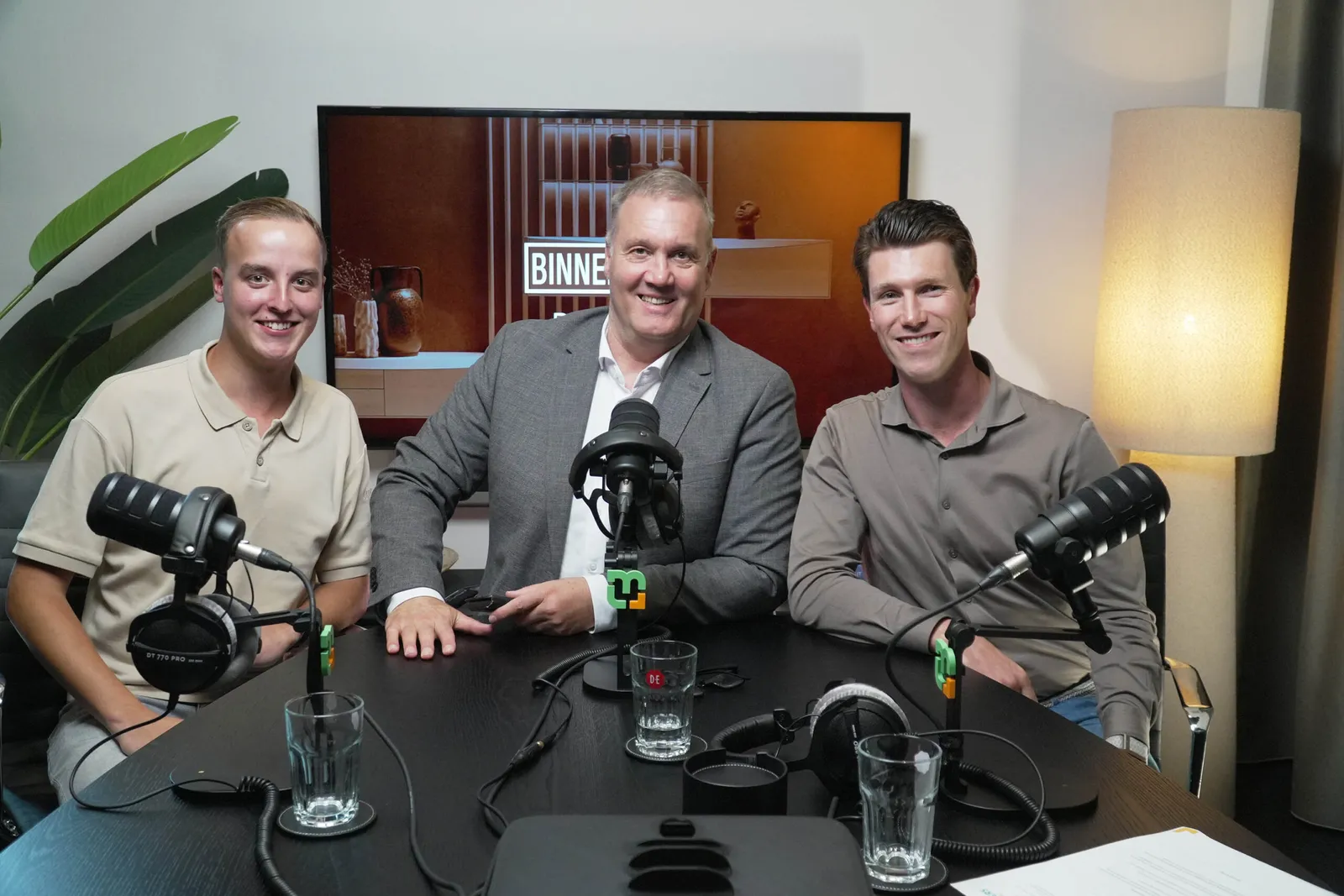
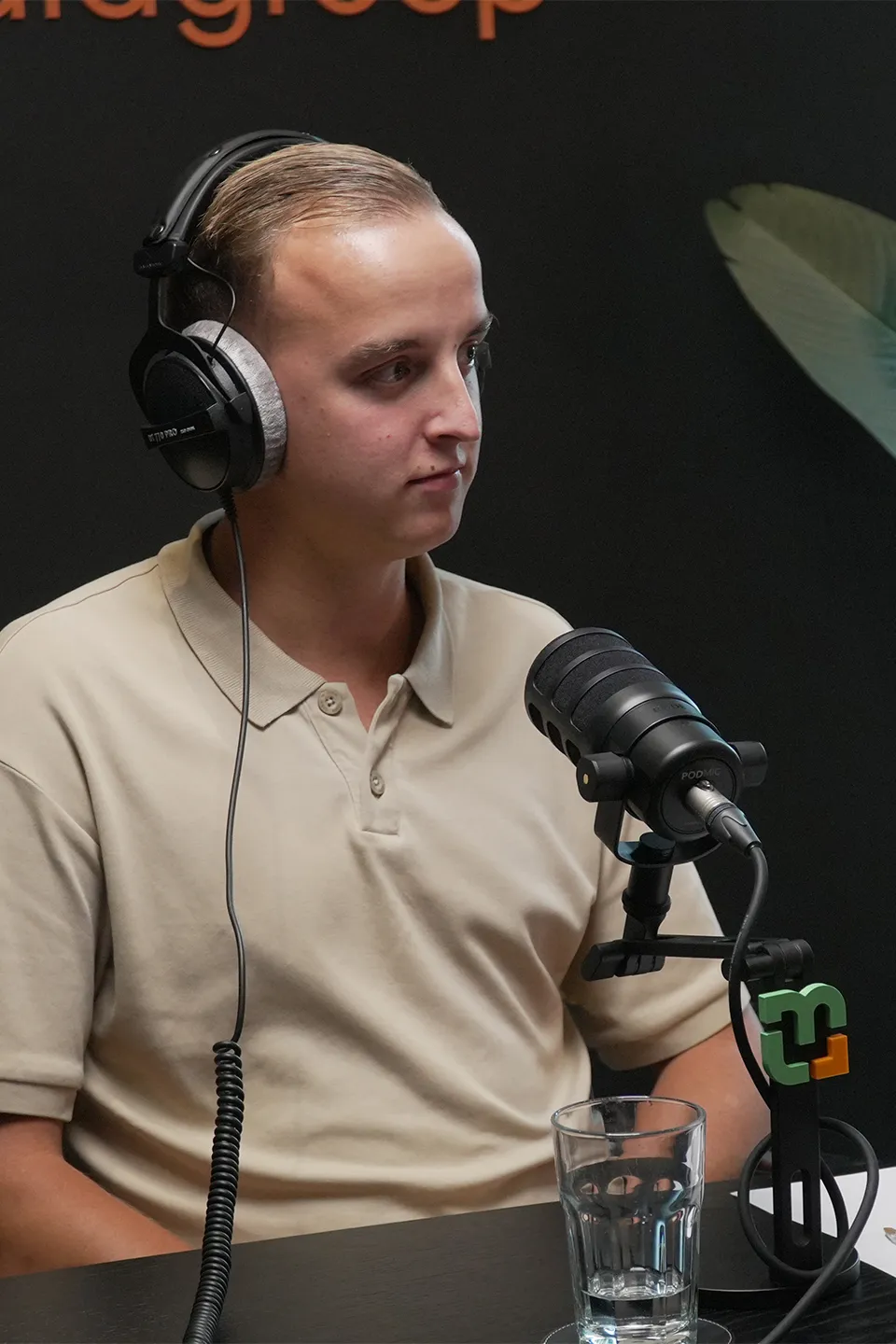
How can interior construction businesses grow when staff are in short supply, workshops are full and grid congestion makes further expansion difficult? And what role will automation, CNC machines and AI play in the workshop of the future? In this episode of Binnenwerk, the podcast, Jerry Helmers talks to Martijn de Groot, Managing Director of De Groot Bewerkingsmachines, and product specialist Daan van den Akker. They discuss how interior construction businesses can make their entire production process more efficient, why automation is about more than just speed, and how to ensure skilled workers are doing the work where their expertise adds the most value.
A conversation with Martijn de Groot & Daan van den Akker
Host: Jerry Helmers

Een zakelijke vraag aan De Groot Bewerkingsmachines? Get in touch
Full transcript
Alle hoofdstukken (22)
- Challenges in interior construction
- Statements on automation and AI
- Martijn de Groot and Daan van den Akker
- Space, staff and grid congestion
- Doing business in an uncertain market
- Getting more out of the same workshop
- Combining processes in a single machine
- Understanding the business first
- Advice versus simply offering the lowest price
- Retaining and developing staff
- Looking ahead to the 50th anniversary
- Is a career in interior construction still attractive?
- Automation, AI and craftsmanship
- Grid congestion as a daily challenge
- A call to politicians and government
- Giving businesses room to operate
- Opportunities for AI in interior construction
- Building knowledge and learning from other industries
- De Groot Bewerkingsmachines in ten years’ time
- Four practical tips for interior builders
- Samen Vooruit on 28 and 29 October
- Closing
Challenges in interior construction
Jerry Helmers Hello, and welcome to another episode of Binnenwerk, the podcast, produced by Louwers Mediagroep. My name is Jerry Helmers and I’m your host. And today I’m joined by none other than Martijn de Groot and Daan van den Akker from De Groot Bewerkingsmachines in Rosmalen. Welcome, gentlemen. Let me get straight to the point. Lots of interior construction professionals and furniture makers listen to this podcast. But why should they keep listening?
Daan van den Akker We’ll be sharing all sorts of tips today, or rather, in this podcast, about the various challenges interior construction businesses face every day.
Jerry Helmers Yes, there are probably a lot of challenges.
Daan van den Akker Definitely.
Jerry Helmers Yes, I think we’re talking about dozens of challenges by now.
Daan van den Akker There are plenty.
Jerry Helmers I’ll hold you to a promise that these will be really practical tips, so that when interior construction professionals have finished listening, they can put them to use straight away. Martijn, you handed over to your colleague Daan. Is there anything you’d like to add?
Martijn de Groot No, I think Daan has just covered it. We’ll mainly be talking about the challenges and possible solutions to them.
Jerry Helmers All right, good. Interior construction businesses in the Netherlands, you’ve heard it: you should keep listening. At least, that’s what the men from De Groot Bewerkingsmachines, our guests in the studio, say. As I mentioned, we’ll introduce you properly in a moment, because we do want to find out who’s sitting here at the microphones. But first, I’d like to put a few statements to you, just to see what you think of them. And it’ll be interesting to see whether you have different views on them yourselves.
Read the full transcriptCollapse transcriptnog 21 hoofdstukken
Statements on automation and AI
Jerry Helmers Agree or disagree? I’ll put the first one to Martijn. In the long run, automation is cheaper for an interior construction business than hiring extra staff. There was a lot of thinking going on. I could tell from the furrowed brows. Daan, do you agree or disagree?
Daan van den Akker Yes, I agree too. Definitely.
Jerry Helmers Yes, that came out a little more emphatically. A little faster. All right. The second statement. I’ll put this one to Daan first. When considering a new machine, interior construction businesses too often focus on everything the machine can do, rather than what their business actually needs. Agree. Ah, that’s a good challenge for the sales team, of course. We’ll no doubt come back to that. Right, I have one more, and it’s about the future. Here goes: AI will change the interior construction profession much more profoundly than many people currently think. Martijn, do you agree? I think you were weighing it up. What do you say?
Daan van den Akker I do agree, but perhaps with a little more nuance. Much more profoundly than people think…
Jerry Helmers Looking at the statement, you’re actually disagreeing with it if I take it absolutely literally.
Daan van den Akker Then perhaps I disagree.
Jerry Helmers Well, you know, it’s a bit cheeky, but I’m going to note that down as disagree. All right, let’s see if we can bring you two colleagues a little closer together. I have one more. By the time De Groot Bewerkingsmachines in Rosmalen celebrates its 50th anniversary in 2028, it will be the best, biggest, most innovative and most compelling machinery company in the Netherlands. Agree?
Martijn de Groot Agree.
Jerry Helmers You can hardly say you disagree with that one. Fair enough.
Martijn de Groot and Daan van den Akker
Jerry Helmers We’ve already got to know you a little. We’ll no doubt touch on these statements again as we discuss the various topics. But first, who’s at the table? Martijn, who are you? Tell us a bit about yourself.
Martijn de Groot I’m Martijn de Groot, Managing Director at De Groot Bewerkingsmachines and the third generation in our family business.
Jerry Helmers Yes, what’s so good about a family business?
Martijn de Groot You get to take over something with many years of expertise behind it, where people have strong ties to the business and its customers, and carry it forward.
Jerry Helmers Was it a foregone conclusion that you’d take on this role in the business as the third generation, or did you ever think, ‘I’d actually like to be a pilot’ or something?
Martijn de Groot Not a pilot, but I don’t think it was a foregone conclusion. In fact, until I was about sixteen, I wasn’t sure I wanted to join the business. Then I walked in one day and thought, ‘Yes, this is what I have to do.’ You only get that chance once, so I had to take it.
Jerry Helmers Yes, exactly. Daan, who are you?
Daan van den Akker I’m Daan van den Akker. I’ve been working at De Groot for three years now, and I’ve been a product specialist for two. I mainly advise customers at the start of a project. I also look at how their workshop could be made more efficient, and we really try to give customers sound, practical advice. I provide advice and demonstrations in the showroom, prepare quotations and handle other things like that.
Jerry Helmers Yes, what’s so good about working in a family business?
Daan van den Akker At De Groot, I really get the feeling that everyone knows one another and wants to help each other get ahead. When I started at De Groot, I remember that being what I appreciated most. I never felt that anyone minded me asking a question or not understanding something. People genuinely want to help one another. I think that’s a real positive.
Jerry Helmers That’s almost a hallmark of a good family business. That’s how it should work. Could some of those big corporates learn a thing or two from that?
Daan van den Akker Exactly.
Jerry Helmers Looking forward to the podcast?
Daan van den Akker I gather this is our worldwide debut. Our actual debut. It’s a little nerve-racking at times, perhaps.
Martijn de Groot For both of us, indeed.
Space, staff and grid congestion
Jerry Helmers All right, good. I’d like to talk to you about the challenges. As you said at the start in the introduction, the challenges we’re seeing in the market. Could you tell us a bit about them? What are interior construction businesses in the Netherlands up against? What challenges do they encounter?
Martijn de Groot A common thread we keep coming across is the space available and staffing.
Jerry Helmers What do you mean by space? The workshop space?
Martijn de Groot The space available in the workshop, or the scope for expanding. Then, of course, there’s the power supply, the electricity connection.
Jerry Helmers And you also mentioned staff just now.
Martijn de Groot Yes, staff.
Jerry Helmers And by that, I think you mean the shortage of workers in the labour market.
Martijn de Groot A shortage of workers in the labour market.
Jerry Helmers And then there’s power and grid congestion. What do you mean? Why is it a risk?
Martijn de Groot Well, with the way we currently approach things as standard, it’s becoming a limiting factor.
Jerry Helmers Any other challenges? I’m turning to your colleague now. Or have we covered the main challenges facing the sector at the moment?
Daan van den Akker I think we’ve covered most of them.
Doing business in an uncertain market
Jerry Helmers I know a few interior construction businesses in my own network, including a good furniture maker. They’re often small businesses and self-employed people who can make beautiful things. I sometimes feel that business owners in particular worry a great deal about the general state of the world, and that they often have no idea what their order book will look like a year from now, say. I’m curious whether you recognise that too, or whether I just happen to know business owners who are a bit pessimistic.
Martijn de Groot No, certainly not. Looking at myself and the business, there’s a lot going on, of course. Can we look a year ahead? No, we can’t. But should that hold us back? I don’t think so. I prefer to turn it around: all right, what can we do? What do we need to do? A lot is happening around us, certainly. We can either sit back and do nothing, or ask ourselves what we can do. That also applies when we look at the challenges facing the interior construction sector right now. Take space, power connections and grid congestion. What can we do? One thing I find interesting about our business is that we visit a lot of companies in the interior sector, but also in plastics processing and solid wood processing. So we see lots of different ways of making things work.
Jerry Helmers Yes, and that’s exactly what we want to discuss. But that really is the essence of entrepreneurship, isn’t it? You shouldn’t think in terms of problems, but challenges. Can you solve something? Do you want to solve it? You can also let it go, but that’s not entrepreneurship. You always have to try to think a step ahead.
Martijn de Groot Otherwise, you stand still. And eventually someone else will overtake you.
Jerry Helmers Yes, standing still is going backwards. That’s the old cliché.
Getting more out of the same workshop
Jerry Helmers Earlier, you mentioned limited workshop space as the first challenge facing interior construction businesses. Tell us a bit more about that. It’s not easy to simply rent a larger space, either. One way or another, the business has to be able to afford it.
Martijn de Groot Yes, they have to be able to afford it, and they also need to find the space, while making sure there’s a suitable power connection. We always find this an interesting challenge. Often, the question we get is, ‘All right, I have a machine that I’d like to replace.’ But we want to look at the entire process: could we combine things to save space?
Jerry Helmers It doesn’t always have to be a lack of space. It could also be a perception the interior contractor has. They have a certain amount of floor space and may have to manoeuvre between two or three machines. In the end, there may be much better solutions.
Daan van den Akker I think people are quick to say: I need to look for different premises or a bigger building. But sometimes there’s still plenty that can be done in the premises they currently occupy. We try to help with that and look at the options. It doesn’t always have to mean: I need different premises. Those can often be hard to find, too. So what’s possible in the current building? That’s something we try to assess as well.
Martijn de Groot I think that’s quite a trend we’re seeing. When we’re awarded a contract, we’re very happy, of course. But very often there’s also a move involved. In other words, we rearrange the machines internally to improve workflow or save space, so that, for example, the assembly area can be expanded.
Combining processes in a single machine
Jerry Helmers Can you give a recent example? I understand you might not want to name any customers. But can you make it concrete and explain how it works in practice? You visit an interior contractor, they tell you about their business, and you have that conversation. Of course, you immediately look around and think: right, this is so many square metres, there are three machines here, this could be more efficient. Could you describe a reasonably recent example from practice and explain how you solved it?
Daan van den Akker We often find that a customer comes to us wanting to change something about the panel-sizing process, the sawing process. They’re doing a lot of sawing at the moment. They have a CNC machine and an edgebander, as well as various other machines. And they want to optimise the sawing process. The first thing that usually comes to mind is a panel saw.
Jerry Helmers Yes, that’s what I’d say too.
Daan van den Akker A panel saw also takes up a lot of space. What if we include that beam table? We could supply a single machine that can size panels and also drill holes and insert connectors. Essentially, it combines two process steps. You have one machine that does both. A panel saw takes up a lot of space. A CNC machine with a beam table, or a vertical CNC machine, takes up space too. In this case, the combined footprint is larger than that of a nesting machine, for example.
Jerry Helmers Could you put a figure on that, so to speak? With this specific challenge, interior contractors or furniture makers might be able to gain 20 per cent more space in the same premises. I’m just throwing out a number, I don’t know if it’s right. You’re the expert. Can you say something about the potential gains, and how they might not need to move to a bigger building at all?
Daan van den Akker I wouldn’t like to put an exact figure on it, but I feel sure it could be as much as 20 per cent.
Martijn de Groot If we look at fixed figures, and the first requirement is: right, I want to keep doing the same things, but in less floor space, then it’s easier for us to say yes. That’s achievable, because we can combine processes. But often it’s: right, I actually want to grow and save space at the same time. Then we’ll look at the options. We may not achieve that 20 per cent, but we can still save space and increase the level of automation.
Understanding the business first
Jerry Helmers Everyone is looking for ways to be more efficient in this respect. When you visit a customer, how do you find out what kind of business they are and how their processes work? Because, in addition to your technical knowledge of all the products you sell, I think you also need to be something of a business consultant. You want to understand what an interior contractor does. Do you learn about their business and their customer base? That’s how you can give good advice, isn’t it?
Martijn de Groot Yes, we need to know who we’re dealing with and what their plans are for the future, and how they see things developing. We do have one advantage: we both studied Technical Business Administration, so that’s the perspective we bring. But that’s what I really love about our work: we’re often sitting down with the business owner, rather than being told: right, we’ve put out a purchasing request and you can come and give a presentation. There’s a case to work through. Can we make a convincing case, or what is it you actually want? When you sit down with the business owner, you see their passion come through. Right, what do you want to achieve over the next few years? Then we can offer a much more targeted solution than simply replacing machine A with machine B.
Jerry Helmers When you ask business owners what they want to achieve over the next five years, do they already have an answer?
Daan van den Akker Often not. So sometimes there’s a pause when you ask that question. They need a moment to think.
Martijn de Groot But then if you follow up with: right, how many panels are you processing per week now, and where do you want to get to? We often get…
Daan van den Akker I do think they have a goal, yes. It’s just that expressing it in numbers is also very relevant for us. Once we start talking about quantities. But basically, you’re having a conversation about running a business.
Jerry Helmers Yes, about running a business, growth and innovation.
Advice versus simply offering the lowest price
Jerry Helmers Do you ever visit interior contractors and think: well, we’re not really talking about running a business here? Are you prepared to be critical of that potential customer, if you like?
Martijn de Groot Yes, that happens sometimes. We might go somewhere and realise there’s only one thing they care about: I want this, name the lowest price, and that’s it. Then, as De Groot, I feel we don’t even get the chance to explain our added value. It’s all about one thing. Are you actually focused on running a business, or on how we can use our expertise to help you take the next right step? In that situation, the latter is less important.
Jerry Helmers I imagine that kind of mindset is hard to change for a business owner. It’s a bit like going to the GP after you’ve already diagnosed yourself using Google and ChatGPT, and you just want confirmation. So a potential customer contacts you, has already made their own diagnosis and, as you say, only wants to know the bottom line, nothing more. Are people reluctant to consider other or new solutions?
Martijn de Groot That does happen, of course. You get that feeling. That’s why we think it works well to say: right, if it’s just about that machine, for example, come and see it in Rosmalen. Then you can look at the rest as well. Hopefully, we can explain whether you’re completely on the right track or whether you might want to consider something else.
Jerry Helmers And do they come to Rosmalen, then?
Daan van den Akker Fortunately, they’re usually open to it.
Retaining and developing staff
Jerry Helmers The second challenge you mentioned is finding good staff, which I think everyone can relate to. I don’t know if we can come up with the ultimate solution in this conversation. But it’s probably something you hear business owners talk about as well.
Martijn de Groot Well, I’m not going to offer the ultimate solution today.
Jerry Helmers That’s a shame.
Martijn de Groot We’d have started a company for that. But the main thing is: how can we help? And especially, looking at our customer base, how can we help them retain the staff they have and keep their knowledge up to date?
Jerry Helmers Can you give an example of how you’ve approached this with a business owner facing these kinds of challenges and a genuine shortage of workers?
Martijn de Groot Yes, we have several examples. Here’s one: I have a certain number of people and I want to grow, but, for example, I don’t have the expertise in [unintelligible]. You could provide training programmes for that, for example on the edgebander or the nesting machine. That gives you the chance to build up some knowledge within the business, or to support someone who’s doing something else now but has potential. That way, you can already help with knowledge transfer. You don’t need to hire anyone new for it.
Jerry Helmers Let me ask you a philosophical question, for the potential customer or anyone listening: why should they believe you?
Martijn de Groot I think we can simply show them that we really do have that side of things well organised.
Jerry Helmers To put it very bluntly, you’re getting involved in their work processes and, in a way, the very essence of their business. So the business owner may need to make themselves vulnerable or be open in a certain way if they want to work with you to find the best solution.
Martijn de Groot Yes, and that’s what’s so good about going back to the fact that we’re a family business. We’ve been around for 48 years now. Some of our customers have been working with us since the very beginning. Others have been with us for ten years, or five, or for a longer period. So they’ve already seen what we’ve done for them and, certainly, what we can do for them in the future.
Looking ahead to the 50th anniversary
Jerry Helmers So you’ve been around for 48 years. That means you’re already the biggest, the best, the most innovative and the most appealing. You’ve already achieved all that, then, let’s be honest.
Martijn de Groot I’m not going to budge.
Jerry Helmers Will you celebrate in two years’ time, when you turn 50?
Martijn de Groot Yes, we’ll celebrate. It really is a milestone.
Jerry Helmers Have you started thinking about what you’ll do?
Martijn de Groot We do have some ideas.
Jerry Helmers Perhaps our technical team should come along too, and we could record a celebratory anniversary podcast at your premises in Rosmalen.
Martijn de Groot That’s definitely a good idea.
Jerry Helmers I’ve made a note in my diary. We’ve gone off on a tangent there. But it’s great that you’re already preparing to celebrate half a century in two years’ time. Really good. Anyway, finding good staff is simply difficult. And that’s a key issue too.
Daan van den Akker Definitely.
Jerry Helmers But would you say that using your machines efficiently, or linking different machines together efficiently, could already be part of the solution, or perhaps even the whole solution?
Daan van den Akker Yes, I also think it’s much more about getting the whole process right. You can adopt a way of working where it isn’t always the skilled craftspeople who… What you really want is for skilled craftspeople to focus on what they’re good at. You want anyone to be able to operate a machine. So you start separating those tasks out more. You also want to find people who can simply operate a machine. That’s easier than finding someone who can install or assemble a kitchen really well and give it a beautiful finish. You want those people doing that work, not just pressing buttons on a machine.
Is a career in interior construction still attractive?
Jerry Helmers I see what you mean. Is this a kind of broad, general question: is a career in interior construction or cabinetmaking still appealing? Is it being promoted properly and highlighted in vocational education, at MBO colleges? What’s your view? Are we still appealing enough as a profession?
Daan van den Akker I think that when we talk about automation, people often get defensive and say: ‘Yes, the craftsmanship will disappear, so the interesting part will disappear too.’ But I see it differently. I don’t think a good interior builder who enjoys working with their hands is keen to lug large sheets around at a panel saw. They want to make something perfect, something they can look at and think: ‘Hey, I’m proud of that.’ And you can do that with an automated machine too. Ultimately, the person who assembles it determines the end quality. Of course, the machine has a part to play in that. But I think the finishing and so on will always take craftsmanship. So the craftsmanship remains, but shifts a little further down the process. I don’t think most interior builders are keen to do nothing but saw panels or drill hinge holes over and over again, endlessly. I don’t think that’s the enjoyable part of the job at all. The enjoyable part is assembling and installing the work, and handing it over.
Jerry Helmers You know, Daan, you should go and tell this at all kinds of MBO colleges. I completely agree that we need to make that distinction, or see the nuance. But the question is whether all those young people, aged fifteen, sixteen or seventeen, who are about to start a course or are thinking about one, need to hear what you’ve just said.
Daan van den Akker Yes, I do notice that a lot of people are afraid of automation and therefore think: ‘The interesting part will disappear, it won’t be fun any more.’ In my view, it only makes the job more enjoyable. In the end, the enjoyable part is what remains.
Martijn de Groot Ultimately, it’s still about you, as an interior builder, if I may put myself in your shoes, being able to make something really cool with your team and make another customer happy.
Daan van den Akker That’s what it comes down to in the end.
Jerry Helmers But you have to enjoy the process too, of course.
Martijn de Groot Absolutely, you certainly have to enjoy it too. But I think that’s also what’s great about machines, and even AI, if we’re talking about what it’s going to do. In the end, though, you’ll still have to make something together. A computer alone won’t take that over, and neither will a machine.
Automation, AI and craftsmanship
Jerry Helmers Yes, I hear that a lot: a computer or AI will never take over. But do we really have such supreme wisdom that we can say that now, in 2026? We really don’t. Or that the world will look completely different when you’ve been around for fifty years, or even longer. Because perhaps machines will be able to do it at some point, but the question is whether we’ll want them to. It almost becomes a philosophical discussion, whether we want it or not. But suppose we don’t want it. Can we avoid it?
Martijn de Groot There’s always a middle ground, of course. But then you also look at what you see, for example, at the very large companies that make identical cabinets. Or you look at it the other way: I want a personalised interior, and to connect with someone, and then I want that after all.
Jerry Helmers But still, how do we retain people in this field? I think one of the things we need to do is get you to repeat that story, the argument you’ve just made, a hundred times at all kinds of schools. Well, perhaps that’s the tip for now.
Martijn de Groot Yes, I think so. I think everyone ultimately wants to make beautiful things. If you look at the business, it’s not just about specific jobs, but also about roles. So let’s look at it: we have logistical requirements, of course. We need to bring panels in and take them away again, and they need to be processed. Then there’s the responsibility of keeping the machinery running. For that, we need people who can actually operate it. And then, of course, there are the people who do the assembly, who actually make things.
Grid congestion as a daily challenge
Jerry Helmers That’s a great segue into the third challenge we’re all facing. The machines need to keep running, but they need electricity. Grid congestion. Why did you specifically name this as a challenge for all interior builders in the Netherlands?
Martijn de Groot We come across this every day. And there are solutions to it too. Many people naturally think: ‘OK, then we need a battery system, or a larger connection.’ But then you’re looking at waiting lists of at least five years. We’re based in Rosmalen, where our showroom is, and we’re affected by it too. If we try to switch everything on, the power trips. So we have to distribute the load as well. We’ll see that again in October, when we hold our event Samen Vooruit. We’ll have to take it into account then too. But what we’re seeing, for example, is that some customers need a certain amount of current for their machine to be connected properly. This came up again just this week. I thought I’d be a bit daring and said: ‘We’ve got a meter back at the office. Let’s simulate the customer’s process.’ The current draw turned out to be well below what the manufacturer had specified. What I’m saying is that we can take a closer look in a demonstration or test and ask: ‘What does this machine actually use?’ And perhaps we can run it on a much lower current.
Jerry Helmers The business owner must have been pretty pleased with that.
Martijn de Groot They were pleased.
Jerry Helmers So the question is whether you can solve grid congestion at the source. Probably not, because we’re very dependent on the government and politicians there too. I’ll come back to that in a moment. But there are technical solutions further down the line.
Martijn de Groot There are solutions. The technology is changing too. For example, soft starters in machines mean that some motors start one after another, or gradually, so there isn’t a sudden voltage peak. That’s usually what the current rating is based on.
Jerry Helmers Yes, I can’t argue with that. Well put.
A call to politicians and government
Jerry Helmers Government, politics, grid congestion, all these electricity problems. Does De Groot Bewerkingsmachines have a strong message for Prime Minister Jetten? He’s still prime minister at the moment. We’re recording this podcast in early September 2026. I’ve no idea whether he’ll still be prime minister when it goes online. But I digress. Do we have a message for politicians?
Martijn de Groot Yes, it’s certainly a long-term issue. But above all, look at the Netherlands as a business. What do we need to change to make the whole thing work properly?
Jerry Helmers Do you think our international competitiveness will come under pressure if this isn’t resolved?
Martijn de Groot Definitely.
Jerry Helmers I’m talking about international competitiveness now. I don’t actually know: do you supply abroad too?
Martijn de Groot No, we don’t supply abroad ourselves.
Jerry Helmers Do you have a sense of how Dutch interior builders compare internationally?
Martijn de Groot I’d like to make one small correction there.
Jerry Helmers There is, of course, part of northern Belgium.
Martijn de Groot Yes.
Jerry Helmers But we do call that abroad. You notice it as soon as you cross the border, the roads are different. Let’s put it that way. Of course, you do go a little way south, into Belgium. But in general, you go to trade fairs and talk to all your suppliers. Do you have a sense of where Dutch interior builders would rank internationally? Are we doing well in the Netherlands?
Martijn de Groot Yes, I think we are.
Jerry Helmers Are we in the top ten?
Martijn de Groot We simply do things very differently. If you look at the Netherlands, you can look at interior builders or the window and door frame industry, but here in the Netherlands we still… we want something that’s really our own.
Jerry Helmers What do you mean by that?
Martijn de Groot I mean that you want your own cabinet or your own window frames. You want to decide for yourself what they look like, rather than going to a wholesaler and picking up whatever they have.
Jerry Helmers That really is something distinctive about the Netherlands. A kind of independent streak, we don’t want to follow the mainstream. Interesting. So that’s a message for politicians too: we’re doing pretty well in the Netherlands.
Daan van den Akker Yes, I think that in general, as Martijn says, because we Dutch want to preserve a lot of made-to-measure work, we also have relatively many small interior-building businesses in the Netherlands. We have fewer really large players than, for example, other countries. And I don’t think that’s a bad thing. I think it’s a good thing.
Giving businesses room to operate
Jerry Helmers So that’s also a call to politicians: we need to cherish those small businesses, and perhaps the self-employed too, who can also make some fantastic things. And don’t make the law on self-employment too complicated.
Martijn de Groot We make things much more difficult for ourselves. It gives us a headache when we want to be making interiors. Just let us get on with running our businesses.
Jerry Helmers And doing what we’re passionate about. At one point near the start of this podcast, we also got onto the subject, and I’ll pick it up again now, of general concerns among business owners about the present and the future. Of course, they also look to politicians. You nodded then, or had a little discussion between yourselves: those general concerns are there. What general concerns do you hear business owners talking about? Setting aside the search for good staff, grid congestion and the floor space they have, how do business owners view the state of the world?
Martijn de Groot In the world, yes. So there’s a certain amount of waiting and seeing. It’s simply hard to say what’s going to happen. But then you carry on. We could switch on the news all day and listen to what’s happening. It can make you feel down. But on the other hand, how much does it actually affect the Netherlands each time? Take fuel prices now, that affects all of us. A great many things happen that don’t affect us. But it seems that way because you hear about them all day.
Jerry Helmers Yes, it’s a bit of a self-fulfilling prophecy. You start believing it. Concerns about the long term. Are you also concerned about the development of AI? We’ve touched on it briefly already. Or do we see opportunities too?
Daan van den Akker I definitely see opportunities. I think there are a lot of them.
Opportunities for AI in interior construction
Jerry Helmers What kind of opportunities? Give us an idea of what could inspire an interior builder. I can understand that interior builders know AI has developed enormously over the past two or three years. Many are still using ChatGPT to check the odd bit of text or quotation. But of course it goes further than that. Are interior builders aware of the opportunities AI will really offer in the longer term?
Daan van den Akker I think a lot is going to happen in software in the coming years, and a lot is already happening. But I don’t think it will change things for the worse. I think it will simply make things easier for interior builders in the long run: drawing in software, the design work, controlling your machine. I think all of that will become easier. So I don’t necessarily see it as a bad thing. I also said earlier that I disagreed with the statement. Ultimately, I think… coming back to that end…
Jerry Helmers Let me repeat the statement: AI will change the profession of interior builder far more fundamentally than many people think at present.
Daan van den Akker Yes, and for me it was mainly the words ‘far more fundamentally’. I think it will certainly bring changes to software, controlling your machines and so on. But the final quality, fitting a beautiful kitchen or delivering a fantastic cabinet, will still be hands-on work. At least, that’s how I see it. I’m not saying that will never change. I wouldn’t dare say that. But right now, I can’t see hands-on work disappearing any time soon. So I think the final quality and creating a great end result will still be achieved by hand.
Jerry Helmers [Inaudible] about AI, or do you see some reluctance?
Martijn de Groot Well, some people do and others don’t. It simply depends on the business owner’s age and the kind of company they have.
Jerry Helmers So, for example, do you see young entrepreneurs already making extensive use of AI or aware of it? And what about older entrepreneurs?
Martijn de Groot No, I don’t think you can put it like that. You can see it just by looking around De Groot, for example. There are people of different ages. Some are keen to embrace it, while others think it’s a world away from them.
Building knowledge and learning from other industries
Jerry Helmers Do you have a policy on that? And this is something I’ve been wondering about too: how do you develop your own knowledge? I asked you earlier why people should believe you, and you answered that already. But ultimately, it all comes down to the knowledge and expertise you build up. You have to keep that up to date somehow.
Martijn de Groot And it has to come from us too. We can ask all sorts of questions and then nod along, saying, ‘That’s right.’ But we experience it ourselves. How do we do that? Of course, we visit all our different customers, from large to small businesses, start-ups and established companies, across different industries. So we see a great deal. We attend training courses with our manufacturers. We visit partner companies and ask: ‘How can we work together better?’ Or: ‘What are you seeing that we could use to adapt our machines?’ Because in the end, it all comes together.
Jerry Helmers Do you go to trade fairs?
Martijn de Groot A lot.
Jerry Helmers Are there companies abroad, for example, that really inspire you, or that you follow because they do such great work?
Martijn de Groot Yes, there are a few companies we keep an eye on. We ask ourselves: ‘Can we learn anything from them?’ Definitely. But sometimes they’re in a completely different industry. Then we look at what they do that’s unique and whether we could apply it to interior construction or, more broadly, the woodworking sector.
De Groot Bewerkingsmachines in ten years’ time
Jerry Helmers What do you think your own company, De Groot Bewerkingsmachines, will look like in ten years’ time? You’ll be 58 years old then. I did the maths quickly. What will the company look like?
Martijn de Groot I think we’ll add even more value by developing our customers’ employees. And we’ll help our customers become more self-sufficient. Because here we are again: we’re also asking ourselves whether we can recruit the right people in the right numbers. The number of machines in the country is growing. Or should we instead be looking at how we can help our customers become self-sufficient? That’s a great challenge for us as a company. If customers can handle things themselves, they can get back up and running faster and keep producing, and they’ll be less reliant on our own service department.
Jerry Helmers We’ll have to check in on that in the next podcast in 2036.
Martijn de Groot Yes, that’s right.
Jerry Helmers We can put it in the diary. Daan, what do you think the company will look like in ten years?
Daan van den Akker Well, I hope Martijn is right. I think we need to build on our strengths…
Jerry Helmers It’s good that you’re more or less on the same page. But let’s leave it there for now. 2036, we’ll come back to it.
Four practical tips for interior builders
Jerry Helmers At the start of this podcast, we made a promise to each other. Or, well, I actually made you promise. I’d like to see if we can come up with a few tips for our listeners, for interior builders and furniture makers. They’ve all stayed with us for the podcast, of course. We’ve covered all sorts of things, but I’d like to finish with some tips for interior builders, even though we’ll have a sixty-second round in a moment. Something they might be able to put into practice as soon as they finish listening. Who would like to go first?
Martijn de Groot I’ll start. Above all, look at your entire production process. If there’s something you have questions about, make sure you ask. And consider it from the perspective of being a good employer too.
Jerry Helmers We’ve already touched on that. What do you mean by being a good employer in this case?
Martijn de Groot Being an attractive employer too. That helps address the other challenges we’ve just mentioned, such as finding good staff. So make sure you’re an attractive employer. That means having new machines and keeping things clean.
Jerry Helmers Okay, I was going to say, ‘Can you be more specific?’ But you’ve made it clear. And pay people reasonably well, organise social events.
Martijn de Groot To put it back to you: instead of the industry being attractive, make your own company attractive.
Jerry Helmers Ah, nice. And I think if all these companies become attractive, the industry as a whole will become attractive too.
Martijn de Groot Yes, definitely.
Jerry Helmers Do you have another tip to add? Can you top that?
Daan van den Akker One more tip: get advice, and above all, be open to it. Not just from people like us, but also look around at other businesses in the industry. Find out what’s working for them. What’s right for you?
Jerry Helmers Do furniture makers and interior builders do enough of that? Or do they stay too much within their own little networks?
Daan van den Akker I have to say that interior builders are fairly open to it. I’m not saying everyone does it, but at least people are open to the idea. So if you ask, ‘Can I bring that interior builder along to visit another one?’ I generally don’t hear many complaints. But it doesn’t always happen spontaneously.
Martijn de Groot One way to take that further is to join CBM. There are a lot of interior builders there, of course. You can see that they visit each other and work together a lot. In my view, there could be even more of that, because I think something good is happening there.
Jerry Helmers That’s a real opportunity to learn from one another.
Daan van den Akker Exactly. And I think interior builders are open to it, but it still doesn’t happen often enough.
Jerry Helmers So we could add a sort of sub-tip: join a trade association. Let me briefly summarise before we move on to the sixty seconds. Look at the whole production process. I think that was your first tip. Second, make sure you’re a good employer. Third, get advice. Look around. And let’s call this tip four: join a trade association to build your knowledge. Have I summed that up correctly for you both?
Martijn de Groot Yes, definitely.
Samen Vooruit on 28 and 29 October
Jerry Helmers Okay, good. In that sense, I’ve almost done my job for now. It’s time for the final sixty seconds, the last minute of this podcast. I believe I’m going to hand over to Martijn. I don’t know if you’ve prepared anything, but you have sixty seconds, one minute, to get your message across. You can say whatever you like. You can turn it into a fantastic advert. You can revisit something we discussed on the podcast. You can even reveal what you’ll be doing in two years’ time, when you turn fifty. You can have another go at your colleague over something he said that you disagree with. In short, Jerry Helmers has to keep quiet. I’d like to hand over to Martijn for your sixty seconds. Are you ready?
Martijn de Groot Yes. If you’d like to see how this works in practice, I’d be delighted to invite you for a one-to-one meeting, either at our premises in Rosmalen or at your business. That way, we can take a good look at what you want to do, what your next step will be and whether we can help. And if you’re thinking you’d prefer something shorter, we’re holding our Samen Vooruit event at our premises in Rosmalen on 28 and 29 October. You’re very welcome to come along, and we’d be happy to talk with you there.
Jerry Helmers Thank you, Martijn. You’ve turned sixty seconds into about thirty. Short and sweet. It’s happening at your premises on 28 and 29 October. For completeness, could you give us the address, or say where people can find more information? Do they need to register, or can they just drop in?
Martijn de Groot We’d prefer people to register, so we know what to expect.
Jerry Helmers Yes, of course.
Martijn de Groot More information is available at www.degroot.nl/samenvooruit.
Jerry Helmers There we are, noted. Anything to add, Daan?
Daan van den Akker I’d say, do come along.
Jerry Helmers But you’ll be there too.
Daan van den Akker Of course.
Jerry Helmers What will you be doing that day? Will you be giving any demonstrations?
Daan van den Akker Yes, among other things. I’ll also be walking around, approaching customers and advising them. Just having one-to-one conversations.
Jerry Helmers Are school pupils and students welcome too? I’m going to come back to something we touched on earlier in the podcast, albeit briefly, but I hope to good effect. When you talk about making the industry more appealing and encouraging young people to take up this profession, are they welcome too?
Daan van den Akker Of course.
Jerry Helmers They’re very welcome. And they should come and talk to you to hear your fantastic story again.
Daan van den Akker Absolutely.
Closing
Jerry Helmers That’s clear. This podcast was recorded for the trade platform Binnenwerk. It was a debut for both of you. How do you look back on it? Are you pleased with how it went?
Martijn de Groot Yes, and first of all, thank you for the invitation.
Jerry Helmers You’re very welcome.
Martijn de Groot It was great fun.
Jerry Helmers Thanks again for coming to the studio here in Weert. Have a safe journey home. And, of course, I wish you every success with the preparations for your event Samen Vooruit on 28 and 29 October in Rosmalen. Who knows, I might even pop in to take a look behind the scenes.
Daan van den Akker That would be great.
Jerry Helmers Right. And thank you, listeners, for tuning in to this episode in the Binnenwerk, de podcast series, produced by Louwers Mediagroep.
Companies in this story
Keep following this
Get an email when a new story is published. No account needed.
- ThemeMore bespoke work from the workshop
- SubjectMachinery
- CompanyDe Groot Bewerkingsmachines