











Bring colour into your life and your glass house
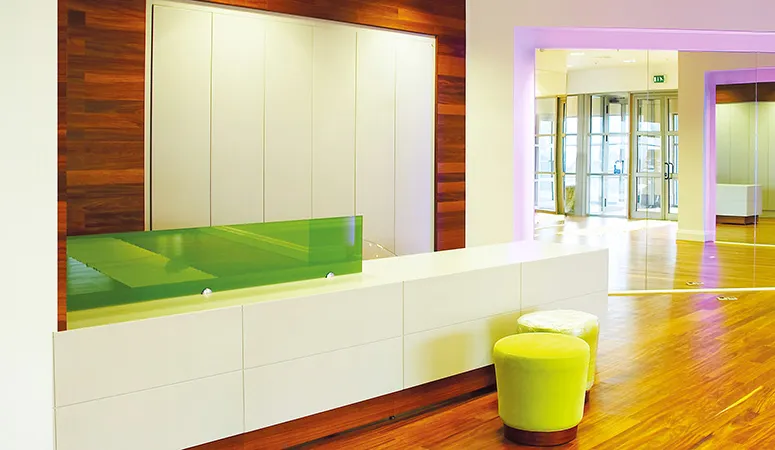
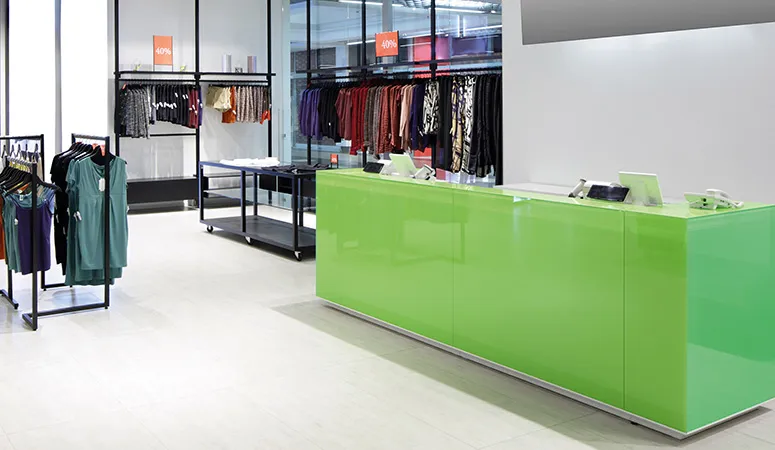
Glass is taking an increasingly prominent place in interior and shopfitting, as well as in exhibition stand construction. Combined with other materials, the possibilities are almost endless. The unique properties of glass make it possible to achieve spectacular effects with lacquer.
Hesse’s glass lacquers can add an extra accent. The right lacquers make it possible to create individual effects. Glass lacquer is also a flexible, quick and cost-effective solution. By combining the right materials with lacquered glass, it is often possible to enhance the value of the structures being built. The excellent scratch resistance of a glass surface is an added benefit, of course. Glass is far more scratch-resistant than painted or laminated surfaces.
Lacquering a glass panel is cost-effective even for a single item. Interior fitters and end customers are not dependent on a minimum order from the glass manufacturer, nor do they have to wait for the glass processor. As anyone working with glass can experiment for themselves, glass lacquer is attracting an ever-growing following. Hydro glass lacquers are particularly popular.
The reasons are clear. Hydro glass lacquer meets the strict solvent limits set by the DecoPaint Directive. This means significantly lower emissions during application and drying. Hydro glass lacquers can also be applied directly on site using the right spraying equipment. As a result, there is little or no odour nuisance.
The unique properties of glass make it possible to achieve spectacular effects with lacquer. (Image: fiphoto, Fotolia)
Before a lacquer system for glass lacquering is approved, it must undergo a series of very stringent practical tests. These include several hours in a 60 °C dishwasher, followed by immersion in a water bath. These processes must never cause any damage. Only once the system has passed these tests is it added to the glass lacquer range.
Hesse is proud to present a wide range of high-quality hydro glass lacquers for both craft and industrial applications: etching, sandblasted, satin, metallic, pearlescent and colour effects (RAL, NCS, etc.), in both opaque and translucent finishes.
Here are two examples of craft applications.
A colourless sandblasted effect:
Thoroughly clean the glass with Hesse’s special glass cleaner HS 6601. Spray 1 x 90 to 110 g/m2 of Hesse hydro-PUR glass lacquer HDU 54270 ‘sandblasted effect’ (mixing ratio: 5 to 1 with Hesse 2K hydro hardener HDR 5040). Allow to dry for 16 hours at 20 °C with sufficient air circulation.
Coloured lacquer:
Thoroughly clean the glass with Hesse’s special glass cleaner HS 6601. Spray 1 x 120 to 150 g/m2 of Hesse hydro-PUR glass lacquer HDB 54105-FT (mixing ratio: 5 to 1 with Hesse 2K hydro hardener HDR 5040). Again, allow to dry for 16 hours at 20 °C with sufficient air circulation. And that’s it!
Surfaces accented in this way can be used as partitions, shower screens (lacquered on the back), cabinet doors or shelf bases, among other things, or as eye-catching features in a design object. Give it a try. It is easier than many people think.
Anyone interested in glass lacquer for industrial applications can contact Hesse. As a specialist, it has the materials needed to provide a professional solution for all lacquering work.
Text: Hesse & Rob Buchholz Image: Hesse
Featured image: Hesse’s glass lacquers can add an extra accent. (Image: Moyseeva Irena, Fotolia)
Een zakelijke vraag aan Hesse Benelux? Get in touch
Companies in this story
Keep following this
Get an email when a new story is published. No account needed.
- ThemeDecorative and protective surfaces
- SubjectGeneral
- CompanyHesse Benelux







