











Gyproc, New West and GP Groot join forces
The Netherlands is moving towards a sustainable society and has set itself the goal of becoming circular by 2050. A circular construction economy is essential to achieving this, requiring a radical new approach to building and collaboration.
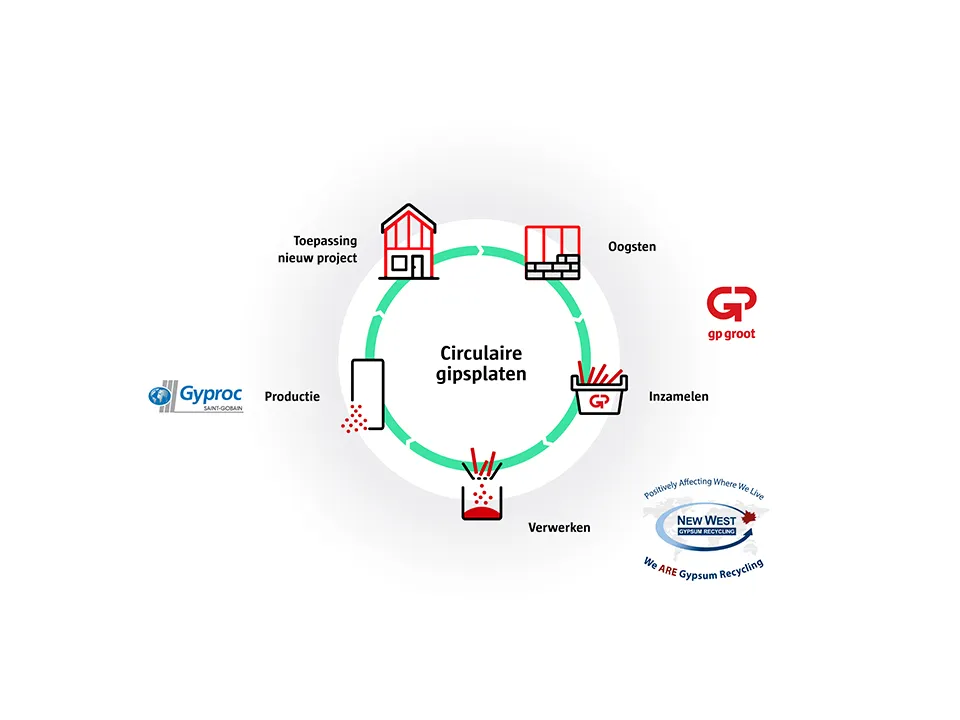
This means clients must specify circular requirements, contractors must propose circular solutions, and building materials manufacturers must develop and offer innovative circular products. Gyproc Nederland, the market leader in gypsum products for interior finishing, New West Gypsum Recycling (NWGR), the world leader in gypsum recycling, and collection and recycling company GP Groot are joining forces to increase the supply of high-quality circular gypsum products for interior finishing.
Circular construction means developing, using and reusing buildings, areas and infrastructure without unnecessarily depleting natural resources, polluting the living environment or damaging ecosystems. Gypsum is an ideal material in this respect, says Maarten Hendriks, managing director of NWGR in Europe. “Gypsum is 100% recyclable and can be reused indefinitely to make new gypsum with exactly the same composition.”
Recycled gypsum is becoming increasingly important
“The production of plasterboard is made possible by mining natural gypsum. It is an extremely suitable material for circular construction because it retains its quality, even after recycling. Tom van Engelen, marketing, technology and innovation manager at Gyproc Nederland, says: ‘The product is too valuable not to recycle, which is why Gyproc Nederland is working to continually increase the proportion of recycled gypsum in its various products.’ From a circular perspective, the manufacturer is keen to take a leading role, setting a new market standard with the Gyproc Regips A plasterboard.”
Gypsum reuse is not necessarily circular
According to Maarten Hendriks of NWGR, reusing gypsum is not automatically circular: “A lot of discarded gypsum, including in the Netherlands, is spread over agricultural land to improve soil quality. Although this is still better than sending it to landfill, from a circular perspective it destroys value. We aim to process as much discarded gypsum as possible into raw material for new building materials. That is why it is important for gypsum to be collected separately, as a single waste stream, rather than, as is all too often the case, ending up in mixed waste, which makes reuse impossible.”
Supply-chain collaboration to promote the use of circular gypsum
Gyproc Nederland, New West Gypsum Recycling and GP Groot have entered into a partnership to expand the circular supply chain for collecting, processing and recycling plasterboard into raw materials suitable for manufacturing new plasterboard. Ronald Balvers, director of GP Groot recycling, says: “Since the 1970s, plasterboard has been used increasingly often in Dutch construction. If we assume an average service life of 40 years, this means that more and more gypsum will be coming out of buildings in the years ahead. In theory, gypsum is 100% recyclable. In practice, however, the percentage is lower. The gypsum waste submitted for processing too often contains other construction waste, and the plasterboard itself is covered in paper. By focusing on collecting gypsum separately from demolition and construction waste, and optimising our sorting and recycling processes, we aim to produce larger quantities of high-quality recycled gypsum waste. NWGR processes the gypsum waste into circular, recycled gypsum raw material, and Gyproc turns it into new building materials, giving construction customers a solution that closes the loop.”
Question about this story? Ask your question
Keep following this
Get an email when a new story is published. No account needed.
- ThemeMore sustainable materials and longer use
- SubjectGeneral







