











Hand-sanding Solid Surface all the way is a thing of the past
Whether in the kitchen and bathroom industry, hospitals or laboratories, we are seeing the use of composite materials increase. It is a logical choice, since these ‘solid surface’ materials, made from acrylic or polyester, can be joined seamlessly and are therefore hygienic to use.
These solid surface materials are often still sanded by hand. “There’s no need,” says Peter van den Berg, managing director of Boere Machinefabriek in Waddinxveen. “As specialists in sanding machines, we can offer the perfect sanding solution.”
From worktops to cladding
Van den Berg notes that a surprising amount of sanding is done by hand. “We’re seeing solid surface increasingly used for cladding. That makes sense, since the material is maintenance-free, dirt-resistant and easy to clean. When you consider how many square metres of solid surface are sanded by hand for a single façade, you can see why there is a need for a fully-fledged sanding solution.”
According to Van den Berg, achieving a high level of finish still requires manual sanding and polishing, but the key is what happens beforehand. He explains: “Sometimes teams of ten to twelve people are sanding. Whether you’re dealing with a single worktop or a batch of façade panels, how much easier would it be to process them on a wide-belt sander? Boere has the solution in the form of wide-belt sanders, together with the expertise needed to sand solid surface materials properly.”
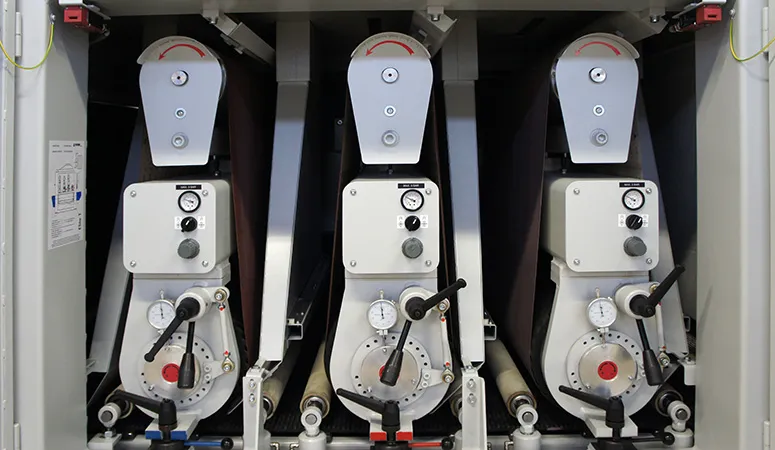
We ask what makes sanding solid surface so specific. Van den Berg explains: “The underside of solid surface must be sanded first. By making the underside nice and flat, you achieve a better result on the top side. You use standard sanding belts for wood, but you should start with the coarsest grit possible. This minimises heat input, which is important because composite materials are sensitive to heat due to their low melting point. In the subsequent passes, you finish with a belt that polishes more than it sands, to remove the sanding marks.”
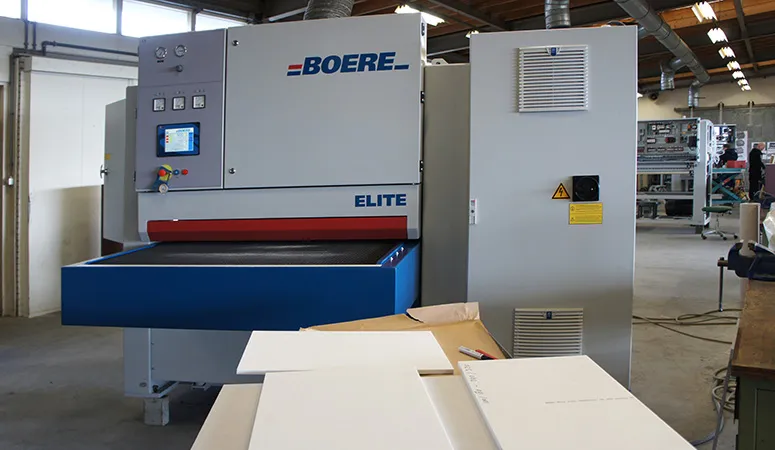
As specialists in sanding machines, Boere provides the perfect sanding solution for Solid Surface materials.
Dust-free working is essential
“To comply with health and safety regulations and achieve the best possible end product, it is important to work dust-free. This means wearing personal protective equipment (PPE) and ensuring proper earthing, because composite dust carries a static charge. Our sanding machines deionise the workpiece and dust particles, and provide effective extraction, provided a suitable extraction system is in place, of course,” Van den Berg continues. “The sanding belt speed can be adjusted on our machines, and we have paid a great deal of attention to the rubber compound used on the contact rollers. Aesthetic finishing requires attention, experience and the right tools.”
Special demonstration days
Boere Machinefabriek is organising demonstrations and workshops together with Maiburg lijmen and Marlan, a supplier of polyester composite sheets. “The first takes place on 12 February, with a further session on 13 February. Participants will receive some theoretical background, watch adhesive-bonding demonstrations and take part in finishing workshops. Anyone who misses out can always request a demonstration,” Van den Berg concludes.
Words: Jan Mol Image: Boere Machinefabriek BV
Featured image: ‘You use standard sanding belts for wood, but you should start with the coarsest grit possible’.
Question about this story? Ask your question
Companies in this story

Keep following this
Get an email when a new story is published. No account needed.
- ThemeFrom sheet materials to construction
- SubjectGeneral
- CompanyMaiburg







