











In focus: AI developments in interior construction
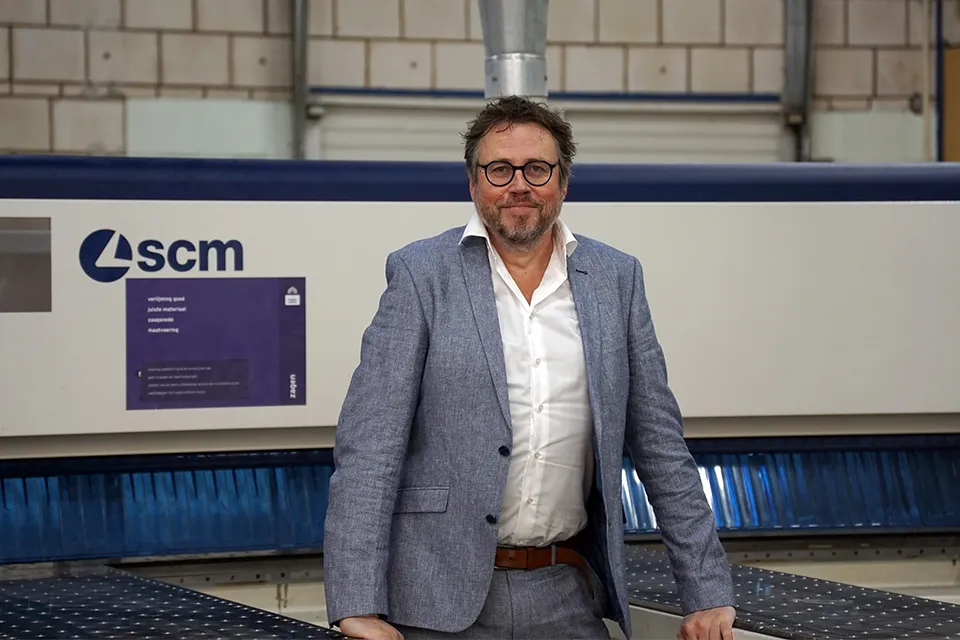
René Oosterhoff: ‘Most companies are still at ChatGPT level’
Talk to René Oosterhoff about software and developments affecting the work of interior contractors, and the question soon arises of how much of a role Artificial Intelligence already plays. Has AI already fundamentally changed the woodworking and interiors sector, or is that still to come? “Most of it is still to come,” says René, director of Syntri ERP.
René and his colleagues develop and implement ERP systems and create links with other software systems. And yes, AI is knocking at the door. “Most interior construction companies are still at ‘ChatGPT’ level: exploring and experimenting. That is already delivering considerable benefits in various areas, particularly those focused on text,” says René. “But over the next few years, AI will also add real value in other parts of the process. It will deliver tangible operational gains: forecasting market trends, improving demand and lead-time forecasts, creating more streamlined and automated workflows based on data, optimising material planning and detecting quality issues. All of this is directly relevant to interior contractors. And for our CAD colleagues, we are seeing increasingly advanced visualisation of designs. Augmented Reality is one example.”
“Most SMEs won’t invest in developing AI themselves. They don’t have the time or resources. Instead, they will choose new AI features brought to market by ERP and software suppliers: an internal search engine or an AI chatbot using their own data. In other words, an AI agent that does more than follow planning rules: it can read historical data and provide better planning advice or more precise purchasing recommendations. For example, where should I buy what, nearby or further afield? What have other people’s experiences been? Analysing historical data can also help produce more predictable project cost estimates and forecast machine maintenance notifications.”
Measurable benefits
René compares it to LEGO: “ERP and software suppliers provide smart AI building blocks. You don’t have to invent them yourself, you can use them in your own automated processes. That makes a huge difference to the cost, especially in a few years’ time, when more has been developed, implemented and brought to market.”
Tangible, measurable benefits are already emerging. “Take material waste and the costs of errors: AI can combine historical cutting data and ordering patterns to reduce waste. Or consider work preparation: automatically generated bills of materials and nesting for CNC machines cut programming time and eliminate errors before anything reaches the workshop. For business owners, that means less rework, shorter production and delivery times, and a higher margin per project. At least, as long as you stay a little ahead of your competitors.”
The customer-facing side
René stresses that AI also has an impact on the customer-facing side. “3D designs can undergo real-time business checks for manufacturability, cost and lead time,
so that quotations can be produced in a single workflow. This speeds up quotations and increases the acceptance rate. Just as importantly, AI can automate and check routine administrative tasks, such as invoicing and time recording, giving employees more time to spend on work that boosts productivity.”
His advice is practical: “Start at the beginning: make sure your basic automation is properly set up, with CAD or a configurator and ERP, naturally linked together. Build on that with small, measurable pilot projects. As a business owner, you often have a sense of where you are incurring too many costs or making too many mistakes. Measure the situation to get a clear picture. Don’t invest straight away: first investigate the causes and possible solutions. Talk to colleagues or CBM. Once you know which direction to take, speak to several suppliers. Those who use AI purposefully, viewing an AI agent as a colleague who never forgets and can handle great complexity, and who can organise process standardisation and targeted automation, will boost productivity, cut costs and grow competitively.”
Question about this story? Ask your question
Companies in this story
Keep following this
Get an email when a new story is published. No account needed.
- ThemeFrom site measurement to production
- SubjectGeneral
- CompanySyntri ERP







