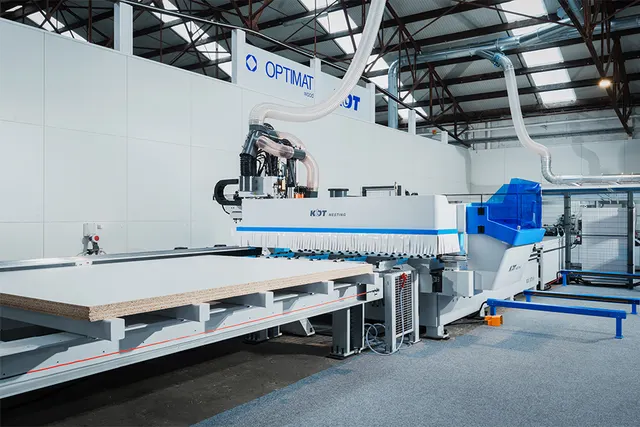
How to calculate the perfect feed rate in woodworking
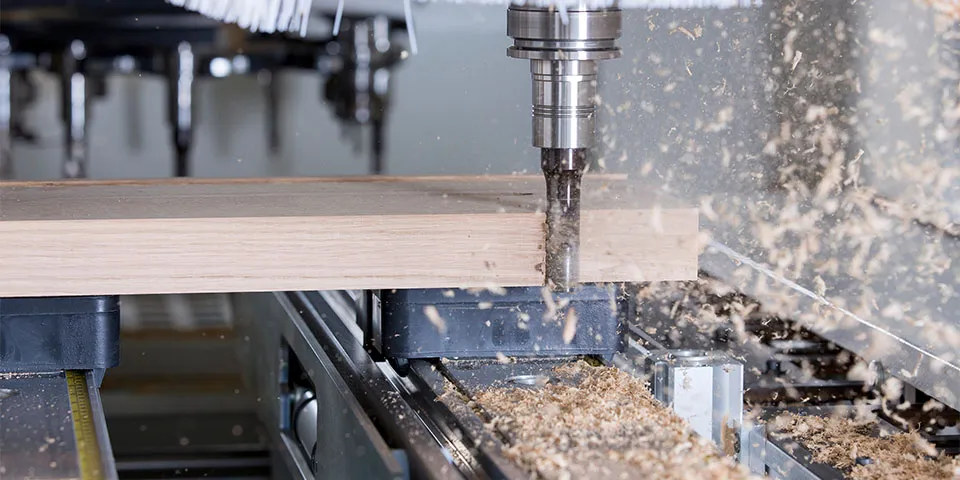
When a woodworker starts machining materials, they need to take account of both the feed rate and the corresponding spindle speed. The question is: why calculate the perfect feed rate? And why is it so important? Ad Biemans, a specialist at KMWE Toolmanagers, explains.
KMWE Toolmanagers is a manufacturer and supplier of a comprehensive range of tooling for the wood, metal and plastics machining industries. The company sells, develops, manufactures, reconditions and resharpens all types of cutting tools. This family business has over 60 years’ experience and is based in the Netherlands (Eindhoven) and Belgium (Oudsbergen).
“The right spindle speed is just as important as the right feed rate,” says Biemans. “A good combination of these two factors extends tool life and reduces noise levels. To calculate the perfect feed rate, use the following formula: Feed rate = (feed per tooth x 1,000) : (spindle speed x number of teeth). The operator also needs to take the material into account. The most common materials in the woodworking industry are solid-core panels, plywood, MDF, softwood along the grain, softwood across the grain and hardwood. The machining method must also be taken into account.”
“What is the goal? A fine (smooth) or coarse cut? If you choose a coarse cut, for example when pre-milling, the chip load per tooth needs to be greater than when machining finely. This shows that several factors need to be considered. That is because each material behaves differently.”
Calculating the right feed rate is important to prevent the following:
· Poor milling finish;
· Tools becoming blunt more quickly;
· More noise during machining;
· The risk of the tool breaking;
· The risk of burning the product, and therefore generating smoke.
Biemans says: “A high feed rate means more is produced than at a low feed rate. The perfect feed rate delivers the best possible results. This can be achieved by increasing the number of metres until the point at which product quality starts to deteriorate. This is the most efficient way of working and leads to higher output. The chip thickness (Fz) should therefore be as large as possible. That is when machining is most efficient.”
Factors that affect Fz include:
· The finish of the workpieces;
· The customer’s quality standard for
the product;
· The machine’s power;
· How securely the workpiece is held;
· The stability of the machine;
· The condition of the cutting tool;
· Chip extraction;
· Different feed rates for machining along and across the grain.
Biemans concludes with a calculation example. “Suppose you want a smooth finish on MDF. The chip load per tooth should then be approximately 0.3 to 0.5 mm. In this example, a feed rate of 12 metres and a spindle speed of 16,000 rpm are used. (Feed rate 12 metres x 1,000 =) 12,000 : (spindle speed 16,000 x 2 =) 32,000 = 0.375 mm per tooth. The conclusion: this produces a good, smooth milling finish.”
Question about this story? Ask your question
Keep following this
Get an email when a new story is published. No account needed.
- ThemeMore bespoke work from the workshop
- SubjectMachinery