Once born of scarcity, now a luxury product
Anyone who has visited my office will know that I have furnished a meeting room with furniture and accessories dating from 1940 to 1955. It is a vintage space with plenty of character, if that is to your taste. One of its standout pieces is an antique desk from 1947, picked up through Marktplaats from a young couple who were moving house. As always, I was curious about the story behind such a find. And there was one. A furniture maker had made the desk in 1947 for a chaplain. One intriguing detail: the furniture maker’s notes are still written in pencil inside one of the drawers.
What is most remarkable about this desk? Despite its solid appearance, it is feather-light. A pleasant surprise when lifting it. On closer inspection, it turned out to be made from thin, lightweight wood covered with veneer. I learnt that this was common in the furniture industry just after the war, when materials were in short supply. Veneer was the perfect way to give the desk a different appearance. This reason for using it is as old as the invention of veneer itself.
Used in ancient Egypt
The origins of veneer are still sometimes debated. Some claim it originated in ancient China, while others are convinced that the ancient Egyptians were the first to work with veneer. What is certain is that trees were scarce in the Nile region, so the choice of fine timber was limited. The finest pieces of wood were therefore made into veneer and used to cover less attractive timber. Magnificent wooden elements were found in the tomb of Tut-Anch-Amon, for example, covered with ebony veneer.
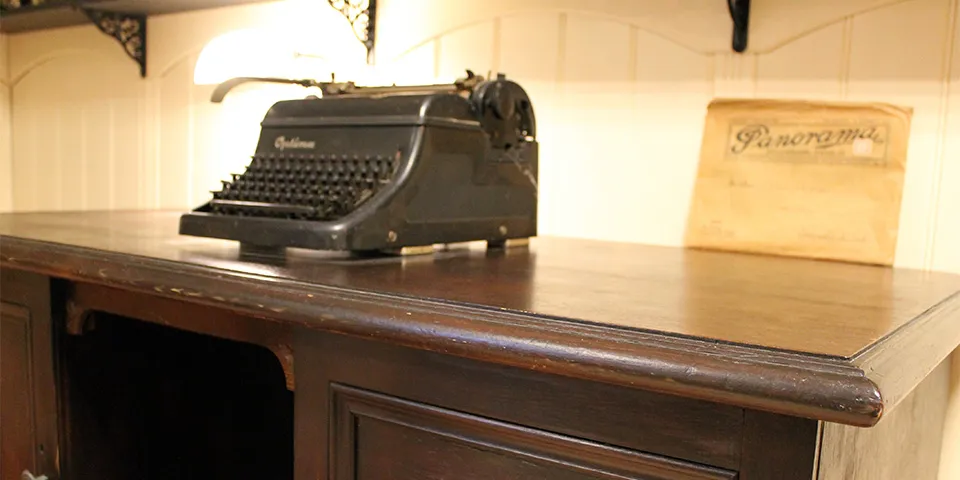
The feather-light desk from 1947.
Veneer in Western Europe
While the art of veneering faded into the background in China and Egypt, the craft was revived in Italy around 1300. During the Renaissance, the woodworking technique spread across Europe, and veneer’s luxurious appearance found favour especially with the nobility. Combining different types of veneer in artistic patterns also became popular. The exotic character of this inlay technique brought natural beauty to all kinds of surfaces.
In the years after 1600, the craft of veneering benefited from the development of new, finer and thinner saw blades. These enabled woodworkers to produce thinner sheets of veneer and create more intricate pieces for inlay. In the 18th century, a shift in furniture styles brought changes to veneering techniques. The focus moved away from decorative veneer inlays and towards using veneer as a general wood finish on furniture. In the 19th century, veneer was used mainly to imitate sought-after, scarcer timber species such as walnut and mahogany. More readily available species such as maple and birch served as the substrate. These common species were also used for the first time in the production of plywood using veneering techniques. The plywood could, of course, then be covered with high-quality wood veneer.
Veneer today
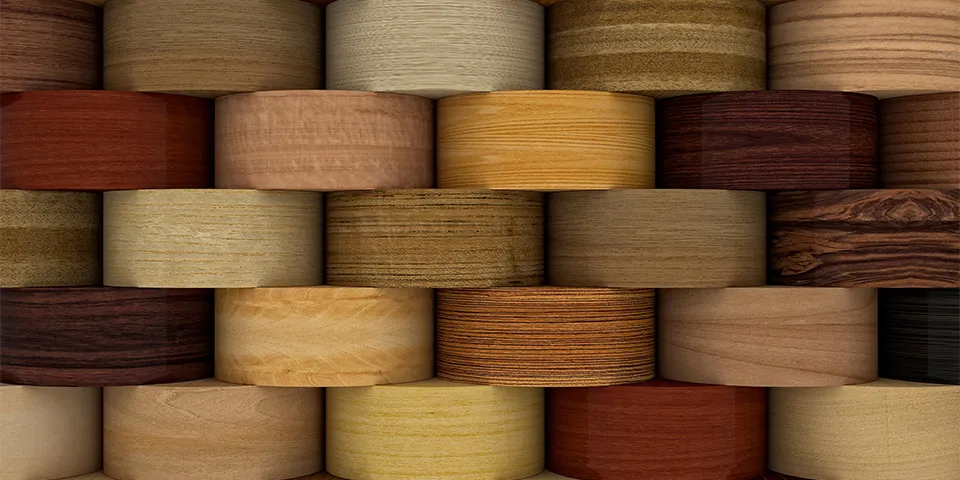
Veneer-cutting techniques have now advanced to the point where sheets can be as thin as paper. Veneer has become a product synonymous with a luxurious appearance. Once used to prevent furniture from being made of ‘ugly’ wood, today it is an upgrade for any piece of furniture or interior.
Question about this story? Ask your question
Keep following this
Get an email when a new story is published. No account needed.
- ThemeFrom sheet materials to construction
- SubjectProducts