Ostermann experts answer frequently asked questions
Dispersion adhesives (white wood glue) have been used every day in workshops for more than 50 years. What should you bear in mind when using them? Edging specialist Ostermann answers frequently asked questions.
The Ostermann range includes a wide selection of different adhesives.
Ostermann’s highly trained staff receive numerous practical questions every day. In close cooperation with our suppliers, including Frencken, Henkel and Jowat, we answer every question from kitchen, furniture and interior fitters.
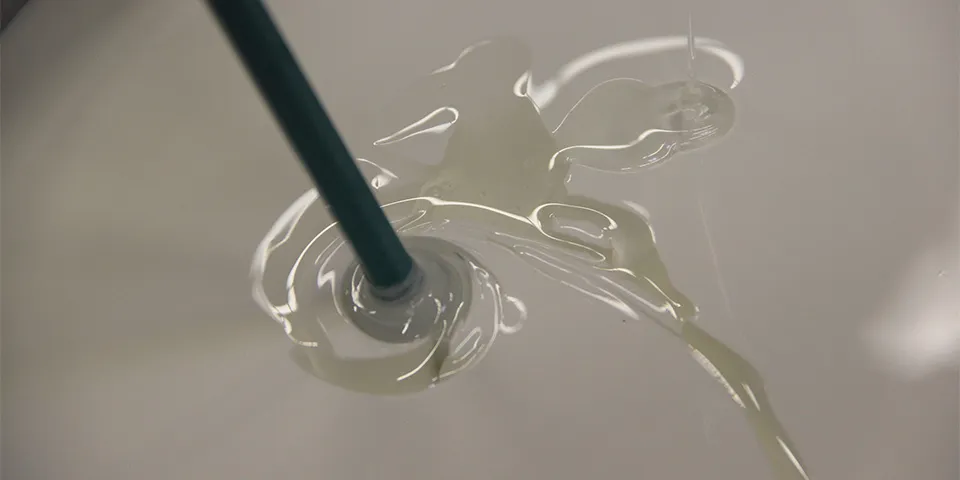
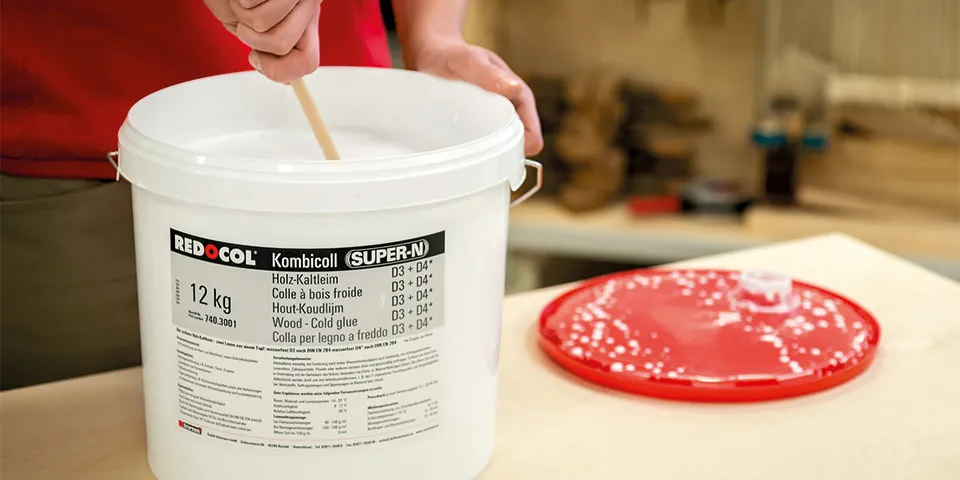
Adding chemical hardeners to a ready-to-use 1-component white adhesive produces an adhesive with a higher durability class. When mixing large quantities, a standard power drill fitted with a spiral mixer has proved effective.
What are the most common causes of bonding problems?
A number of factors must be taken into account to achieve a perfect result. These are listed on the adhesive’s technical data sheet. Failure to follow them precisely can lead to bonding problems. A common application error is exceeding the open time. If the open time is exceeded, for example because applying adhesive to larger surfaces takes too long and a film forms as the adhesive cures, there will be insufficient adhesive transfer and the two components will not bond optimally. Another application error is failing to observe the minimum pressing time. This is specified on the product’s technical data sheet, but also depends on various factors such as the type of wood, ambient temperature, press pressure and pressing temperature. Hardwood and resinous or oily wood species, for example, require a longer pressing time.
Why can the ambient temperature cause bonding problems?
The open time stated on the technical data sheet is tested in accordance with the international standard EN 16556. At lower temperatures, the open time is longer. At temperatures above 30°C, the open time is considerably shorter. A 10°C rise in temperature reduces the open time by around one third. Every adhesive has a temperature below which it will no longer cure. The adhesive then remains white, which is why this is also known as the white point. If the ambient temperature or the material to be bonded is too low, this white effect may occur, resulting in poor final bond strength.
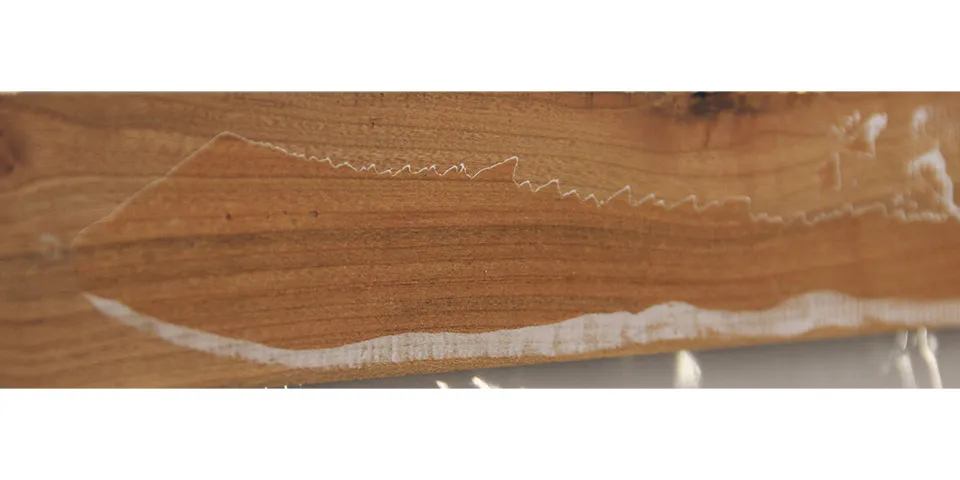
Every adhesive has a temperature below which it will no longer cure. The adhesive then remains white, which is why this is also known as the white point. If the ambient temperature or the material to be bonded is too low, this white effect may occur, resulting in poor final bond strength.
Are dispersion adhesives water-resistant?
The water resistance of white adhesives is determined in accordance with a European standard. There are 4 classes. D1 is not moisture-resistant and is intended for dry indoor conditions. D2 is moisture-resistant and is intended for indoor use with occasional, brief exposure to moisture. D3 is water-resistant and is intended for indoor use with regular exposure to moisture, for example in bathrooms. D4 is waterproof and suitable for outdoor use, provided adequate surface protection is applied.
What should you bear in mind when using a hardener?
To ensure that the white adhesive and hardener form a homogeneous mixture, smaller quantities should generally be mixed vigorously for at least 5 minutes. For larger quantities, a standard power drill with a spiral mixer can be used. Mixing will need to take longer in this case. As a rule of thumb, mix for 5-10 minutes per 10 kg of adhesive, but at a low speed. The mixing speed affects the quality of the adhesive mixture and can significantly shorten the working time. When mixing mechanically, take the drill’s direction of rotation into account. It should run clockwise. If the working time is longer, stir the adhesive again before applying it.
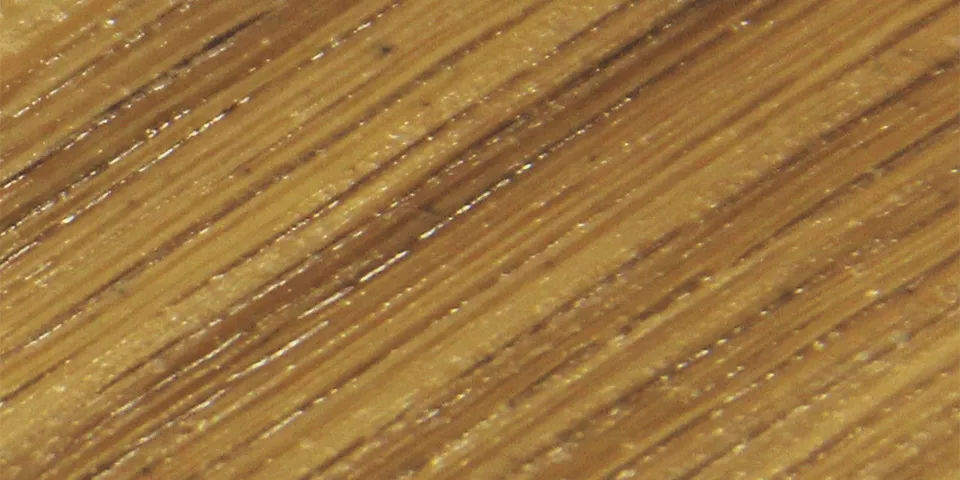
The dark spots on the wood surfaces were caused by iron compounds in the adhesive.
Why is pH important?
White adhesives can intensify the colour of wood. This is due to the acid content of the adhesive, which can cause discolouration, particularly in wood species containing tannins. White adhesives in durability classes D1 and D2 are pH-neutral and therefore do not cause discolouration. Traditional D3 dispersion adhesives have a pH value of 2.5 - 3.5 and are therefore classed as acidic adhesives. Acidic pH values can cause wood discolouration, particularly when working with certain wood species that are especially prone to discolouration, such as Cherry and Maple, as well as with thin veneers. Whether and how quickly a wood species discolours also depends on the origin of the natural product, including its location and region. Heat and UV radiation to which the finished product is exposed also play a part. For this reason, a pH-neutral D3 adhesive with a pH value of 5.0 - 7.0 has been available for around 10 years.
Why must the adhesive not come into contact with iron?
When “acidic” dispersion adhesive comes into contact with iron, it causes blue discolouration of the wood. All parts that come into contact with the adhesive should therefore be made of stainless steel (V2A / V4A) or plastic. When using a power drill and spiral mixer, make sure the spiral mixer has no damage to its coating and is not made of untreated metal. Otherwise, wood discolouration may occur!
For more information about dispersion adhesives, search for “Dispersion adhesive” on the Ostermann website www.ostermann.eu
Question about this story? Ask your question
Companies in this story

Keep following this
Get an email when a new story is published. No account needed.
- ThemeDecorative and protective surfaces
- SubjectProducts
- CompanyOstermann