Create better-informed quotes with 3D configurators: Margaux Donckier
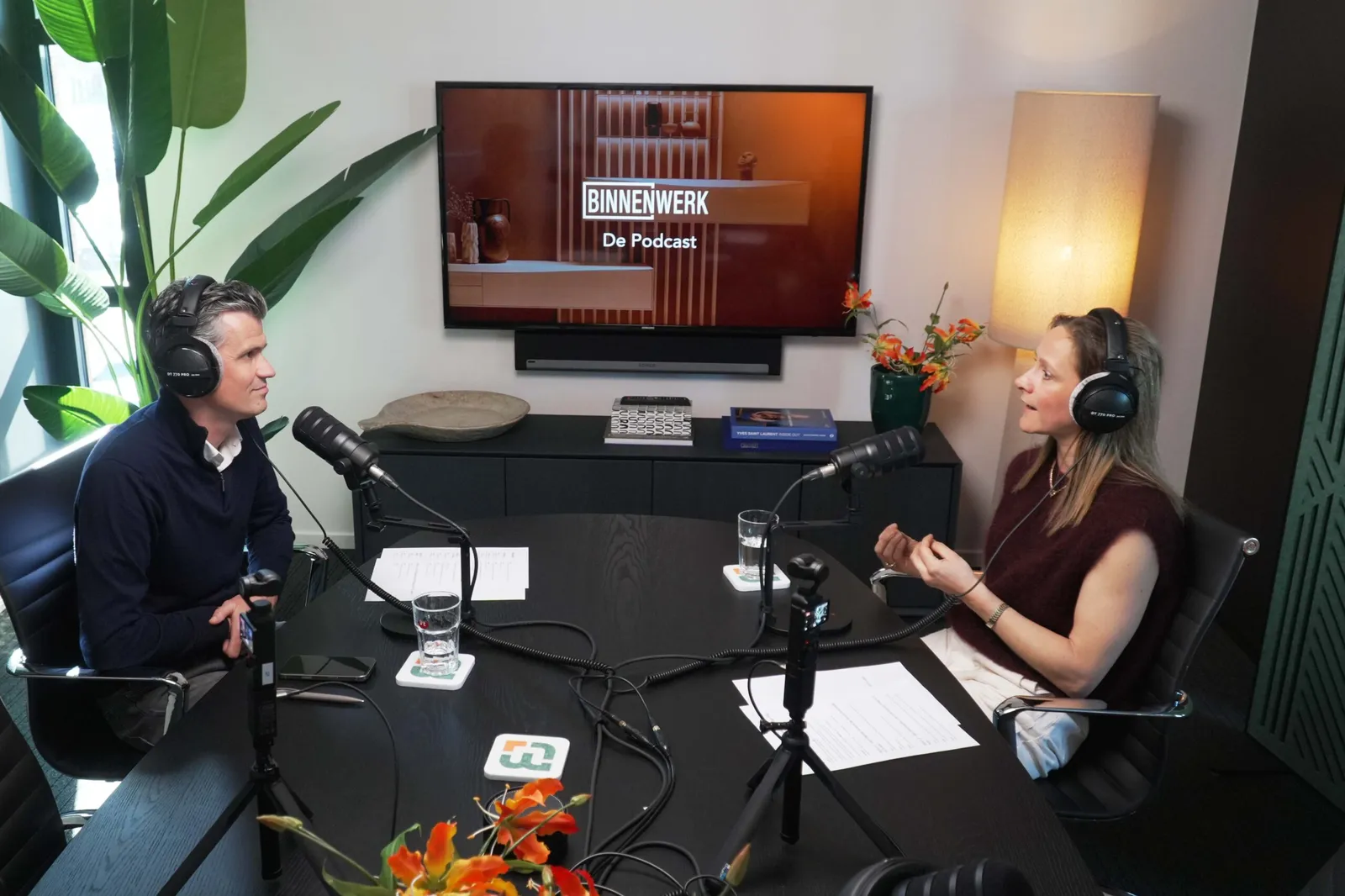
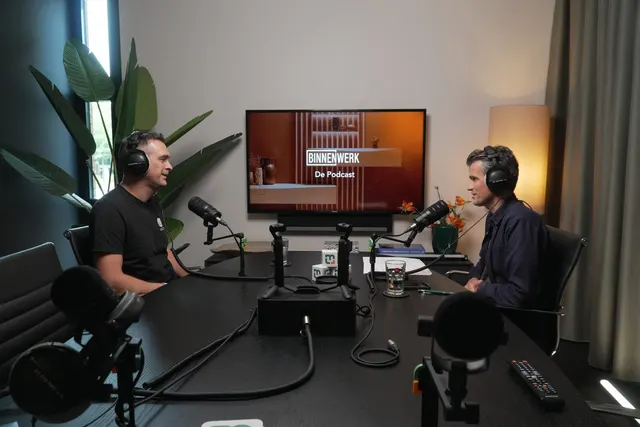
A conversation with Margaux Donckier (Flux), hosted by Roel van Gils
Preparing quotes often takes manufacturers hours and slows growth. In this episode of Binnenwerk, Margaux Donckier (Flux) explains how 3D configurator software automates the process, from quotation to production. Find out how parametric design, real-time pricing and integration with CAD and ERP systems drive greater efficiency, a better customer experience and scalable growth in manufacturing.
Full transcript
All chapters (27)
- Introduction and topic of the episode
- Introducing the guest
- Challenges in bespoke manufacturing and quoting
- Time lost and staff shortages
- Automating quotes for B2B and B2C
- How the 3D configurator works
- Every configurator is bespoke
- Focusing on niches in manufacturing
- From quotation to production
- Efficiency gains and visual selling
- Parametric product assembly
- Dynamic configuration without packshots
- Use in B2B and B2C
- Real-world examples
- Growth through automated sales
- Customer experience and visualisation
- AI and visualisation in the configurator
- AI does not replace developers
- The Flux Academy and the limits of AI-generated code
- The Flux Way and direct customer contact
- Responsibility and the creative role of developers
- No conventional SaaS model
- Growing with the client
- Expanding into other applications
- When is Flux worth considering?
- Final advice for businesses
- Wrapping up the conversation
Introduction and topic of the episode
Roel van Gils Welcome to Binnenwerk, the podcast where we look at what really goes on behind the scenes at companies and in technology. Today we’re talking about something that surprisingly many manufacturers struggle with: preparing quotes. It takes an incredible amount of time. I’m joined by Margaux Donckier from Flux. Welcome, Margaux.
Margaux Donckier Thank you, hello.
Introducing the guest
Roel van Gils Hello. Tell us a little about yourself.
Margaux Donckier I’m Margaux Donckier. I work for Flux, a Belgian software company that develops 3D configurator software.
Challenges in bespoke manufacturing and quoting
Roel van Gils Right, we’ll talk about that technology in a moment. First, let’s look at the problems you see in the market. What challenges do many manufacturers face? Can you tell us a little about that?
Margaux Donckier We focus on manufacturers, companies that make bespoke products. Think of cabinets and kitchens, but it could also be bespoke furniture. When you make products to order, you always have to work something out specifically for the customer. Very often, that has to be drawn up first so it can then be costed. Naturally, preparing a quote for that takes a lot of time.
Time lost and staff shortages
Roel van Gils And what goes wrong? It mainly takes a lot of time, I imagine.
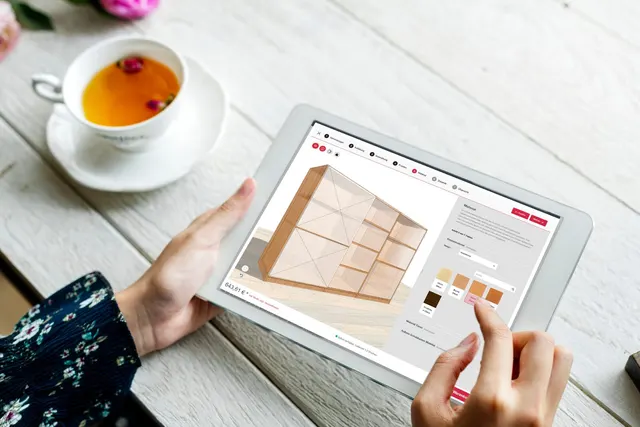
Margaux Donckier Yes, there are two things. On the one hand, costing bespoke products takes time. On the other, it’s also very difficult these days to find the right people for that kind of work. You need technical draftspeople, as well as estimators who can calculate everything. So we developed software, which we call 3D configurator software at Flux, that automates the whole process. You get an instant, bespoke quote. For example, say you want to make a custom-fitted wardrobe. You can immediately see how the price changes depending, for instance, on the wood you choose.
Read the full transcriptCollapse transcript23 more chapters
Automating quotes for B2B and B2C
Roel van Gils So you no longer spend hours on something that might not lead to a sale in the end.
Margaux Donckier Yes. What we often find is that companies come to us thinking, “I’ll make this quoting tool available to the end customer.” And the end customer can indeed get started themselves, designing and drawing up their custom-fitted wardrobe, choosing the colours and materials, and seeing how the price changes. But we find that it’s particularly useful in the B2B sector. Manufacturers can provide the quoting tool to their B2B partner network, giving partners the ability to calculate quotes quickly and place their orders straight away.
How the 3D configurator works
Roel van Gils OK, so the basis is 3D configurators, right?
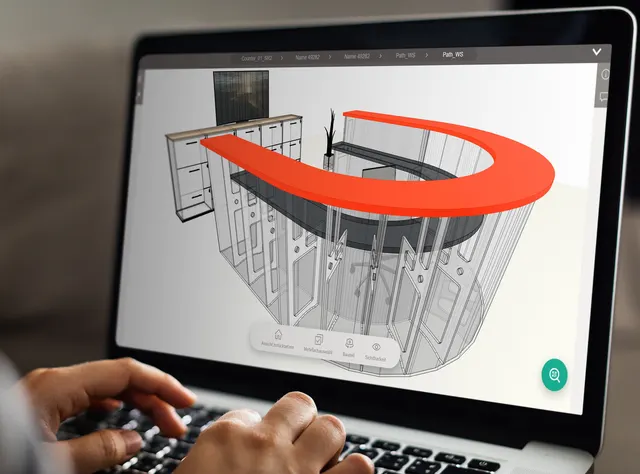
Margaux Donckier Yes, it’s 3D configurator software. To use the custom-fitted wardrobe as an example again, you see the wardrobe being drawn. You draw it yourself using highly intuitive software. No training is needed. You simply click on the modules you want and choose how to build your wardrobe. You can then choose the colours, materials and handles. The wardrobe appears on screen, and you can see the price change instantly too.
Roel van Gils So if you select a different type of wood or something else, or a different handle, you see the price change straight away too?
Margaux Donckier Absolutely. The price changes immediately. That’s very convenient for many companies. We tailor the configurator software to each business. Every company has its own materials and its own way of calculating prices. We take all that information into account when setting up the configurator. Then the customer can get started with software tailored to their needs, which enables them to calculate quotes quickly.
Every configurator is bespoke
Roel van Gils So do you also have a digital overview of an entire stock, or all the parts and everything? Right, every configurator really is bespoke.
Margaux Donckier Everyone uses different materials. But something else I’ve learnt is that every wardrobe is assembled differently too. It’s not a case of having six shelves and putting them all together in the same way. Everyone has their own ways of joining things, their own materials, and their own method of calculating prices. We take all of that into account to deliver a truly bespoke product: a software package tailored to the customer.
Focusing on niches in manufacturing
Roel van Gils Yes, and I understand that you don’t try to cover everything, but focus on a particular niche, or specific niches?
Margaux Donckier We’ve been working on 3D configurator software since 2018, so for quite a while now. At first, it was very new. Computers would start whirring because it was so demanding on them, including when it came to visualising everything. A lot has changed since then, of course. Everything is much faster and more efficient. There are now lots of platforms that can configure all sorts of things, from dog kennels to cycling jerseys to swimming pools. We decided to focus. At Flux, our philosophy is that we want to make bespoke manufacturers in Europe more competitive again. The only way to do that is to help them work more efficiently. That’s why we decided to focus on woodworking companies, larger joinery businesses, carpentry firms and furniture manufacturers. At the moment, we offer our software in three categories: custom-fitted wardrobes, kitchens and furniture, including bespoke pavilion chairs. Then there are larger structures, such as garden rooms, chalets and carports.
From quotation to production
Roel van Gils OK. And what I also find interesting is that you don’t stop at the quote, do you? The software goes further.
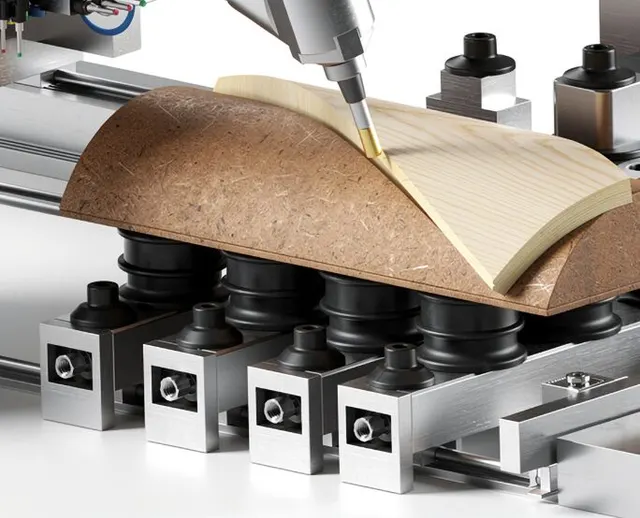
Margaux Donckier That’s right. Because we work in such a focused way, we don’t want to work broadly. We prefer to work in depth, with vertical integration. We’ve also made a strong effort to connect our software to the existing software programmes companies already use. For example, we integrate with ERP systems, so they can keep their stock management up to date directly from the configurator. We also integrate with the CAD programmes they use, whether that’s PaletteCAD, VLECAD or CADWorks. It doesn’t really matter. Our software integrates with that kind of software. We even go as far as generating production files, so the machines can be started up straight away.
Roel van Gils So you go from idea to production without any intermediate steps?
Margaux Donckier Absolutely. Everything is vertically integrated, from quotation to production.
Efficiency gains and visual selling
Roel van Gils I imagine that’s a huge change for many companies that are used to calculating everything the traditional way.
Margaux Donckier Yes, it brings huge efficiency gains, of course. Everything happens much, much faster. There’s no work involved for you. And the process is highly visual too. In the past, if you went to a timber merchant wanting to make custom-fitted wardrobes, you might turn up with a sketch or something. Well, today, you can immediately create a 3D drawing. And with the arrival of AI, you can also visualise it in a beautiful room, or probably in your own room soon?
Parametric product assembly
Roel van Gils We’ll probably come back to that later. You focus on specific niches, but I can imagine that building a kitchen or a table, with all due respect, is a very different proposition in terms of how it’s put together and so on.
Margaux Donckier Yes, the common thread in our software is that everything is assembled parametrically. That means, for example, that when you order a table, we start with a model, which is then generated and visualised on the spot based on the dimensions you enter. That’s the common thread. Tables, chairs, cabinets, kitchens, everything is generated dynamically according to the dimensions you enter.
Roel van Gils So the tool looks different for each company too?
Margaux Donckier Yes, we also do white labelling. Under the hood, every configurator is built and developed in the same way, of course. But the frontend, as we call it, what you see when you visit a URL, is of course designed to match the look and feel of the individual company.
Dynamic configuration without packshots
Roel van Gils And what does a configurator like that look like? You mentioned that it’s built parametrically, so it’s quite different from, for example, configuring a car, to use something everyone might recognise.
Margaux Donckier With a car, for example, you probably start with a 3D model or an image of the car and can click around and try different colours, but naturally, your options are limited. With us, the possibilities are endless. Take a chair configurator, for example. A company might have ten chair models, but you can generate 200 different fabrics for them. If you work in the same way as the car industry, you need a packshot of every possible combination of chair model and fabric type to include in the configurator. We don’t work like that. We dynamically combine the chair model with the colour and fabric, so you can generate thousands of combinations on the fly. It happens instantly. That makes things easy for a lot of companies, of course. They don’t need to supply endless packshots of every possible combination they offer for us to turn into a configurator. We generate them dynamically ourselves.
Use in B2B and B2C
Roel van Gils Is your tool mainly used for B2B, or also for B2C and consumer products?
Margaux Donckier: Yes, both. We really see the combination. As I said, it often depends a little on what brings people to us. Customers come to us either because they have run into the problem that they simply can’t get quotes out quickly enough, and they really do have room to grow. Their machines are standing idle. But because they can’t process quotes in time, they lose a lot of customers and can’t keep their machines running enough. That’s actually the main group of customers we have. They really say: we want to move forward, we want to grow, but we need a fast quoting tool.
Roel van Gils And they still have production capacity available.
Margaux Donckier: Yes, they want to scale up. On the other hand, you have companies that come to us more from a marketing perspective and say: yes, we’re doing well, but we offer lots of options and people can customise things. They want to move away from brochures showing all those photos, the various pack shots of possible combinations, while customers are left to imagine everything else. So they come to us to create a configurator, allowing people to try out combinations for themselves, matching the fabric they want with the model they want, and see what it looks like straight away.
Real-world examples
Roel van Gils Yes, OK. Do you have a real-world example that makes your configurator more tangible, so to speak?
Margaux Donckier: Yes, I think we have two really striking examples. On the one hand, we worked with a timber company that had a stand at Batibouw. Batibouw is a very large trade fair in Belgium. In just one day, they generated a thousand quotes at the fair itself.
Roel van Gils At one fair?
Margaux Donckier: At one fair, without having to invest their own time and effort. And they didn’t go home with a stack of papers covered in notes that then had to be processed. No, they simply had a thousand completed quotes.
Roel van Gils And did they go through it together with the customer? Or how should I picture that?
Margaux Donckier: Yes, there were computers there and customers could just…
Roel van Gils The customers themselves?
Margaux Donckier: Either by themselves or with guidance from someone at the company, they could put together their cupboard, choose the materials, colours and handles, and see the price. They immediately received an email with the PDF and a reference to the configuration they had created. So they could bring that configuration back up and try out different materials again if they wanted. And they knew straight away where they stood.
Roel van Gils And I assume they still have to send out the quote themselves afterwards? Or how does that work?
Margaux Donckier: No, it all happens automatically in the system. You create a configuration, enter your details at the end, and then you receive an email with the configuration you created and its price. So the quote lands straight in your inbox.
Roel van Gils So it doesn’t need to be checked by…
Margaux Donckier: No one needs to check it. The configurator is set up to get it right. The accurate price is shown instantly.
Growth through automated sales
Roel van Gils I’m curious, then, how many of those turned into orders.
Margaux Donckier: A lot. We have another customer, for example. It’s a very young Dutch company, growing very quickly. They manufacture chairs, and they immediately decided to have us build a chair configurator. Their entire sales platform was automated straight away. They didn’t need a large sales team because sales happen through the configurator. People can use it to choose their chair, the model, the type of fabric and the colour. They can see how it looks and whether the combination works, see the price and order instantly. As a result, the company has invested heavily in marketing. The combination of a good sales and quoting tool with good marketing has helped it become a major player in the market.
Customer experience and visualisation
Roel van Gils So that changes the customer experience too. They get clarity straight away.
Margaux Donckier: Yes, the customer experience. With AI, of course, everything is becoming very visual and immediate. Manufacturing companies have to ride that wave too. When you design something for a customer, you have to make sure they can immediately get an idea of what it will look like. For example, if a customer comes in for a dressing room, as we call a fitted wardrobe in Belgium, they want to see what it will look like straight away. Or they might bring in a mood board from Pinterest or Instagram and say, ‘This is what I want.’ You can’t just come back with a sketch any more. You have to be able to present it visually too. That’s where configurator software is perfect. You can show them straight away what they have in mind and what you’re designing, with the price alongside it.
Roel van Gils So the imagination gap, the question of what it could become, is completely closed. And you’re already making the connection to AI and visualisation. How does that work for you? I imagine that with AI, at least as we know it, you type something in, a prompt, and there you go, it’s done. But I don’t think it’s that simple.
AI and visualisation in the configurator
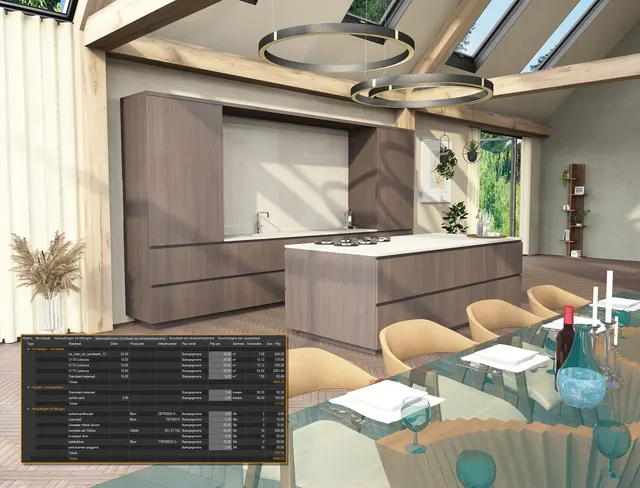
Margaux Donckier: AI makes so much possible, making everything much more visual, and it also takes our configurator software to an even higher level. Configurator software is already very advanced and highly visual. With AI integrated into our software, which we’re already doing, you can see the designed or drawn cupboard in a room straight away.
Roel van Gils That’s possible too.
Margaux Donckier: So you don’t have to imagine anything any more, you can simply see it. And AI delivers photorealistic renders, real-looking photos that you can’t distinguish from an actual photograph. That’s great for people, because they no longer have to be afraid of ordering a bespoke product. People used to say: I’ll just go to the furniture shop and choose what’s on display. I can see that. Now, of course, you can go back to manufacturing bespoke products, because you can see them straight away.
Roel van Gils But can you also project your product into your own space, or have you not got that far yet?
Margaux Donckier: Yes, today we mainly work with pre-sets, where rooms are created in advance and the bespoke product is placed in them. But you can feel that things are evolving every two weeks. I feel like I’m working for a software company now. For our developers, it’s an adult playground. Every two weeks, there’s something new. Is there one AI model that can do more than another? Of course, we follow all of this very closely and share our experiences. We’re constantly learning. We’ve also set up the Flux Academy internally, where we share those experiences with each other. Things are moving so fast, we have to keep up. And it’s really exciting to be right in the middle of it.
AI does not replace developers
Roel van Gils Yes, I understand. But AI isn’t replacing you, or your people, at least.
Margaux Donckier: No, of course. For one thing, it still hallucinates 50% of the time. But what we do is still bespoke. As we said earlier, we integrate with production and connect to CAD programmes. You really need to know how the cupboard is constructed, how the company calculates its prices, what software it already uses, which CAD programme, ERP system and CAM software. AI can’t yet handle the task of making all those different software systems work together. You really need a skilled developer who can connect all those things. AI does make everything more efficient and faster, but you still need good developers to bridge the gaps between all those different systems.
The Flux Academy and the limits of AI-generated code
Roel van Gils Yes, I understand. And you just mentioned the Flux Academy. I imagine you discuss the latest trends there too. Can you give an example? What are you seeing now? What changes are you noticing?
Margaux Donckier: For example, we also use programmes such as Google’s Nanobanana Pro. We’re always among the first to be able to test and use the latest technologies. Visual capabilities are particularly impressive, advancing in huge leaps. On the other hand, code can also be written very quickly. But we’re seeing that AI still can’t solve everything. You still need to be a developer who understands code in order to work with it. Because, again, AI hallucinates 50% of the time. If you don’t know how code is structured, or how to structure it so that it can be developed further, things will eventually go wrong. In our industry, we call that spaghetti code. Everything gets tangled up, and when you want to add something, you eventually hit the limits. So you still need well-trained developers who can check whether the code AI writes actually makes sense.
The Flux Way and direct customer contact
Roel van Gils Yes, OK. And you talk about the Flux Way. What makes your approach different from others? Or perhaps you could start by explaining exactly what it involves.
Margaux Donckier: At Flux, we have around twenty developers permanently on the payroll, so we’re not a small company.
Roel van Gils That’s quite unusual, actually, having so many developers.
Margaux Donckier: It is, but we need every one of them. We’re still hiring too. The Flux Way means that we put our developers on the front line. We have a deliberately flat structure. In software and technology companies, in particular, there are often all sorts of layers because people think developers shouldn’t interact too much with customers, since they speak developer language. We absolutely disagree. It’s very important for the developer who is actually going to build the software a customer will use to have direct contact with that customer, so they understand each other. The developer needs to know what’s needed, what’s missing, how the customer wants to solve something and what approach they want to take. We’re also often paired with the CTO, the technical person who builds and manufactures the cupboards, kitchens or whatever it may be. So understanding the technical language is very important. This makes us much more efficient. We don’t waste time with various key account managers in between, passing messages back and forth.
Roel van Gils Does something get lost again?
Margaux Donckier: Yes. Does some of the message get lost? Or does someone promise something that turns out to be technically more complex? That’s why we make sure our developers are in direct contact with customers.
Responsibility and the creative role of developers
Roel van Gils And are there any other aspects that define the Flux Way?
Margaux Donckier: I think the Flux Way also means that developers have a great deal of responsibility. And that’s a good thing. They have to come up with solutions themselves. They come up with out-of-the-box ideas themselves. How are we actually going to tackle this problem? They’re not just implementers who can write good code. No, they’re creative problem-solvers who work with the client to find the best solution.
No conventional SaaS model
Roel van Gils Right, and you’re not a conventional SaaS model, are you? Or is that a deliberate choice?
Margaux Donckier: Very deliberate, because if you want to work closely with your clients, you realise that there’s a lot of customisation involved. As I said, unfortunately, a cabinet isn’t always built in the same way. Not everyone uses the same CAD software, and not everyone uses the same machines. So it always takes custom work to make sure that what we offer is tailored to the company it’s being offered to or implemented for. So yes, it is a product, of course. The configurator software starts with a basic set-up. That means we can also get things up and running quickly and efficiently. We don’t have to reinvent the wheel every time. So we can move quickly, while still tailoring it to the client.
Roel van Gils Does the programme run on a local server, then?
Margaux Donckier: Everything runs in the cloud, so there’s nothing to install locally. Flux’s philosophy is also very much that it has to be intuitive. We’re not going to say everyone needs training to use our software. No, it should come naturally. It’s as simple as an iPhone, so to speak. You see it, click on it and see it happen. So our model is simple: there’s a set-up fee, an implementation fee to tailor our software to your business, and then a monthly fee that mainly covers hosting, keeping it online, updates and servers, as well as support if there are any questions.
Roel van Gils No further licence fees.
Growing with the client
Margaux Donckier: And that way you can grow with the client too, of course. Yes, because that’s something we really believe in. We’re highly focused and very niche. We know exactly the kinds of companies we want to work with, and which ones we don’t. We often grow alongside our clients too, because they often come to us because they’re struggling to turn quotes around quickly. But once you’ve solved that problem, another one often emerges: production can’t keep up. And then we focus on that, of course. That’s how we grow with them. And when, for example, the cabinet configurator is fully up and running efficiently, they might say: perhaps we’ll start producing kitchens now. Then we move into that area, and into other product groups. So more and more product groups are added. We often work with woodworking companies. They start with cabinets, but then move on to kitchens, garden rooms, terraces and so on. It’s the same with furniture manufacturers. We start simply with tables, then add chairs. Because when people buy tables, they also want to see chairs with them. One client says: I only make tables. But in the meantime, they’ve almost accidentally started selling chairs as well.
Roel van Gils Thanks to you, really.
Margaux Donckier: Yes, because people simply want to see the whole set. They see it all together in the configurator, and the chairs are then upsold as well. Kitchen manufacturers can upsell appliances, just as table manufacturers can offer chairs. Yes, and once that’s working, I think: perhaps we’ll take the step into sofas.
Expanding into other applications
Roel van Gils So you grow with your clients. But does the move into garden rooms have more to do with the product, or with the woodworking side?
Margaux Donckier: Yes, that’s actually where it starts in the woodworking industry: timber companies that want to sell panels and turn them into cabinets, kitchens, chalets or garden rooms.
Roel van Gils And plastics? No. Plastic panels, for example, you see those too sometimes.
Margaux Donckier: Yes, we also have a number of container companies as clients, because the common denominator is the same. The material is less important; it’s the parametric configuration. How do you enter dimensions and make something bespoke? That’s the common thread, which is why we also have the best container configurations. Containers can mean site cabins, but the range goes all the way to complete tiny houses.
Roel van Gils You mean modules?
Margaux Donckier: Yes, modular living. So it also extends into modular housing, with entire structures that can be built this way.
Roel van Gils Goodness, so it’s going to go much further still.
Margaux Donckier: Yes, it’s always a bit of a nice problem to have, but the possibilities are endless. That’s why we really do want to focus. We have to disappoint quite a few clients with fantastic ideas, because taking them on would distract us too much from our focus.
Roel van Gils From the core business, really.
Margaux Donckier: Yes, from the focus we’re pursuing at the moment. But still, it’s a nice problem to have, of course.
When is Flux worth considering?
Roel van Gils But looking ahead, when does it make sense to start using Flux?
Margaux Donckier: It makes sense as soon as you realise: ‘OK, I can’t process my quotes on time, they’re piling up.’ We can provide a solution very quickly. It also makes sense if you want to scale up and say: ‘OK, I have these machines, and they’re not being used enough.’ Or if, for example, you’re mainly active in B2B but want to move into B2C. With the configurator, you can quickly test what people respond to and what they don’t, and produce to order. You’re not taking any risks, because you don’t need to produce items in advance and keep them on hand or in stock. You create them online using the configurator software, then produce them only once they’ve actually been ordered.
Roel van Gils Once the order has been placed, in other words. So you reduce your risk. So basically, you’re saying that when growth starts to slow, it might be a good time to get on board.
Margaux Donckier: Absolutely. And if you have spare production capacity, of course. If you want to turn quotes around quickly, scale up or broaden your target market, it’s worth considering.
Final advice for businesses
Roel van Gils Do you have one final tip or piece of advice for listeners?
Margaux Donckier: One final tip or piece of advice. Software is a must. One thing we often find with companies is that we ask difficult questions. A number of decisions have to be made to set up the configurator.
Roel van Gils Such as?
Margaux Donckier: For example, if you make fitted cabinets: what materials do you supply? How do you set your prices? At the outset, it often seems that anything is possible. Then it turns out their product range is too broad. We make them simplify it and get back to basics. And then it turns out they can grow more easily too. Because if you focus, rather than holding all those different colours or materials in stock and tying up money in items that are only ordered occasionally, you realise that sometimes we’re missing out on revenue by not focusing enough.
Roel van Gils Right, so you can pass that on to your clients because you see it happening with other clients.
Margaux Donckier: Yes, we’ve built up quite a bit of experience by now, so we guide our clients in making choices in a certain way, calculating prices in a certain way and structuring their product range in a certain way, so that everything becomes more efficient.
Wrapping up the conversation
Roel van Gils OK, thanks, Margaux, for this conversation.
Margaux Donckier: My pleasure.
Roel van Gils And let’s hope the ‘Flux Way’ helps companies focus on what they’re really good at.
Margaux Donckier: Nicely put, thank you.
Roel van Gils Thank you. Today we’ve seen how technology is fundamentally changing the manufacturing industry. Thank you for listening to Binnenwerk, the podcast. Until next time. Thank you for listening to Binnenwerk, the podcast. And until next time.
Companies in this story
Keep following this
Get an email when a new story is published. No account needed.
- ThemeFrom site measurement to production
- SubjectSoftware & digitalisation
- CompanyVlecad