Grid congestion as a challenge: how Verel and De Groot Bewerkingsmachines work together on solutions
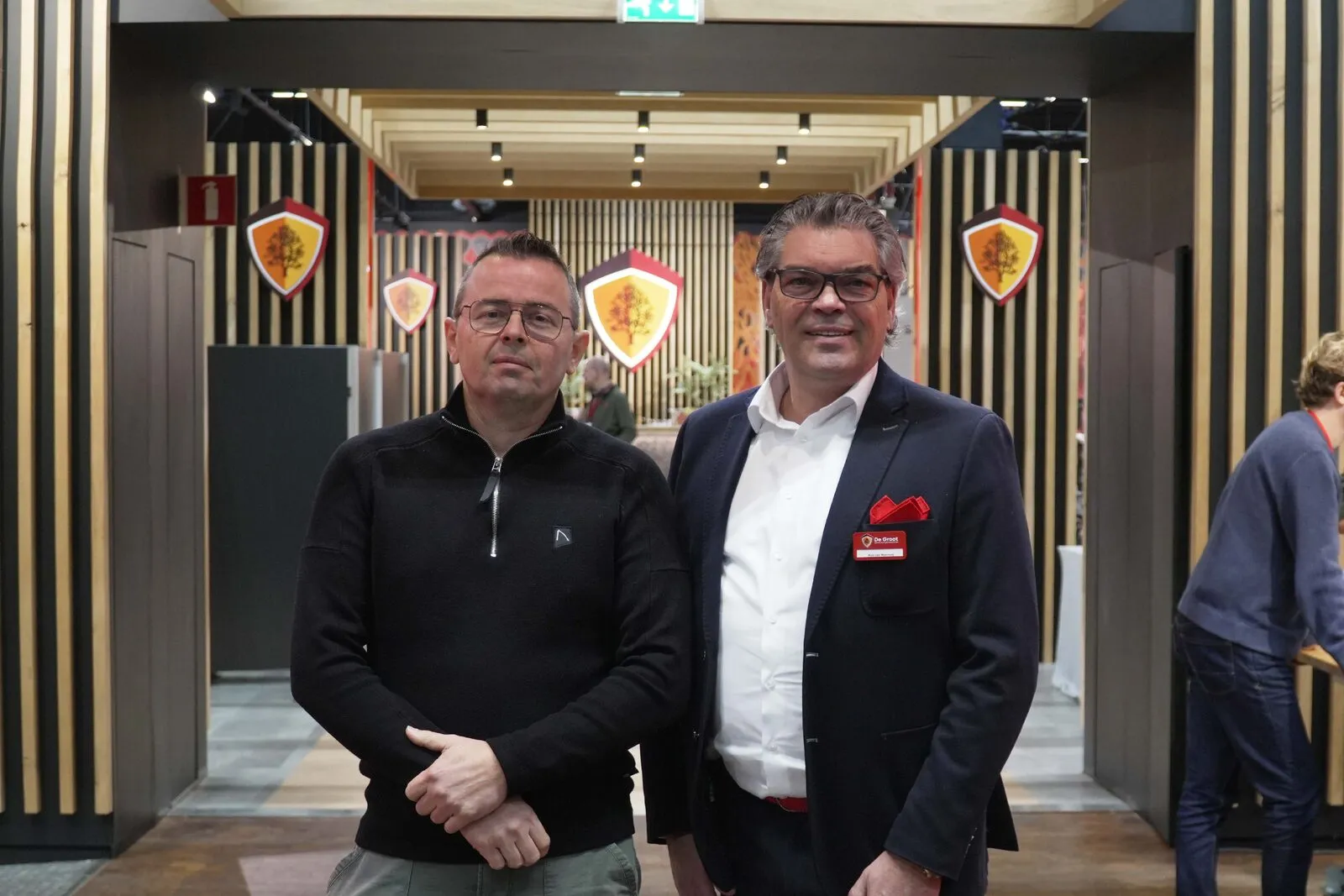
Speaker(s): Rob van Wanrooij, Account Manager at De Groot Bewerkingsmachines / Lando Oomen, Head of Interior Construction at Verel Building Experiences | Moderator: Jerry Helmers.
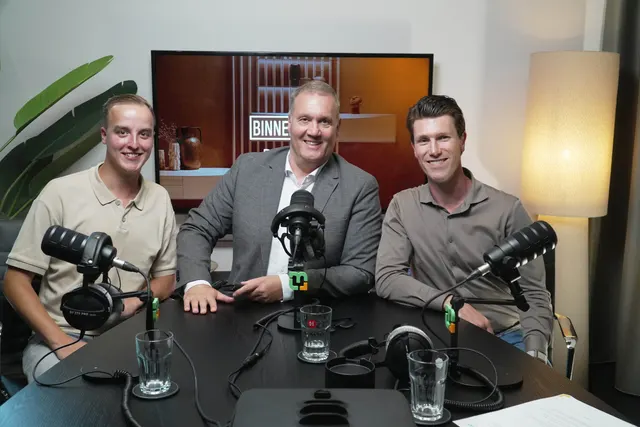
What if your company wants to grow, but the electricity grid won't cooperate? In this episode of Binnenwerk, the podcast of Louwers Mediagroep, presenter Jerry Helmers talks to Rob van Wanrooij of De Groot Bewerkingsmachines and Lando Oomen of Verel Building Experiences. Using the new Verel Experience Campus as a case study, they discuss how grid congestion complicated their expansion plans and how close cooperation between different specialists ultimately led to a workable solution. A conversation about growth ambitions, smart production technology and the importance of looking beyond machines alone.
A business question for De Groot Bewerkingsmachines? Get in touch
Full transcript
Read the full transcriptCollapse transcript
Jerry Helmers Great to have you listening to a new episode of Binnenwerk, the podcast of Louwers Mediagroep. And today's recording is a rather special one, because we are visiting De Groot Bewerkingsmachines in Rosmalen, which is hosting the Samen Vooruit days. And who is sitting at the table with me in this mini podcast of about half an hour? That is Rob van Wanrooij of De Groot Bewerkingsmachines, account manager. But Lando Oomen is here too, head of interior construction at Verel Building Experiences in Den Bosch. Have I said that correctly, gentlemen?
Lando Oomen Perfectly.
Jerry Helmers So the introduction has gone well already. Perfect.
Jerry Helmers Before I introduce you both in a little more detail, I'd really like to know: who should be listening to this podcast, and why? Who should invest half an hour of their time to hear your story and my questions about it? Who gets the floor?
Lando Oomen Well, it's about grid congestion. Mainly the problems that companies run into when they want to expand and fall short on grid capacity.
Jerry Helmers Are you talking about manufacturing companies?
Lando Oomen Yes, manufacturing companies that want to expand their production or are in the construction phase of a new building, and run into problems with the grid.
Jerry Helmers Okay. Rob, anything to add?
Rob van Wanrooij Yes, we also meet a lot of people who want an extension to increase their capacity. They come to us for new machines. And the first thing we usually run into is power. People find it hard to get a power supply at the moment. So we always advise looking at power first, before you look at new machines.
Jerry Helmers Yes, exactly. It's quite something, this electricity misery in the Netherlands.
Rob van Wanrooij Misery.
Jerry Helmers Shall we make any political statements about this wonderful government we have?
Rob van Wanrooij I don't think so.
Lando Oomen We want to keep the podcast pleasant.
Jerry Helmers Yes, we want to keep the podcast pleasant, indeed.
Jerry Helmers Right, I'd like to put a proposition to you. And I'm very curious what you'll answer. So you're not allowed to look at each other. Look at me. I want you to give your answers independently of each other. The proposition is, and I'll ask Rob for his answer first: to be relevant, a supplier of machining equipment has to be more than just a supplier of machining equipment. Do you agree or disagree?
Rob van Wanrooij I agree.
Jerry Helmers You agree. And what is Lando's answer?
Lando Oomen Well, it would be nicest if I said "disagree" now. But I do agree with the proposition.
Jerry Helmers A podcast is of course more fun when my interviewees thoroughly disagree with each other. But it's nice too, isn't it, when you do agree. Anyway, the answer is clear.
Jerry Helmers A short introduction. What is Verel? I should really say: Verel Building Experiences in Den Bosch. So who you are and what the company does.
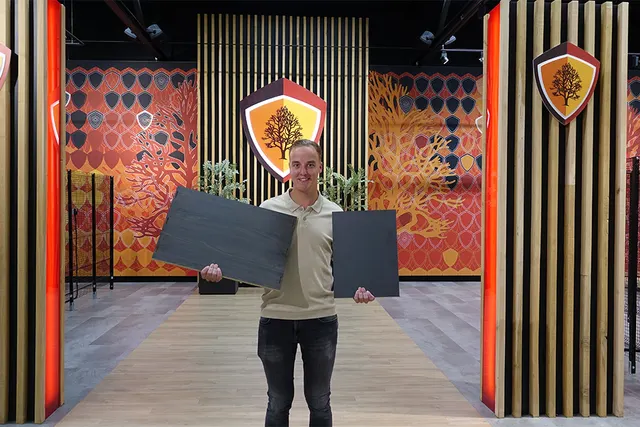
Lando Oomen I'm Lando. I've been working at Verel for eleven years, in recent years as the person primarily responsible for the interior construction department. We have been around for 22 years. We started out as an exhibition stand builder. After a number of years an interior construction department was added. We work a lot in the business-to-business world, mainly for A-list clients. What we like to do for those clients is to strengthen their brand specifically.
Jerry Helmers Yes, yes.
Lando Oomen We can do that by devising a concept, or by producing a design. But once we've made the design, we can also realise it and develop it fully. And for a few years now we've added a digital layer on top of that.
Jerry Helmers And which project are you proudest of, without doing the other projects an injustice? When you look back over the past few years at what you, as head of interior construction, have achieved with your team?
Lando Oomen In those 22 years, KPN is one of our best clients. About a year and a half ago we delivered a completely new experience centre for KPN in Rotterdam, on the Kop van Zuid. And when you talk about really cool things, we're very proud of that.
Jerry Helmers Yes, you're proud of it. When you drive past it, you think: yes, we did that.
Lando Oomen Yes, especially the last part.
Jerry Helmers Especially the last part, indeed.
Jerry Helmers Rob, who are you? What do you do at De Groot Bewerkingsmachines? And could you also tell us in twenty seconds what De Groot Bewerkingsmachines actually does, for those few people in the industry, the interior builders and furniture makers, who have never heard of you?
Rob van Wanrooij Okay. I'm Rob van Wanrooij. I've been at De Groot for 25.5 years.
Jerry Helmers Wow.
Rob van Wanrooij I'm an account manager in the Den Bosch and Nijmegen region, where I've been visiting all the clients for 25 years. And I think De Groot is very good at listening to clients, solving problems, offering new things and looking at what a client needs for their production process.
Jerry Helmers I see. That's why you agreed with the proposition, of course, isn't it? That a supplier of machining equipment has to be much more than just a supplier. Okay. You just said that you find it a challenge to solve the problems and bottlenecks of your client or target group.
Jerry Helmers Well, perhaps I should look at you both for this question. In the industry at the moment, and I'll take the perspective of furniture makers and interior builders, what are the biggest challenges we face? Who gets the floor?
Lando Oomen Well, the biggest problem is what this podcast is actually about. People who want to expand or are working on a new building.
Jerry Helmers Yes.
Lando Oomen In the current Dutch climate we are simply dealing with a shortage of power on your connection, which hampers you in the issue you face when you want to expand or are working on a new building.
Jerry Helmers Yes, earlier we joked: shall we talk about politics or not? But there are quite a few challenges in the Netherlands still to be solved in that respect. Because grid congestion, when that word crosses your path, it gives you a terrible shock.
Lando Oomen This of course also has to do with limiting your growth ambitions. Partly it's political, but in terms of infrastructure we are simply a few years behind. We are in the middle of accelerated electrification in the Netherlands. We all want electric cars, we basically want to get to zero on the meter. But the infrastructure isn't actually ready for it yet.
Jerry Helmers Yes, how politicians will solve that, I don't really know either. But you as a company are of course affected by it. And especially as you describe it: at some point you decided, we want to move, we want a bigger building. Could you tell us a little about that? Because you clearly have growth ambitions. What is the reason for becoming bigger?
Lando Oomen Well, we had been in a rented location for a number of years. We wanted something of our own. Christian, our owner, had a dream: he wanted his own building with all its facilities in one place, where we could really present ourselves well with what we do. That's why we called it the Verel Experience Campus.
Jerry Helmers That's the name of the new building. But that building is already there?
Lando Oomen Yes, that building is already there.
Jerry Helmers To set out a kind of timeline: there came a point when you thought: we want to get bigger, we're going to grow. I'd say 2020, 2021.
Lando Oomen Yes, it has been going on a bit longer. Actually just before covid. The covid period put the plans on hold for a while. After covid we got back into gear fairly quickly: we still wanted to push ahead. So in 2023, 2024 those plans took shape. Then come the permit applications, then you have to sit down with an architect. Yes, then the whole routine starts.
Jerry Helmers But the building is there now, isn't it?
Lando Oomen The building is there now.
Jerry Helmers Because we are recording this podcast in the autumn of 2026. As I said, we are at the Samen Vooruit days at De Groot Bewerkingsmachines in Rosmalen, which are indeed being held in October 2026. Anyway, you wanted to grow. The building is there now. But at some point you discovered: help.
Lando Oomen Yes, help. In the beginning you think: well, we're moving to a new building, we want to expand, we want to do something with that in production. So you knock on De Groot's door. We have a problem. We want to expand our production. What is the best way to do that?
Jerry Helmers Yes, because then you're also talking about expanding your machine park.
Lando Oomen Yes, certainly as regards the machine park. Well, what can you do? What is your advice for us? De Groot took us to Italy, to Biesse.
Jerry Helmers Oh, you're going very fast, indeed. Rob, can you still remember Lando walking in and explaining what was going on for the first time? I know we're going to end up with the two of you having been to Italy or something. Well, we'll hear that shortly. But you were in your office and Lando walked in.
Rob van Wanrooij No, no, no. His employer Christian called me.
Jerry Helmers Yes.
Rob van Wanrooij Saying: we actually want a new building, we want to increase capacity. Can you help us with that?
Jerry Helmers Then as an account manager you naturally think: I want to help think it through. Yes, exactly.
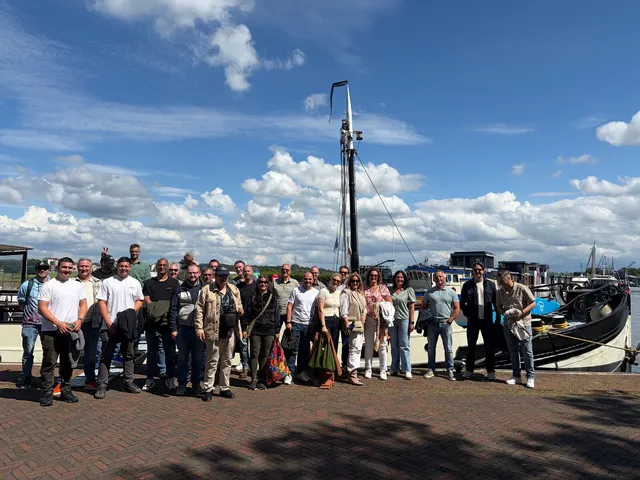
Rob van Wanrooij So I'll just make an appointment and have a look. We take stock of what you're going to do, which direction you want to go, what kinds of components you want to make. And well, we happened to have a tech tour to Italy coming up. So we invited them to join.
Jerry Helmers Okay.
Rob van Wanrooij And then in Italy we show...
Jerry Helmers What is a tech tour?
Rob van Wanrooij A technical tour for a number of clients. We do that a few times a year.
Jerry Helmers Okay.
Rob van Wanrooij We go to Biesse with a number of clients, to see in the factory what the possibilities are for a client who might want to expand.
Jerry Helmers Oh, how nice. Can I come along some time? Shall we record a podcast in Italy too?
Rob van Wanrooij Well, that's how it is.
Jerry Helmers Yes, exactly. You have...
Rob van Wanrooij We have been.
Jerry Helmers Oh, so you were on board straight away, Lando, when it came to joining the trip to Italy.
Lando Oomen Those are invitations you accept very quickly.
Jerry Helmers What did you expect from that tour? Or did you already sense that they could probably help you with this? Because so far we've really only been talking about machine capacity.
Lando Oomen We'll come back to power in a moment, especially capacity. What you want is to see with your own eyes what they propose to us. What advice do they give? What options are there? And there's really no better place than to go and look there, to pick out what you actually need yourself.
Jerry Helmers Do you feel a sort of responsibility, Rob, because you're also thinking along with the customer? Correct me if I'm putting this wrongly, but you're really thinking along about a company's growth ambitions. I'd say you almost need to be a business economist, because you have to ask very targeted questions, don't you? After all, this is about machine capacity.
Rob van Wanrooij But it's our daily work, of course. Every day we advise people and look at increasing production capacity. And what's always important then is to ask: where do you want to go? How many parts do you want to be able to make? And depending on that, we put together a machine that is the optimum fit for the customer.
Jerry Helmers How do you know what to ask? You said you've worked here for 25 years.
Rob van Wanrooij Yes.
Jerry Helmers So you've obviously built up a certain expertise. But what I see is that technological developments are moving incredibly fast. I wonder how you keep up with it all, so that you also know which questions you can or should ask.
Rob van Wanrooij Like I said, I try to visit Biesse's factory once or twice a year. And internally we also have a number of product specialists who are constantly looking at what's out there in the market, what is going to change, and what machines we're getting from Biesse. We can put questions to Biesse, saying that we'd like certain components or certain features built into the machine. And Biesse then thinks along with us.
Rob van Wanrooij Biesse is a very large company, worldwide. It employs 4,200 people globally. We have a factory of 130,000 square metres in Italy, which we visited together. There you see the complete production process of the machines. And there we can also show what the capacity is for the customer. To show: right, this is the machine you need.
Lando Oomen Yes, this suits you.
Rob van Wanrooij This suits you.
Jerry Helmers That's incredibly inspiring, of course. But I think the way you handle it is very different from twenty years ago. You have to switch quickly now, I think.
Rob van Wanrooij At the moment you have to switch very quickly. And the technology keeps getting more advanced. The problem right now is also the people on the shop floor. So we are constantly looking at how to save people on their shop floor. And we did that at Verel too.
Jerry Helmers Yes, because you also said saving people. There is of course a tremendous shortage on the labour market. That won't change.
Lando Oomen A pressing problem. Good, skilled people are one thing.
Jerry Helmers Yes, but that is of course an extra incentive, or perhaps even an extra compulsion, to keep examining your own efficiency. So what kind of machine was it in the end? Or is it in the end?
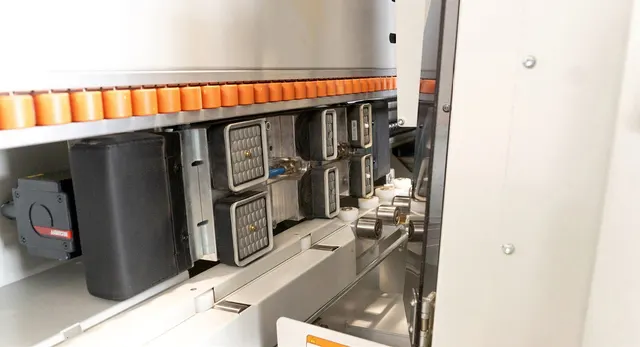
Rob van Wanrooij It was the Biesse Nesting Cell.
Jerry Helmers A Nesting Cell, yes.
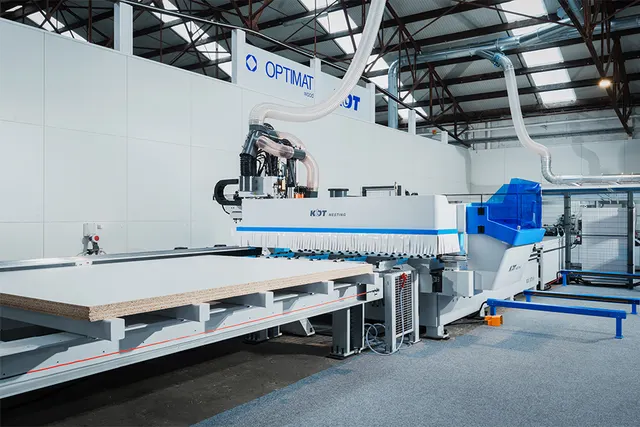
Rob van Wanrooij So we offered a Nesting Cell where everything is nested. In the past they always cut on a beam saw. That means you always handle everything twice. Plus the time involved is far, far longer. Now we put the board on the machine. It is nested, an outfeed belt takes it out and then it goes to the edge bander. So you skip a number of steps in the process compared with how we used to do it. So capacity increases because the work is easier.
Jerry Helmers That was a very nice offer, of course, that you received then.
Lando Oomen Yes, it was a good offer.
Jerry Helmers Did that already happen in Italy? In the evening over a glass of wine on a terrace?
Lando Oomen Actually beforehand. No, beforehand. We had of course already seen a bit beforehand: right, these are the possibilities. But it's great to see things in Italy. You also have more options there. You can be shown more machines. You can also see how far you want to take it. What options do you want on it? And we were very well supported in that.
Jerry Helmers And then you thought: right, we land back at Schiphol, or I don't know which airport in the Netherlands, or if we came back to Belgium. You drive home and the next working day you go in and you think: we have the solution. It's sorted. We're going to order that machine.
Lando Oomen Yes.
Jerry Helmers But that suddenly brought another grid congestion issue. We thought: it was really nice to see a wonderful machine there in Italy. I think you're pleased that you were able to help your customer. But you're also just an account manager, that's the reality. And then suddenly there was a new challenge.
Lando Oomen Yes, we thought we had a solution and a new problem arose.
Jerry Helmers Tell us more.
Lando Oomen When we were in the permit process with the municipality of Den Bosch, where we are based, we were told: you really have to end up at zero on the meter. You won't get gas. You will get a construction connection. A construction connection is 3 x 80 amps. That is certainly not enough to run a production workshop. So challenges land on your plate: how do we tackle this? As an entrepreneur or a company, it's not something you're waiting for. No, you want to move forward and not be dealing with this kind of thing...
Jerry Helmers No, right, and then?
Lando Oomen Yes, and then? Then it's very important to surround yourself with good people and get good advice on how best to approach this. In our new building we of course already had an engineering firm that had done all the calculations on the indoor climate, fresh air and temperatures. It had already made a calculation for the building: we have a few heat pumps that require a certain capacity.
Lando Oomen At the old location we carried out a quarter-hourly measurement. That was partly on De Groot's advice, too. Map out what your exact power consumption is there with the machines you currently have at your old location. Roughly the average over a week. Then you get figures you can work with. You take those figures to the new building. New machines are being added, and you add those on as well. In the end you get a total, and then you find out: my connection isn't big enough.
Jerry Helmers But that has to be resolved.
Lando Oomen It has to be resolved, yes.
Jerry Helmers So frustrating.
Lando Oomen There were moments when you really had your head in your hands. How are we going to solve this?
Jerry Helmers And yet De Groot Bewerkingsmachines somehow became involved?
Lando Oomen Yes, in the end we put together a team. I'll call it a building team with the right people in it. We were in it as Verel with our question. De Groot was in it as machine supplier. We have another De Groot on the list, but that's an electrical contractor, the in-house installer. We always had the idea that we had to move towards something with batteries, solar panels, that sort of thing. So a battery supplier, Kiwatt, was involved, which could supply the batteries to us. Then you still have to bring the picture together: how is it really going to work?
Lando Oomen In the end we got that working, we thought it through, and we started running. We thought: we've solved it very nicely. We can carry on like this. And we started running. Then all at once we suffered from voltage peaks in our system. Machines switch on, switch off. The moment a machine switches on, a peak is suddenly drawn. That's only milliseconds. But during those milliseconds the main fuses in our meter cupboard tripped and we were at a standstill.
Jerry Helmers What do you do about that?
Lando Oomen The whole building completely without power, because the main switch trips out. That happens several times a day. And then you think to yourself: this is no longer workable. Until at a certain point it escalated so far that we said: we want all parties at our table tomorrow morning. A solution has to be found very quickly, because this is going to go badly wrong, because you can't produce like this.
Jerry Helmers But had you already bought that machine at that point? Had you already closed the deal?
Lando Oomen The deal had already been closed. Everything was installed.
Jerry Helmers I don't want, as a person... I think it's going to be a big investment.
Lando Oomen No, certainly not. It has to become a workable environment, and at that point we really didn't have one.
Jerry Helmers So a sort of building team had emerged, a cluster of cooperating parties. And De Groot was indeed at the table. I'll look at Rob again for a moment. What was your role then? Was it new to you?
Rob van Wanrooij Yes, for me... Look, we have a number of people working for us, mainly in the automation department and in service. And they were involved in looking at power consumption and soft starters. We were able to contribute a number of things to the solution in order to help them.
Jerry Helmers That makes your work very different too, and very dynamic. I think you wouldn't have expected fifteen, or maybe ten years ago, that you'd have to fill in your role as account manager in this way.
Rob van Wanrooij Power has simply become a problem over the last five years. Terrible. And we are constantly dealing with people who come to us, and the first thing we ask is: do you have enough power? I've been told that some parties simply have to wait five years for a power connection. That's just not feasible.
Jerry Helmers No, exactly. Great for Dutch competitiveness. But in the end it all worked out.
Lando Oomen In the end it worked out.
Jerry Helmers We have the right, positive ending.
Lando Oomen We put the right heads together. Solutions came out of that. De Groot made a contribution. You can start machines up with a hard on-off, but you can also build in soft starters, so that certain motors start up one after another with a few seconds in between. Well, that cuts the peak demand considerably.
Lando Oomen In the end we also had the advantage that we were able to upgrade our connection. Let me explain it properly: we were given 3 x 80 on site. That is a very thin cable which came under so much load that it simply got hot. We did get an upgraded connection, but we still get 3 x 80 of power over it. So the connection capacity has not been increased, but the cable has become thicker. And as a result the meter cupboard is also fused more heavily.
Jerry Helmers So it's in the small details?
Lando Oomen Yes, but because it is fused more heavily, we are at least rid of the peak moments. At those peak moments we ground to a halt every time. And now the fuse box holds up. And we can simply keep running. We no longer suffer from those peaks.
Jerry Helmers I'd almost say: all's well that ends well, right?
Lando Oomen In the end, yes. What we're still fine-tuning, because it's great that we now have the whole package together: we have solar panels that charge the battery from time to time. We have a 3 x 80 connection that trickle-charges the batteries at night. But we're now building a kind of management system on top of it, so we can monitor where the specific demand peaks occur. And can we fine-tune that with a kind of dashboard, so that it's regulated even more tightly?
Jerry Helmers Then I'll turn to Rob again. This must have given you an enormous number of learning and inspiration moments too, right? Because you talk to a great many customers and potential customers in the market. Well, perhaps I'm drawing that conclusion myself, but you may have to draw it too. And you've already built up a great deal of expertise, for instance with a challenge like this one, which you can use again on the next project.
Rob van Wanrooij Yes. Well, Christian also said it, and Lando too: should there be customers who would like some inspiration, or at least a direction for solving a problem. And we know the phrase: it can be done. So it is a problem, but it can be solved.
Jerry Helmers It can be done, but businesses in the Netherlands have to make it happen. It can be done.
Lando Oomen It's also a bit in the DNA of our company. For our customers we always go the full 100%, and we will always come up with a solution.
Jerry Helmers Yes, exactly. I'm looking at you both. I'm curious who will answer first. Why is it enjoyable for you to work together? What do you like about each other?
Lando Oomen Let me go first, then. I already knew De Groot from my previous employer. I worked for my previous employer for 24 years. I've been here for eleven years. Throughout that entire period I've been involved with De Groot. I always say: sociable, open, decent as a company, and always thinking in terms of solutions.
Jerry Helmers It's a bit of an old-boys' network.
Lando Oomen Yes, it is. But we're there for each other and we sort things out for each other when we have to.
Jerry Helmers Well Rob, there you go. You've sold those people in one go.
Rob van Wanrooij Yes, that's great. I've known Lando for 25 years too, from his previous employer. You need to have a certain click with a company. And I always value openness towards customers. If something's wrong, you have to be there. And I think Lando can confirm that as well. As in: guys, if something's wrong, you have to be there. If he calls, I turn up on the doorstep to solve the problems. And I think short lines of contact are really important.
Jerry Helmers Short lines, yes.
Rob van Wanrooij Short lines.
Jerry Helmers Before we move on to what I always call Rob's 60 Seconds of Fame, let's call it the commercial Loeki the Lion moment. Shortly you can take a full minute of your own airtime and say whatever you like. We'll turn it into a nice commercial for the listeners. But before we do that, I'd like to see, and perhaps I'm ambushing you a little here, whether there are three good tips or recommendations for those listeners, the furniture makers, the interior builders, you name it, that they can use if they recognise themselves in the challenges we've just discussed. I may be ambushing you a bit, but do you have two or three good tips?
Rob van Wanrooij I think the first tip is very important. If you want to look at optimisation within your production process, first look at what power supply you have. Before you start looking at machines.
Jerry Helmers Yes.
Rob van Wanrooij Because...
Jerry Helmers It's actually the other way round, as Lando...
Lando Oomen Thinking the other way round.
Jerry Helmers It ended well, but still.
Rob van Wanrooij Exactly.
Lando Oomen The current situation demands that you think the other way round.
Jerry Helmers Yes. I think that's a very good tip. So first look at the power capacity or the options, so that you aren't confronted with grid congestion. Do you have a second tip?
Rob van Wanrooij If it turns out you don't have enough power, then, just as they did, put a team together. Make sure the right people are around you who can help you tackle that power consumption if necessary and give good advice on it.
Jerry Helmers Okay, I actually hear two tips in there. And you say it's really the last one. Yes, about the power capacity. That's of course a logical consequence of the question when you're investigating how things stand with that power capacity. But your third tip is really: make sure you sit down with the right parties. Like Lando, for instance, that's one of the examples.
Lando Oomen Yes, I call it a building team, but put together a team with the right specialists who can help you further with your own particular issue.
Jerry Helmers Clear! Then I'd say we've arrived at the Loeki the Lion moment. Lando, you have to keep quiet for a moment. I have to keep quiet for a moment. That should work, that should work. Rob will hopefully say some nice things into the microphone.
Jerry Helmers I have no idea whether you've prepared this, but I'm going to give you sixty seconds. Actually too short. Yes, account managers can certainly talk, right? Yes, we've noticed that today as well. No, but I really am going to give you sixty seconds. You can say whatever you want. Make something good of it, something motivating, or perhaps you want to come back to something that wasn't discussed in the podcast. So I'm asking: are you ready?
Rob van Wanrooij Yes.
Jerry Helmers Jingle.
Rob van Wanrooij Would you like good advice on how you use your machinery? Do you want to start optimising? Do you have questions about your production capacity? Come to De Groot in Rosmalen. We have a variety of fine machines available, from the biggest European brands. We're talking about Biesse, we're talking about Weinig, we're talking about Striebig, Hans... We have a solution for every party.
Rob van Wanrooij Whatever you want to make, everything in the field of wood and plastics processing, optimising everything. We're a family business. The company has existed since 1978. We employ 110 people. We're actually active in every sector in the Netherlands. We have a fine service department to help you with breakdowns, servicing and everything else that goes with it. So we're a proud company from Rosmalen, a family business. Come to Rosmalen, come and see our showroom.
Jerry Helmers Jingle. Well, that was, I think, Rob, almost exactly one minute, give or take half a second.
Rob van Wanrooij Yes, I was just...
Jerry Helmers But you know what, I'll give you three extra seconds. Just give us the website address and the telephone number. Or, say, an email address.
Rob van Wanrooij Okay.
Lando Oomen Go on, then.
Rob van Wanrooij Go to www.degroot.nl. Telephone number 073 547 1300. And we're available for you.
Jerry Helmers Okay, that's how you fill a Loeki the Lion moment. It gave me a shock that I asked you... You can mention your website too. Yes, exactly. So then I think: am I the account manager now? No, no, you're the account manager.
Jerry Helmers Okay. Gentlemen, we've reached the end of this podcast. I really enjoyed it. First of all I'd like to say to Rob: thank you for having me as a guest at your wonderful company. In a moment I'm going to walk around here and see what's on show. It really looks wonderful.
Jerry Helmers And I can also see it's getting nice and busy, because of course we're still here at the Samen Vooruit days. Yes, we've been sitting here at the end of October. The end of October 2026. Did you enjoy making this podcast, Rob? Because it was your worldwide debut, wasn't it?
Rob van Wanrooij Yes, worldwide debut. I also try to do a lot on LinkedIn. So for those who want to follow me: Rob van Wanrooij. You see, a bit of advertising after all.
Jerry Helmers Of course!
Rob van Wanrooij No, but there's often interesting stuff on there. And I try to record lots of videos too and put them on LinkedIn.
Jerry Helmers Yes, so I'd say: promote this podcast too, Rob.
Rob van Wanrooij Yes, promote it?
Jerry Helmers Yes.
Rob van Wanrooij So we'll definitely do that.
Jerry Helmers Absolutely.
Rob van Wanrooij I'll make a nice link and it'll all work out.
Jerry Helmers Rob, thank you. Lando too. I think for you as well it was, well, your worldwide...
Lando Oomen It was my worldwide debut too.
Jerry Helmers Two debutants at the table.
Lando Oomen But it turned out 100% better than I expected. I actually think...
Jerry Helmers Do you perhaps have a commercial sign-off?
Lando Oomen Commercial sign-off. If you have a question about your interior or exhibition-stand work, come to Verel and we can help you with anything. From concept to realisation. And do check out www.verel.org. You'll find some really great things.
Jerry Helmers Very good. Thank you too for coming, for being willing to join us here and have this conversation with Rob. I thank the listeners, of course, for listening. I think we've managed to inspire you. I wish the listeners every success with all the next steps.
Jerry Helmers Actually I also hope that grid congestion will simply no longer be a problem at all. So if they're still listening in The Hague, that's my hope. Yes, then I also hope: guys, it can be done. Because these entrepreneurs are proving that they can solve it in the end. But you're making it really difficult for them from The Hague.
Jerry Helmers Listeners, thank you for listening. This was Binnenwerk, the podcast, recorded at the Samen Vooruit days in Rosmalen at De Groot Bewerkingsmachines. Thank you for listening. My name is Jerry Helmers and I say: until next time.
Magazine. Finding smart solutions together. Growing despite grid congestion. Interior builders who want to expand quickly think of new machines and more production capacity. But what if the electricity grid doesn't cooperate? Verel Building Experiences from Den Bosch found out when realising its new Experience Campus. Together with De Groot Bewerkingsmachines and various technical specialists, the company went looking for a solution. During the Samen Vooruit days in Rosmalen, Lando Oomen and Rob van Wanrooij explain in the Binnenwerk podcast how they tackled that challenge.
Growth demands smart investments. Verel Building Experiences started 22 years ago as an exhibition-stand builder and later expanded its activities to include interior building. After years of working from a rented location, the company decided to invest in its own building. The new Verel Experience Campus had to bring all activities together and leave room for further growth.
That also included an expansion of the machine park. Together with De Groot Bewerkingsmachines, Verel investigated how it could organise its production process more efficiently. A visit to machine manufacturer Biesse in Italy ultimately led to the choice of a Biesse Nesting Cell. With this machine, sheet materials can be processed more efficiently, with fewer handling operations and higher production capacity. An important step, especially in a sector where skilled employees are becoming ever harder to find.
When the grid doesn't cooperate. However, the plans took an unexpected turn. During the permit process it emerged that the available 3 x 80 amp connection was insufficient to run the entire production workshop. In addition to the existing machines, new equipment and heat pumps also had to be supplied with electricity.
To map consumption more accurately, Verel carried out quarter-hour measurements at the old site. This data was combined with the expected energy consumption of the new installations. The conclusion was clear: the available capacity was not sufficient. "You mainly want to move forward, not be tied up with this kind of problem," says Lando Oomen, head of the interior fit-out department at Verel.
Working together on a workable solution. Verel put together a construction team of various specialists, including De Groot Bewerkingsmachines, an electrical installation company and a supplier of battery storage. Together they investigated how solar panels, batteries and the existing grid connection could work together optimally. A first solution was installed, but short current peaks occurred when machines were started up. As a result, the main circuit breaker regularly tripped and production came to a standstill.
The parties involved once again looked for a solution together. By using soft starters, among other measures, machines could be started up more gradually and the peak load was limited. The electrical infrastructure and protection were also modified. The result? A production environment that functions reliably again. In the meantime, Verel is continuing to work on an energy management system to monitor and adjust power consumption even more precisely.
Power first, then machines. According to Rob van Wanrooij, account manager at De Groot Bewerkingsmachines, this real-world case shows how important it is to look beyond machines alone. His main piece of advice to interior fit-out companies with expansion plans? First check how much power is available, and only then investigate which machines fit that capacity.
Both interviewees also stress the importance of collaboration. By bringing the right specialists to the table in good time, challenges can be tackled that would be difficult for a single party to solve. Verel's experience proves that grid congestion does not necessarily have to hold back growth ambitions. As Van Wanrooij puts it in the podcast: "It can be done."
Curious about the full story? Scan the QR code and listen to the podcast on Binnenwerk.
Companies in this story
Keep following this
Get an email when a new story is published. No account needed.
- ProjectVerel Experience Campus
- ThemeMore bespoke work from the workshop
- SubjectMachinery
- CompanyDe Groot Bewerkingsmachines